
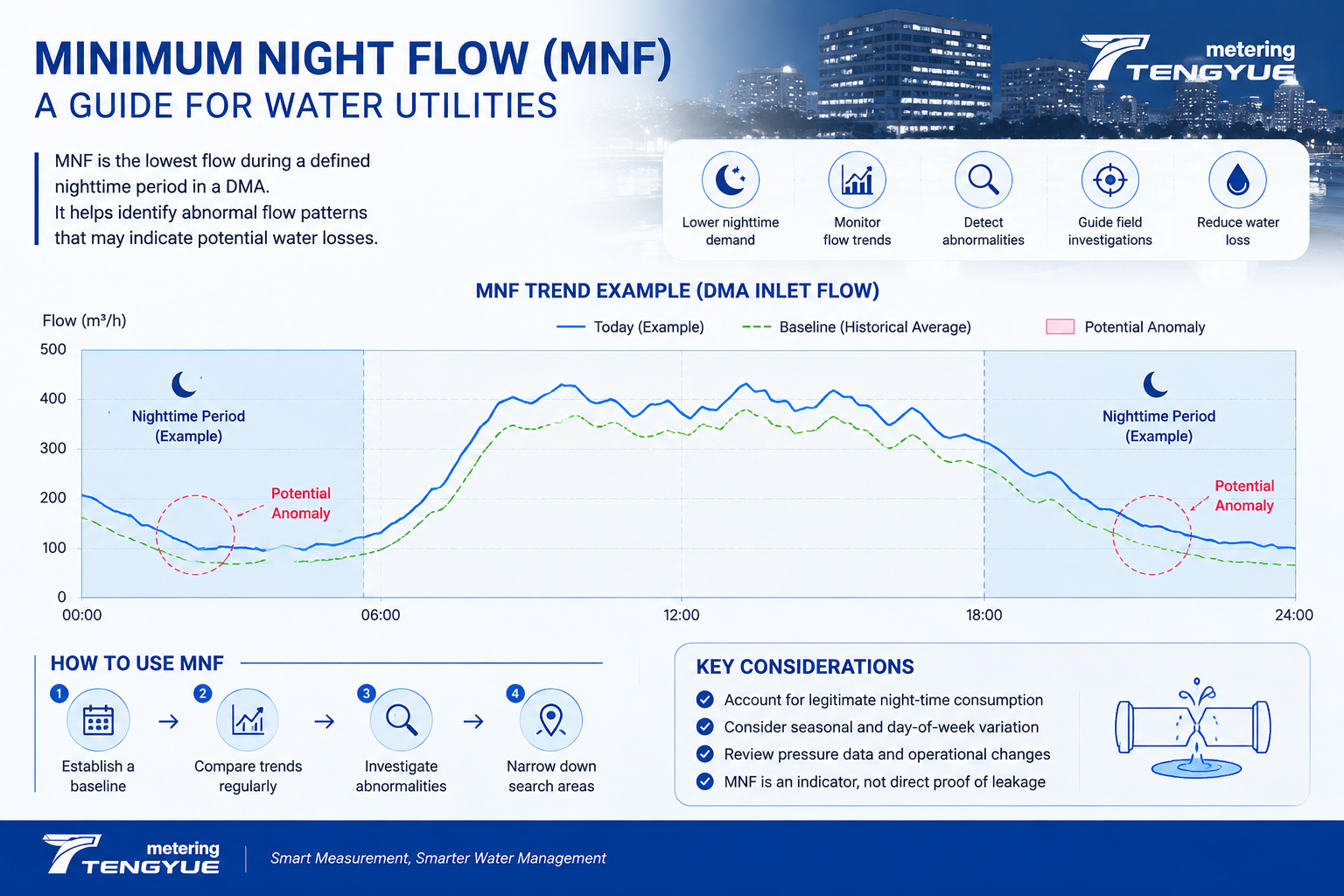
Minimum night flow (MNF) is the lowest measured flow during a defined nighttime period in a monitored area, such as a District Metered Area (DMA). Water demand usually changes throughout the day, and in many distribution networks consumption falls during nighttime hours. This makes nighttime flow an important indicator for utilities investigating potential water losses.
Utilities use minimum night flow analysis to understand nighttime network behavior, identify unusual flow patterns, and decide where further investigation may be justified. MNF is not a leak-location tool by itself; it is an operational indicator that becomes more useful when compared with historical baselines, pressure data, authorized nighttime use, and field information.
Why Is Minimum Night Flow Important for Water Utilities?
When legitimate water consumption is low, persistent flow through a DMA may make background leakage easier to investigate. A nighttime window—often around 02:00–04:00, depending on local demand—can provide a quieter signal than daytime flow. Utilities may compare that signal across days, weeks, and seasons.
However, nighttime flow is not the same as leakage. Hospitals, industrial facilities, night-shift businesses, storage tanks, and other legitimate uses may continue consuming water overnight. Pressure conditions also affect flow. A DMA with higher nighttime pressure may show more background leakage, while pressure management can change the MNF baseline. IWA water loss methodology and AWWA M36 both emphasize that flow data should be interpreted with operational context rather than as a standalone leakage number.
For water utilities, MNF is valuable because it supports prioritization. A sustained change in minimum night flow can help a team decide where to check supporting data, review pressure trends, or plan field work. MNF is most useful as a screening indicator that points to where engineering judgment and field verification are needed.
How Do Utilities Use Minimum Night Flow Analysis?
A practical MNF analysis process includes four steps. The exact nighttime window, baseline period, and thresholds should be defined locally.
1. Establish a Baseline
Collect nighttime flow readings over a suitable period and understand the area’s normal operating pattern. Account for seasonal changes, day-of-week differences, and known nighttime users. A useful baseline usually needs multiple nights, not a single reading. Flow meters should be selected and maintained with measurement accuracy in mind; ISO 4064 provides a common framework for water meters.
2. Compare Current and Historical Trends
Look for sustained increases, unexpected changes, or repeated deviations from the baseline. A single unusual reading may result from a temporary event or measurement issue. A practical review might ask whether a rise persists for several nights, whether it appears at the same time each night, and whether pressure or authorized consumption changed at the same time.
3. Check Supporting Data
Review DMA inflow, pressure readings, recent operational activities, and authorized nighttime consumption. Pressure loggers recording at 15-minute intervals can help separate a flow change from a pressure change. These details help determine whether an anomaly deserves further investigation.
4. Narrow the Investigation Area
If the pattern indicates a potential problem, use DMA boundaries, network information, and additional field measurements to guide the next steps. Nested DMAs, step testing, and pressure-flow correlation may be appropriate. MNF helps identify a potential water-loss problem within a monitored area, but it does not automatically identify the exact pipe or leak point.
| Nighttime signal | Possible interpretation | Useful next check |
|---|---|---|
| Single high reading | Temporary event, measurement issue, or short-term use | Repeat measurement and check alarms |
| Sustained rise over several nights | Changed nighttime use, pressure change, or background leakage | Review pressure, authorized use, and DMA inflow |
| Rise with stable pressure | Possible change in consumption or leakage | Check night users and field conditions |
| Rise with higher pressure | Pressure-driven flow increase possible | Review pressure management and baseline |
What Data and Standards Support MNF Interpretation?
MNF interpretation is stronger when data quality is explicit. Flow and pressure sensors should have known accuracy, time stamps should be synchronized, and missing data should be flagged. ISO 4064 is relevant to water meter performance; IWA water loss methodology and AWWA M36 provide widely used frameworks for leakage management and performance indicators. Some utilities also use BABE (Burst and Background Estimate) concepts to separate background and burst-related losses.
At a minimum, document the nighttime window, the baseline period, the pressure range, and any known nighttime users. For example, a utility might define MNF as the average flow between 02:00 and 04:00, compare it with a 28-day baseline, and review pressure at the same interval. These are illustrative choices, not universal rules. Local demand patterns, network size, meter calibration, and data completeness should determine the final method.
Can Minimum Night Flow Identify the Exact Leak Location?
Not by itself. MNF helps identify a potential water-loss problem within a monitored area, but it does not automatically identify the exact pipe or leak point. More detailed localization may require pressure-flow correlation, nested DMA analysis, GIS network information, and field verification.
Illustrative Scenario: A Sustained Nighttime Flow Increase
Consider a desensitized example: a DMA with about 1,800 connections has a 28-day nighttime baseline of 3.2 m³/h between 02:00 and 04:00. Over five consecutive nights, the average rises to 4.6 m³/h—about a 44% increase—while pressure remains broadly stable and known nighttime users report no change.
The utility reviews DMA inflow and pressure logs, confirms the pattern is sustained, and uses step testing to narrow the investigation area. Field verification then determines whether the cause is leakage, a valve issue, or an unrecorded night user. This example is illustrative and should not be read as a universal threshold.
Making Minimum Night Flow Part of a Continuous Process
TY Leakage Monitoring includes MNF trend analytics based on nighttime baselines for DMAs, helping utilities investigate persistent background leakage patterns. Its wider workflow can combine flow and pressure data with GIS visualization to support more targeted follow-up.
For water utilities, the value of MNF is not just knowing the lowest flow reading. It is understanding how nighttime flow changes over time and using that information to prioritize investigations. Consistent monitoring turns nighttime flow from a single number into a useful operational indicator. Utilities can also set alert thresholds around local baselines, review seasonal shifts, and document follow-up actions so that MNF becomes part of a repeatable process.
Frequently Asked Questions About Minimum Night Flow
What is a good minimum night flow for a DMA?
There is no universal “good” value. MNF depends on DMA size, customer mix, pressure, infrastructure condition, and legitimate nighttime use. Utilities should establish a local baseline and look for sustained deviations rather than compare raw values across different DMAs.
Does a high minimum night flow always mean leakage?
No. Hospitals, industry, storage tanks, night-shift businesses, and other authorized uses can keep nighttime flow elevated. Pressure changes and metering issues can also affect readings. MNF should be interpreted with supporting operational data.
How long should minimum night flow be monitored?
Many utilities review multiple nights and compare against a rolling baseline, such as 28 days, while also checking seasonal patterns. The right period depends on local demand variability and the purpose of the investigation.
Can minimum night flow help prioritize leak detection?
Yes. MNF trend analysis can help utilities decide which DMAs deserve closer review, pressure checks, or field investigation. It supports prioritization, not final leak localization.
How does pressure affect minimum night flow?
Higher nighttime pressure can increase background leakage and some consumption. Pressure management can change the MNF baseline, so flow and pressure should be reviewed together.
If you are reviewing nighttime flow patterns in a DMA, contact our engineers for a DMA MNF review and discuss how flow, pressure, and GIS data can support your leakage investigation.