
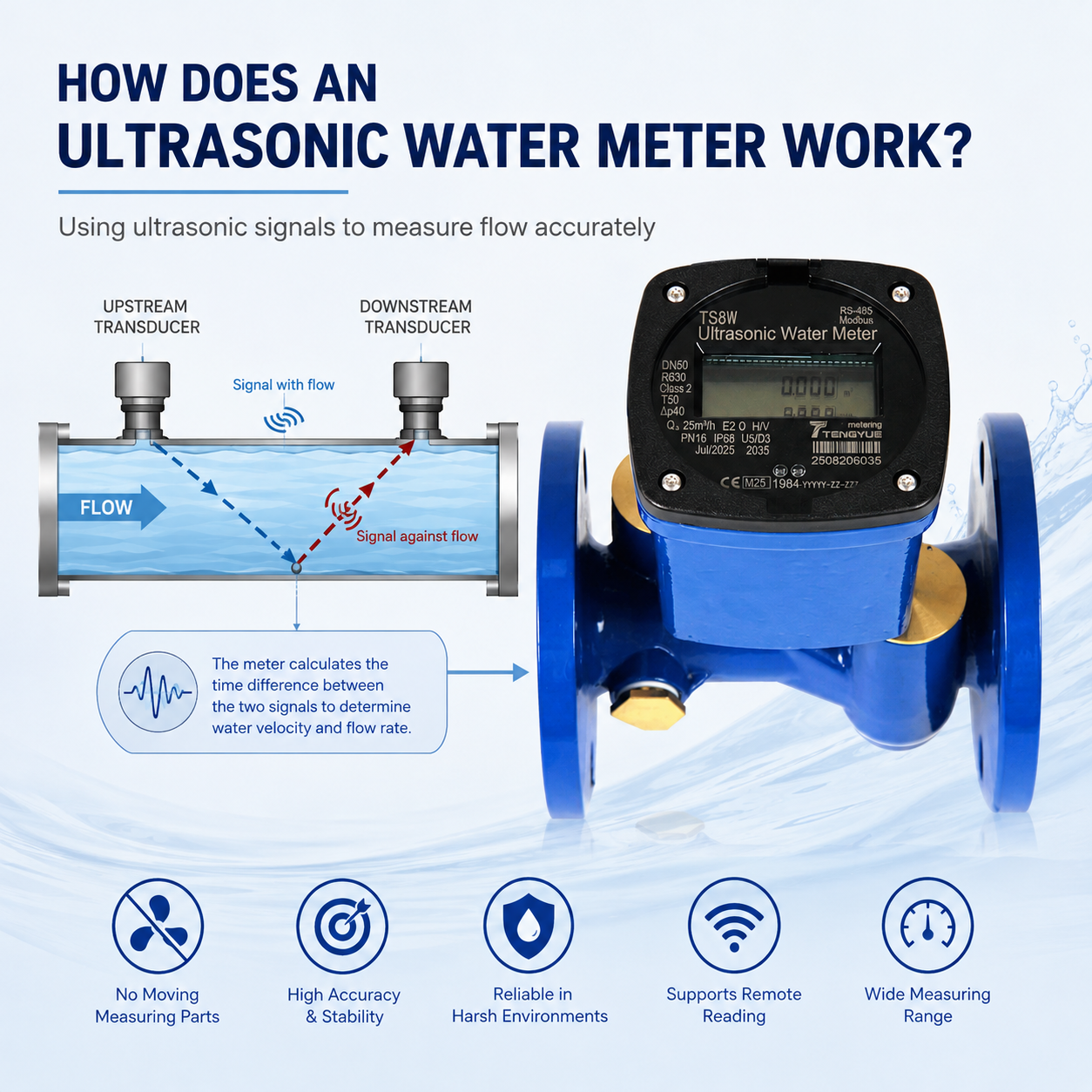
How Does an Ultrasonic Water Meter Work?
Water utilities need reliable measurement data to manage consumption, monitor distribution networks, and make informed operational decisions. Ultrasonic water meters offer an electronic approach to flow measurement without the moving measuring parts found in many traditional mechanical meters.
But how does an ultrasonic water meter work, and what should buyers understand before selecting one?
1. The Working Principle of an Ultrasonic Water Meter
An ultrasonic water meter uses ultrasonic signals to measure the flow of water through a pipe.
In a common transit-time design, ultrasonic signals travel between transducers along the direction of water flow and against it. The flow of water affects the travel time of these signals. By comparing the measured travel times, the meter calculates the water velocity and uses it to determine the volume passing through the meter.
The calculated measurement is processed electronically and displayed or transmitted according to the meter’s design and configuration.
The exact measurement architecture can vary by product, so technical specifications should always be checked against the relevant manufacturer’s documentation.
2. Why Does the Measuring Principle Matter?
- No moving measuring parts
Ultrasonic measurement does not rely on a rotating impeller as its measuring mechanism. This can reduce wear associated with moving measuring components.
- Electronic measurement
Electronic processing supports measurement display and, depending on the model, additional functions such as remote data reading and flow-status alarms.
- Potential for smart metering integration
Some ultrasonic water meters support wired or wireless communication. When the meter is connected to a suitable data collection system, utilities can use meter readings to support remote monitoring and operational analysis.
These capabilities depend on the selected model and communication configuration.
3. Where Are Ultrasonic Water Meters Used?
Ultrasonic water meters can be used in different water measurement scenarios, depending on their diameter, flow range, pressure and temperature ratings, installation requirements, and available communication options.
Typical applications may include:
- Residential and commercial water consumption measurement.
- Water supply networks and distribution pipelines.
- Industrial water use.
- Agricultural irrigation.
Smart metering projects that require remote data collection.
A meter designed for a small service connection should not automatically be considered suitable for a large distribution pipeline. Selection must be based on the project’s actual operating conditions.
4. What Should You Check Before Choosing One?
Before purchasing an ultrasonic water meter, review the following:
Flow range: Confirm that the meter covers the expected minimum and maximum flow rates.
Accuracy and range ratio: Compare the specifications required by the project with the model’s documented performance.
Installation conditions: Check pipe arrangement, meter orientation, and any specified upstream or downstream requirements.
Pressure and temperature: Confirm that the meter is suitable for the actual operating environment.
Communication: Check the exact wired or wireless options available for the selected model.
Protection and certification: Verify the required ingress protection, approvals, and applicable local standards.
Understanding how an ultrasonic water meter works is the first step toward selecting the right metering technology. The next step is to match the meter’s documented specifications with the project’s flow conditions, installation environment, and data collection requirements.
Tengyue Metering provides ultrasonic water metering products for different application scenarios. Contact our team to discuss your project requirements and identify a suitable model.