
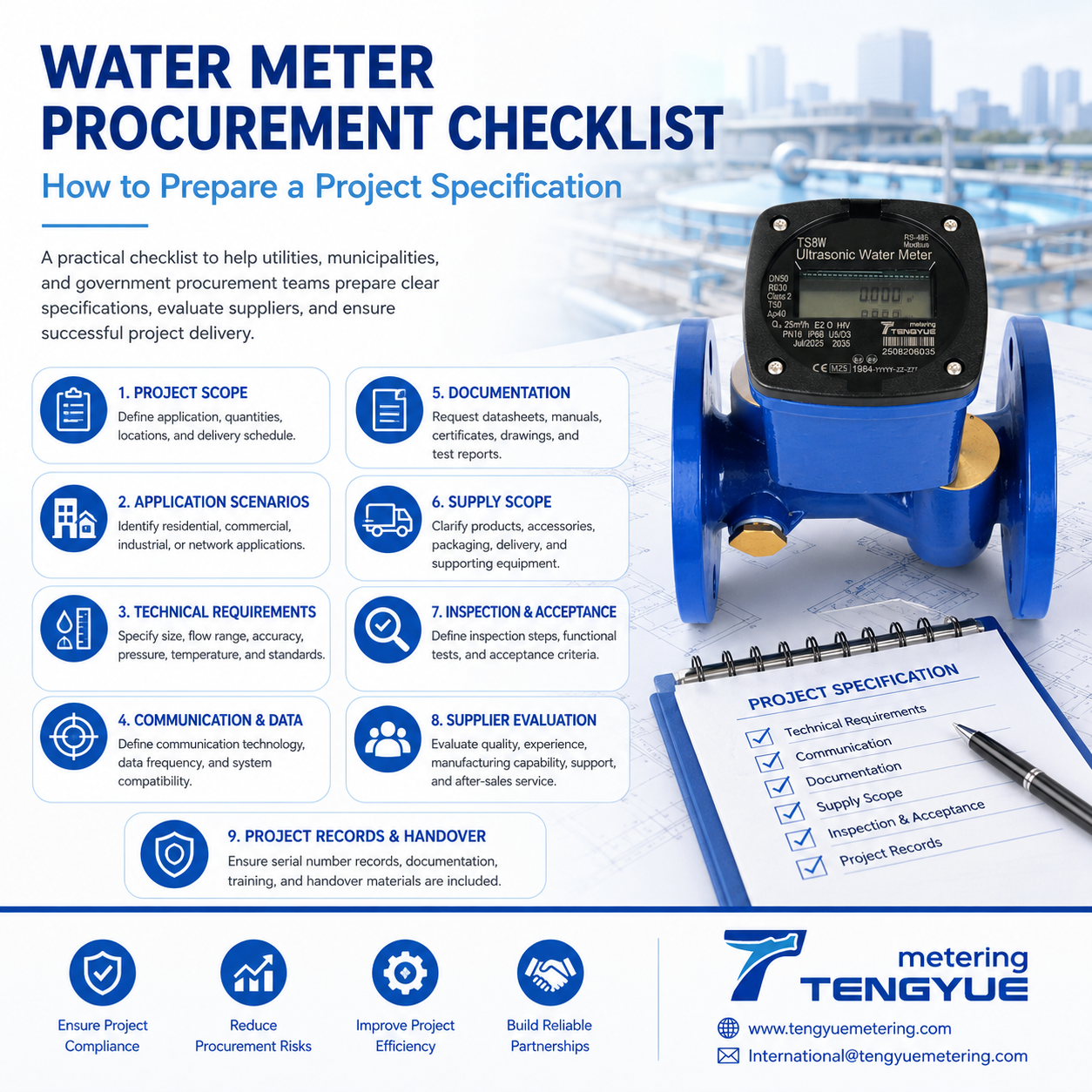
A water meter procurement checklist helps project teams prepare a clear specification before quotations are compared. A successful water meter procurement project starts long before the purchase order is issued. For water utilities, municipal authorities, and project contractors, preparing a clear procurement specification is an important step in avoiding misunderstandings, controlling project risks, and ensuring that the supplied equipment meets operational requirements.
However, procurement documents sometimes focus heavily on product specifications while overlooking other important factors, such as installation conditions, communication requirements, documentation, delivery scope, and acceptance procedures. A well-prepared water meter procurement checklist helps project teams evaluate suppliers more consistently and make purchasing decisions based on the actual needs of the project. This guide outlines the key areas to consider.
Why a Water Meter Procurement Checklist Matters
A procurement checklist turns project requirements into comparable supplier commitments. Without it, two suppliers may quote different configurations, different documentation, and different acceptance terms while appearing to offer the same product. The result is a quotation comparison that is difficult to interpret and a project that may face rework after delivery.
ISO 4064 and OIML R49 provide widely used frameworks for water meter requirements and testing. IEC 62056 / DLMS-COSEM is common in smart metering communication. ISO 55000 asset management principles support aligning procurement decisions with lifecycle and risk considerations. These standards help define requirements, but they do not replace a project-specific specification.
A useful principle is: procure by application and scope, not by product name alone. The checklist below follows that principle.
Define Project Scope and Technical Requirements
Before requesting quotations, clarify where and how the water meters will be used. Different applications may require different meter types, configurations, and supporting functions. Residential and commercial buildings need individual consumption measurement and remote reading requirements. Water distribution networks need bulk measurement at supply points, distribution zones, or network boundaries. Agricultural and industrial applications need measurement for irrigation systems, industrial processes, or large-volume water supply.
The procurement specification should identify project location and operating environment, intended application, estimated number of meters, required meter sizes and configurations, expected delivery schedule, and whether the project is a new installation or a replacement program. Defining the project scope at the beginning gives suppliers a clearer understanding of the application and helps prevent unsuitable product recommendations.
Technical requirements should be based on the actual operating conditions of the project rather than copied from a previous procurement document. Depending on the application, the specification may need to address nominal diameter and connection type, expected flow conditions, operating pressure and temperature, required measurement performance, installation orientation and available space, environmental protection requirements, and relevant standards and certification requirements.
For ultrasonic water meters, buyers should also confirm which measurement functions and configuration options are included in the proposed model. For example, some projects may require reverse-flow detection, non-full-pipe detection, or specific remote reading capabilities. These functions should be clearly identified in the procurement documents instead of being assumed to be standard across all products. It is also important to distinguish between mandatory requirements and optional preferences. This makes supplier evaluation more transparent and reduces unnecessary restrictions during procurement.
Specify Communication, Data, and Documentation Requirements
For smart water metering projects, communication requirements should be considered during the procurement stage. A meter may provide accurate measurement, but the overall project can still face difficulties if its communication method is incompatible with the existing infrastructure.
Project teams should clarify required communication technology, whether wired or wireless communication is preferred, data transmission frequency, compatibility with existing reading systems, required communication interfaces or protocols, and whether remote configuration or valve control is needed. Not every project requires the same communication configuration. A residential metering project may prioritize remote reading and individual consumption records, while a bulk metering project may focus on monitoring water flow at important network points. The procurement specification should therefore describe the intended data collection process and system environment.
Product documentation is an important part of supplier evaluation. Before placing an order, buyers should identify which documents are required for technical review, project approval, installation, and future maintenance. A typical documentation checklist may include product datasheets and technical specifications, product installation manuals, operation and maintenance instructions, applicable test reports, relevant certificates and declarations, communication documentation where applicable, product drawings and connection information, and warranty terms and after-sales support information.
Buyers should also check whether the submitted documents correspond to the exact model and configuration being offered. If a supplier proposes several models, each model should have clearly identifiable documentation. This makes technical comparisons easier and helps prevent confusion during delivery and installation.
Define Supply Scope and Acceptance Criteria
A procurement specification should clearly explain what is included in the supplier’s quotation. This is particularly important for projects involving multiple meter sizes, communication accessories, or supporting equipment. The purchasing team should confirm product models and quantities, included accessories, communication modules if required, installation-related components, packaging and labeling requirements, delivery locations and schedules, required shipping and customs documentation, and spare parts or additional components if applicable. For larger projects, it may also be useful to request a model-by-model supply list. This allows procurement teams to compare quotations more accurately and identify differences in supply scope before making a final decision.
Acceptance requirements should be agreed upon before the order is placed. Without clearly defined criteria, buyers and suppliers may have different expectations about what constitutes an acceptable delivery. Depending on the project, acceptance procedures may include product and quantity verification, documentation verification, functional verification, and project record completion. The exact acceptance procedure should reflect the contract, applicable standards, and project requirements. It should not rely on assumptions made after delivery.
| Procurement area | Key questions | Evidence to require |
|---|---|---|
| Project scope | Are application, quantities, and installation locations clear? | Project brief and site list |
| Technical requirements | Are meter sizes, operating conditions, and required functions defined? | Technical schedule with Q3/Q1, pressure, temperature |
| Communication | Are communication methods and system compatibility specified? | Protocol, module, and platform compatibility statement |
| Documentation | Have all required manuals, datasheets, and certificates been identified? | Model-specific document list |
| Supply scope | Are accessories, packaging, and delivery responsibilities clear? | Model-by-model supply list |
| Acceptance | Are inspection procedures and acceptance criteria agreed upon? | Acceptance checklist and test records |
The table is a general guide. Actual requirements depend on the project scope, applicable standards, and contract terms.
Evaluate Suppliers and Build a Procurement Checklist
Price is an important purchasing consideration, but it should not be the only factor in supplier evaluation. A low quotation may not represent the best project value if important documentation, technical support, or required accessories are excluded.
When evaluating suppliers, procurement teams should consider product suitability for the intended application, completeness and consistency of technical documentation, manufacturing and quality-control capabilities, experience with similar projects, communication and project coordination, delivery capacity, and warranty and after-sales support. For international projects, buyers may also need to consider export experience, documentation coordination, packaging requirements, and communication across different time zones.
A structured supplier evaluation process helps project teams look beyond the initial purchase price and consider the overall reliability of the supply arrangement.
Illustrative Scenario: Preparing a Specification for a Mixed Project
Consider a desensitized example. A utility plans to procure about 1,200 meters: 8 DN200 bulk meters at DMA boundaries, about 1,150 residential and commercial meters, and 42 terminal points with valve control. The bulk meters need 15-minute flow data for DMA water balance; the residential meters need daily readings; the terminal points need valve status monitoring and an authorized control process.
The procurement specification defines the technical schedule, communication requirements, documentation list, supply scope, and acceptance criteria for each group. A 28-day pilot covering 60 meters, including 15 difficult sites, is included as an acceptance condition. This example is illustrative and should not be read as a universal specification.
Before issuing a request for quotation or finalizing a procurement specification, use the following checklist: Is the project scope clear? Are technical requirements defined? Are communication and system compatibility specified? Have required documents been identified? Are accessories, packaging, and delivery responsibilities clear? Are inspection procedures and acceptance criteria agreed? Are technical capability, quality control, and support included in supplier evaluation? This checklist can be adapted to the size and complexity of each procurement project.
A well-prepared water meter procurement specification helps utilities and project contractors reduce uncertainty before purchasing equipment. By defining the project scope, technical requirements, communication needs, documentation, supply responsibilities, and acceptance criteria, buyers can make supplier comparisons more transparent and improve coordination throughout the project.
For water meter manufacturers, understanding these requirements is equally important. A reliable supplier should be able to provide not only suitable products, but also clear technical information and practical support throughout the procurement process. Tengyue Metering works with water utilities, distributors, and project partners on water metering products and smart water management applications. If you are preparing a water meter procurement project, our team can help you review the application requirements and identify suitable product options.