
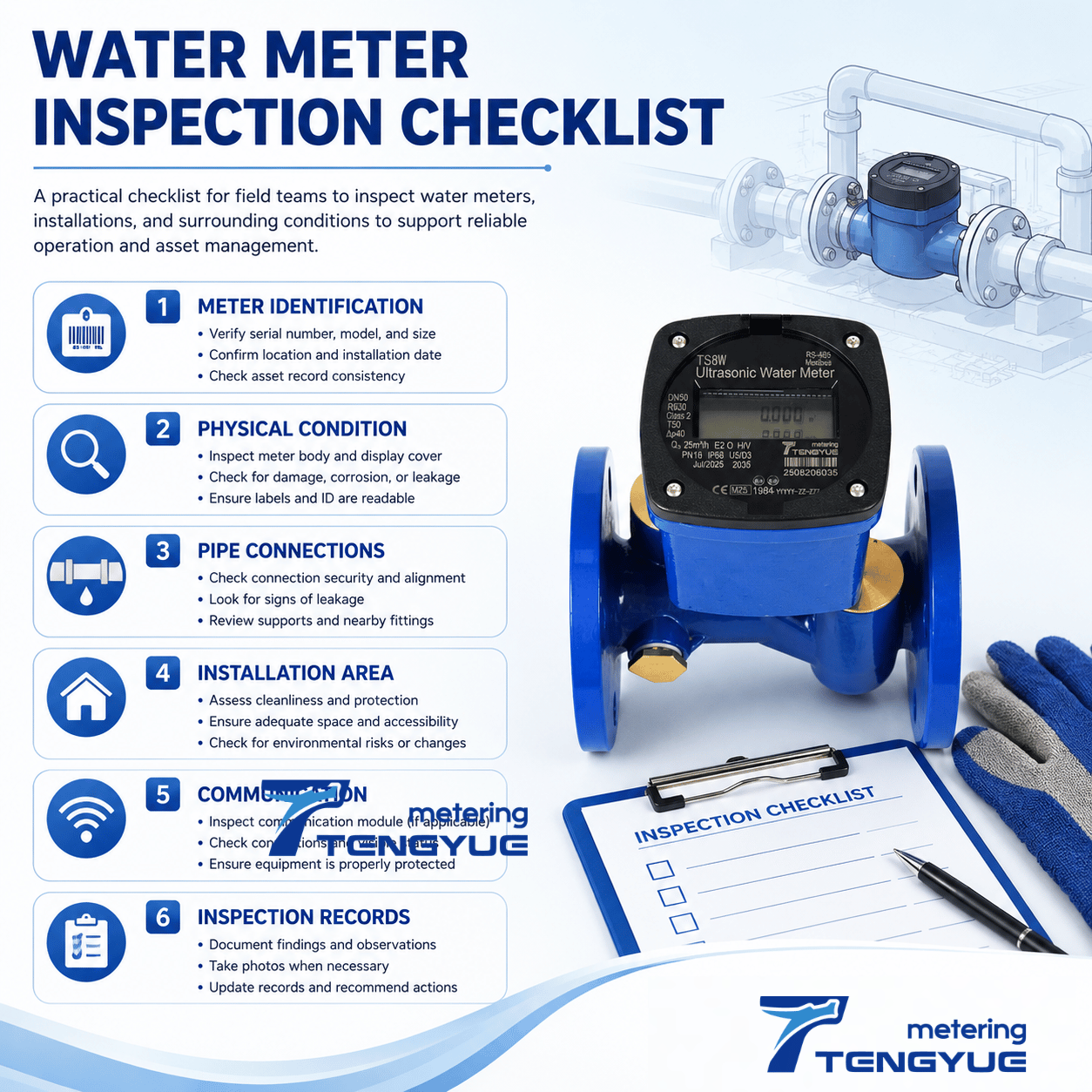
A water meter inspection checklist helps field teams perform consistent water meter field inspections and record findings that support maintenance decisions. Regular water meter inspections help water utilities maintain reliable metering infrastructure and identify potential equipment or installation issues before they become larger operational problems. For utilities managing hundreds or thousands of meters, field inspections are an important part of daily asset management. They provide an opportunity to check equipment condition, review installation environments, identify visible damage, and keep meter records up to date.
However, an effective inspection should involve more than simply looking at the meter display. The surrounding pipework, connection points, installation conditions, communication equipment, and asset information can all affect the long-term operation and management of a metering installation. A standardized water meter inspection checklist helps field teams perform inspections consistently and record findings in a way that supports future maintenance decisions.
Why a Water Meter Inspection Checklist Matters
A routine water meter visual inspection is not a full performance test. It is a condition assessment: a structured check of what can be seen, accessed, and recorded without unauthorized disassembly or adjustment. The value of the inspection depends on three things: consistency across field teams, accurate asset identification, and a record that maintenance planners can actually use.
ISO 4064 and OIML R49 provide widely used frameworks for water meter accuracy and testing. IEC 62056 / DLMS-COSEM is common in smart metering communication. ISO 55000 asset management principles support aligning asset information with risk-based decisions; inspections are one of the main ways that asset information stays current.
For utilities with DMA monitoring and water balance programs, an inspection that misses a damaged chamber cover, a leaking connection, or an unreadable meter ID can create data gaps that later look like network anomalies. A 15-minute data interval is only useful if the physical asset is in a condition to measure reliably.
Verify Meter Identification, Physical Condition, and Asset Records
The first step in a field inspection is to confirm that the equipment matches the utility’s asset records. Incorrect or incomplete identification information can create problems during maintenance, billing, data management, and future replacement projects.
Field teams should check the meter serial number or identification number, product model and nominal diameter, installation address or network location, installation date if available, asset record consistency, and whether the meter has been replaced or modified since the previous inspection. The physical meter identification should be compared with the corresponding asset management or metering records. If any information is missing or inconsistent, the discrepancy should be recorded and updated through the utility’s established asset management process.
A visual inspection can help identify obvious signs of equipment damage or deterioration. Field technicians should examine the meter body and visible external components without opening or modifying the equipment unless the manufacturer’s instructions specifically allow it. Important inspection points include the meter body (visible cracks, deformation, corrosion, or other signs of physical damage), the display and cover (intact and the reading area accessible), external connections (secure and free of visible damage), labels and identification (readable), and protective condition (adequate for the surrounding environment).
If visible damage is found, record its location and severity and follow the utility’s maintenance procedures. The inspection should not involve unauthorized disassembly or adjustments to sealed components.
| Inspection area | What to check | Record if abnormal |
|---|---|---|
| Meter ID | Serial number, model, DN match asset record | ID mismatch or unreadable label |
| Meter body | Cracks, deformation, corrosion | Location and severity of damage |
| Display and cover | Intact, readable, accessible | Cover damage or display failure |
| External connections | Secure, no visible damage | Loose or damaged connection |
| Labels | Serial number and model readable | Missing or faded label |
| Protection | Suitable for the environment | Water ingress or inadequate cover |
The table is a general guide. Actual inspection items depend on the meter model and site conditions.
Check Pipe Connections, Installation Environment, and Accessibility
The condition of the surrounding pipework is another important part of water meter inspection. Even when a meter appears to be in good condition, problems around the installation may affect operational reliability and increase maintenance requirements.
Field teams should check whether visible pipe connections appear secure, whether there are signs of water leakage around connection points, whether supporting structures show visible damage, whether nearby pipes or fittings show signs of corrosion, whether the installation area is clean and accessible, and whether external objects are placing pressure on the meter or connected pipework. For meters installed in chambers or underground locations, technicians should also review accessibility and the general condition of the chamber. Standing water, accumulated dirt, damaged covers, or restricted access may make future inspection and maintenance more difficult.
Water meters are installed in different environments, including residential buildings, commercial facilities, industrial sites, and water distribution networks. The inspection requirements should reflect the actual installation conditions. Residential and commercial installations should be checked for accessibility and whether surrounding fixtures or building modifications have affected the installation. Water distribution network installations require review of the meter chamber, pipe supports, access covers, and surrounding infrastructure. Industrial and agricultural installations require attention to environmental exposure, vibration sources, and surrounding equipment.
A meter may be operating normally but still create difficulties for future maintenance if it is difficult to access. During inspection, field teams should consider whether the equipment can be safely reached and whether routine maintenance activities can be carried out efficiently. Check whether there is sufficient space around the meter, whether technicians can access the display and identification label, whether the meter chamber or installation area is safely accessible, whether covers and access structures are in acceptable condition, whether there are obstacles that could interfere with future inspection, and whether changes to the surrounding installation have affected maintenance access. Any safety-related concern should be handled according to the utility’s site procedures.
Check Display Status and Communication Equipment
The meter display provides useful information during a routine inspection. Field technicians should confirm that the display is visible and that the required reading information can be accessed. Depending on the meter model, inspection items may include display visibility and readability, current accumulated consumption reading, visible warning or status indications, display cover condition, and whether the meter identification matches the asset record.
For electronic or ultrasonic water meters, the available display information and status indicators depend on the specific product configuration. Technicians should refer to the relevant product manual when interpreting symbols, alarms, or diagnostic information. A routine visual inspection should not be treated as a complete performance test. If a measurement or functional concern is identified, additional testing should follow the manufacturer’s procedures and the utility’s technical requirements.
For smart water metering installations, communication equipment may also form part of the inspection. The specific inspection requirements depend on the communication technology and meter configuration used in the project. Where applicable, field teams should check whether the communication module is visibly intact, whether external communication connections are secure, whether the installed configuration matches the project records, whether there are visible signs of damage or water ingress, whether the communication equipment is properly protected, and whether any available status indication suggests an abnormal condition. For wireless communication installations, the surrounding environment should also be reviewed if physical changes may affect the communication setup.
Not every water meter uses the same communication technology or provides the same diagnostic functions. Inspection procedures should therefore be based on the actual installed equipment rather than a generic checklist.
Update Inspection Records and Use a Practical Checklist
An inspection is only useful if its findings are recorded and can be reviewed later. Consistent records help utilities track equipment condition, identify recurring issues, and plan maintenance or replacement activities. A standard inspection record may include meter ID, location, inspection date, inspector, physical condition, pipe connections, installation environment, display condition, communication equipment, inspection findings, and recommended action. Photographs can also be useful when documenting visible damage, installation conditions, or changes to the surrounding infrastructure.
| Record item | Information to collect |
|---|---|
| Meter ID | Unique meter identification |
| Location | Installation address or network area |
| Inspection date | Date of the field visit |
| Inspector | Responsible field technician |
| Physical condition | Visible equipment condition |
| Pipe connections | Observed connection and leakage conditions |
| Среда установки | Chamber, surrounding space, and accessibility |
| Display condition | Visibility and available status information |
| Communication equipment | Condition, where applicable |
| Findings and action | Identified issues and recommended follow-up |
Utilities should maintain a consistent record format so that information collected by different field teams can be compared over time.
Illustrative Scenario: A 200-Meter Inspection Cycle
Consider a desensitized example. A utility inspects about 200 meters per month across residential, commercial, and DMA boundary locations. The inspection team uses a standardized checklist and records findings in the asset system. During one cycle, the team identifies 6 meters with unreadable labels, 3 chambers with standing water, and 2 communication modules with visible water ingress.
All findings are recorded with photographs and forwarded to the maintenance team. The chamber drainage issue is scheduled for repair, the labels are replaced, and the communication modules are inspected under the manufacturer’s guidance. The inspection record is reviewed at the next 28-day cycle to confirm closure. This example is illustrative and should not be read as a universal procedure.
The following checklist can be adapted for routine inspections and project-specific maintenance procedures.
| Inspection area | What field teams should check |
|---|---|
| Meter identification | Serial number, model, diameter, and asset record |
| Physical condition | Meter body, cover, labels, and visible damage |
| Pipe connections | Connection condition and signs of leakage |
| Среда установки | Cleanliness, protection, and surrounding conditions |
| Display | Readability and visible status information |
| Communication equipment | External condition and configuration, where applicable |
| Accessibility | Space, chamber condition, and maintenance access |
| Inspection records | Findings, photographs, and recommended actions |
The inspection frequency should be determined by the utility according to equipment type, operating environment, maintenance policy, and project requirements. Not every meter needs the same inspection procedure. A bulk meter installed in a network chamber may require different attention from an individual meter installed in a residential building.
Regular water meter inspections help utilities maintain better control over their metering infrastructure. By checking meter identification, physical condition, pipe connections, installation environments, display information, communication equipment, and asset records, field teams can identify visible issues and maintain more consistent equipment information. A structured inspection process also supports better maintenance planning and helps utilities make more informed decisions about repair, further testing, or equipment replacement.
Tengyue Metering provides ultrasonic water metering products for residential, commercial, water distribution, agricultural, and industrial applications. If your team is planning a metering project or reviewing its equipment management requirements, our team welcomes the opportunity to discuss suitable solutions.
Define Supply Scope and Acceptance Criteria
A procurement specification should clearly explain what is included in the supplier’s quotation. This is particularly important for projects involving multiple meter sizes, communication accessories, or supporting equipment. The purchasing team should confirm product models and quantities, included accessories, communication modules if required, installation-related components, packaging and labeling requirements, delivery locations and schedules, required shipping and customs documentation, and spare parts or additional components if applicable. For larger projects, it may also be useful to request a model-by-model supply list. This allows procurement teams to compare quotations more accurately and identify differences in supply scope before making a final decision.
Acceptance requirements should be agreed upon before the order is placed. Without clearly defined criteria, buyers and suppliers may have different expectations about what constitutes an acceptable delivery. Depending on the project, acceptance procedures may include product and quantity verification, documentation verification, functional verification, and project record completion. The exact acceptance procedure should reflect the contract, applicable standards, and project requirements. It should not rely on assumptions made after delivery.
| Procurement area | Key questions | Evidence to require |
|---|---|---|
| Project scope | Are application, quantities, and installation locations clear? | Project brief and site list |
| Technical requirements | Are meter sizes, operating conditions, and required functions defined? | Technical schedule with Q3/Q1, pressure, temperature |
| Communication | Are communication methods and system compatibility specified? | Protocol, module, and platform compatibility statement |
| Documentation | Have all required manuals, datasheets, and certificates been identified? | Model-specific document list |
| Supply scope | Are accessories, packaging, and delivery responsibilities clear? | Model-by-model supply list |
| Acceptance | Are inspection procedures and acceptance criteria agreed upon? | Acceptance checklist and test records |
The table is a general guide. Actual requirements depend on the project scope, applicable standards, and contract terms.
Evaluate Suppliers and Build a Procurement Checklist
Price is an important purchasing consideration, but it should not be the only factor in supplier evaluation. A low quotation may not represent the best project value if important documentation, technical support, or required accessories are excluded.
When evaluating suppliers, procurement teams should consider product suitability for the intended application, completeness and consistency of technical documentation, manufacturing and quality-control capabilities, experience with similar projects, communication and project coordination, delivery capacity, and warranty and after-sales support. For international projects, buyers may also need to consider export experience, documentation coordination, packaging requirements, and communication across different time zones.
A structured supplier evaluation process helps project teams look beyond the initial purchase price and consider the overall reliability of the supply arrangement.