
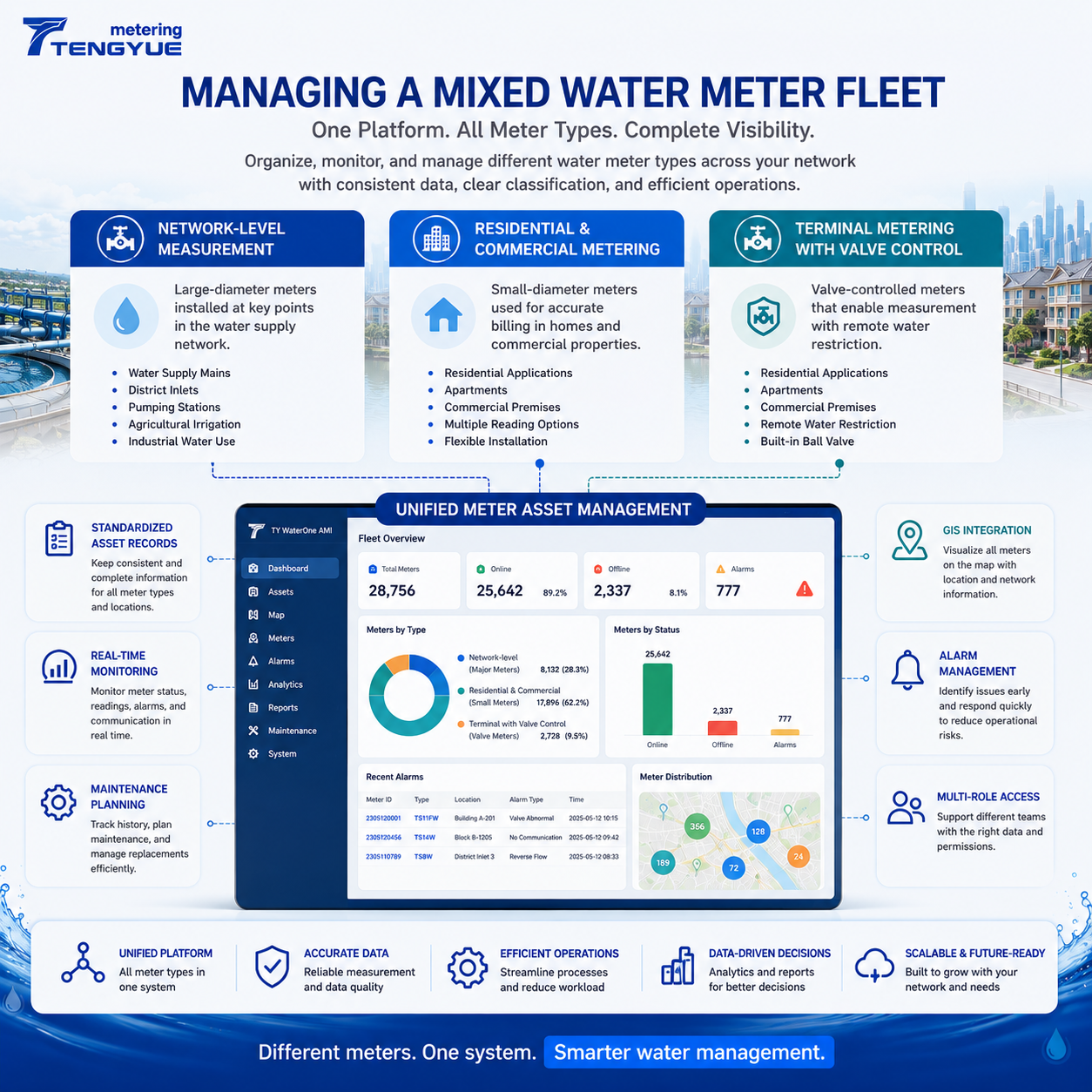
Water meter fleet management is the structured process of identifying, classifying, monitoring, and maintaining different meter types across a utility’s service area. A water utility may operate thousands of meters across residential buildings, commercial properties, distribution networks, and industrial connections. These meters are not necessarily the same type. Some are small-diameter meters used for individual consumption measurement. Others are large-caliber meters installed at network inlets. Certain applications may also require valve-control functionality.
As a result, managing a water meter fleet is more complicated than maintaining a list of installed devices. Utilities need a consistent way to identify, classify, monitor, and maintain different meter types throughout their service areas. A structured fleet-management approach can improve asset visibility, maintenance planning, and project coordination without requiring every application to use the same meter.
Why Mixed Water Meter Fleets Are Common and Need Management
Water distribution systems serve different types of users and operating environments. A utility may need to measure water at several levels: water entering a supply or distribution network; water supplied to a district or specific facility; consumption in residential buildings; consumption in commercial premises; and selected customer connections requiring valve-control functions.
Each application has different technical and operational requirements. For example, a large-caliber meter installed on a supply main cannot simply be treated as equivalent to a small-diameter residential meter. The two devices have different installation arrangements, flow conditions, maintenance needs, and operational roles. A mixed meter fleet is therefore a normal result of operating a diverse water network.
The challenge is to manage this diversity consistently. ISO 55000 asset management principles support aligning asset information with risk-based decisions; for a mixed fleet, that means defining a common classification structure while retaining application-specific fields. ISO 4064 provides a framework for meter accuracy, but fleet management also depends on installation records, communication status, and maintenance history.
Create a Standard Asset Classification System
The first step is to establish a common classification structure. Every meter should have a record that allows the utility to identify what it is, where it is installed, and what role it performs.
A useful asset record may include meter model and nominal diameter, serial number or meter address, installation location, application category, installation date, initial reading, communication method, relevant technical configuration, and maintenance and replacement history.
The utility should also define consistent naming rules. For example, a network-level meter, a residential meter, and a valve-controlled terminal meter should have clearly identifiable application categories. This reduces confusion when different departments work with the same asset information. It also makes it easier to organize procurement, spare parts, maintenance, and reporting.
| Asset field | All meters | Network-level meter | Residential/commercial meter | Valve-controlled meter |
|---|---|---|---|---|
| Model and DN | Required | Required | Required | Required |
| Serial number | Required | Required | Required | Required |
| Installation location | Required | Pipeline and flange details | Building and customer records | Building and control-point records |
| Application category | Required | Network-level | Residential/commercial | Terminal with valve control |
| Communication method | Required | Wired/wireless per config | Wired/wireless per config | Wired/wireless per config |
| Valve status | Not applicable | Not applicable | Not applicable | Required |
The table is a general guide. Actual fields should reflect the meter model, project requirements, and utility asset standards.
Classify Products According to Their Operational Roles
A practical fleet structure can be built around the actual function of each meter.
Network-level measurement: TS8W. The Ультразвуковой водомер TS8W для больших объемов воды is designed for large-caliber measurement in applications such as water supply mains, agricultural irrigation, and industrial water use. Its manual describes transit-time ultrasonic measurement, a measuring mechanism without moving parts, reverse-flow detection, and non-full-pipe detection. Depending on the selected configuration, remote reading can be supported through wired or wireless communication options. In a utility’s asset system, TS8W meters may be grouped under network-level or large-caliber measurement assets. This makes it easier to identify meters that are important for supply monitoring and network-level operational analysis.
Residential and commercial measurement: TS14W. The Ультразвуковой счетчик воды TS14W is intended for small-diameter metering applications. For utilities, these meters may represent a large number of individual measurement points across residential buildings, apartments, and commercial properties. Their records should be organized so that individual meters can be associated with the correct building, customer, connection, and reading process. The exact model configuration and communication arrangement should be recorded rather than assumed from the product family name.
Valve-controlled terminal measurement: TS11FW. The TS11FW Ultrasonic Water Meter combines ultrasonic measurement with a built-in ball valve. Its product manual describes remote water restriction and supported wired or wireless meter-reading options. In a fleet-management system, it is useful to distinguish TS11FW assets from standard measurement-only meters because their operational responsibilities may be different. For example, maintenance teams may need to track both measurement status and valve-related status. The utility should also maintain clear authorization procedures for any remote control operations.
Standardize Information Without Forcing Every Meter to Be Identical
A common fleet-management mistake is trying to make every meter follow exactly the same operational process. Some information should be standardized across the entire fleet, while other fields need to reflect the product’s specific functions.
For example, all meters can share basic asset fields such as model, serial number, installation location, installation date, current status, and maintenance history. However, different meter groups may require additional fields. A large-caliber network meter may need pipeline and flange information. A residential meter may need building and customer records. A valve-controlled meter may need valve status and control-related records.
The goal is a common asset structure with application-specific information. This makes the fleet easier to manage without losing important technical differences. A useful rule is: standardize identity and location for every meter; customize technical and operational fields by application.
Connect Meter Records with Maintenance and Communication Status
Accurate asset records are useful only when they support operational decisions. Utilities can use fleet information to plan inspection, maintenance, and replacement activities. For example, meters can be grouped according to installation date, location, operating environment, or maintenance history. This helps maintenance teams identify assets that require closer attention. It also supports better planning for spare parts and replacement inventory. For a mixed fleet, spare-part planning should consider the different meter models and connection arrangements rather than relying on a single generic inventory list.
For meters connected to a remote-reading system, communication information becomes another important part of fleet management. The utility should maintain records of the communication method and relevant configuration. It should also be able to distinguish between different operational conditions: meter installed and operating; meter installed but not communicating; data received but not matched to the correct asset; communication temporarily interrupted; and meter requiring inspection.
These categories help prevent communication problems from being confused with measurement problems. For example, a missing reading does not necessarily mean that the meter itself has failed. The issue may involve network coverage, gateway availability, configuration, or data integration. A clear classification process helps teams investigate the actual cause.
Illustrative Scenario: Standardizing a Mixed Fleet of 5,000 Meters
Consider a desensitized example. A utility operates about 5,000 meters: 30 DN200 bulk meters at supply inlets, about 4,900 residential and commercial meters, and 70 terminal points with valve control. The asset records use a common identity structure for model, serial number, location, and application category, plus application-specific fields for pipeline details, building/customer records, and valve status.
The utility reviews communication status monthly. Meters that are installed but not communicating are classified separately from meters with missing data matched to the wrong asset. Maintenance planning groups meters by installation year and site conditions. A 28-day review of exception cases helps the team refine the classification rules. This example is illustrative and should not be read as a universal specification.
Improve Visibility Through Centralized Data and a Scalable Process
As a meter fleet grows, maintaining separate spreadsheets or disconnected records becomes increasingly difficult. A centralized information structure can help utilities bring together meter identities, locations, readings, and operational status. Solutions such as TY WaterOne AMI are designed to integrate smart meters, communication infrastructure, and analytics software. The solution documentation describes dashboard-based visualization, data analysis, and integration options. For utilities, the value of this type of platform depends on how well the meter records, communication architecture, and existing operational systems are aligned. The platform should support the utility’s actual asset-management process rather than simply display a large volume of disconnected data.
A good water meter fleet-management system should remain useful as the network expands. It should support new meter installations, replacement projects, different application types, and future communication requirements. A practical process includes: define a common asset identification structure; classify meters by application and model; record installation and configuration information; maintain communication and operational status; link maintenance and replacement history; connect meter data with relevant management systems; and review asset information regularly.
For utilities operating mixed metering environments, the goal is not to eliminate product diversity. It is to make that diversity visible and manageable. Tengyue Metering provides different ultrasonic water metering options for network-level, residential, commercial, and valve-controlled applications. TS8W, TS14W, и TS11FW can be organized within one broader asset-management framework while retaining their individual application roles. The appropriate configuration should be confirmed against the project’s technical requirements.