
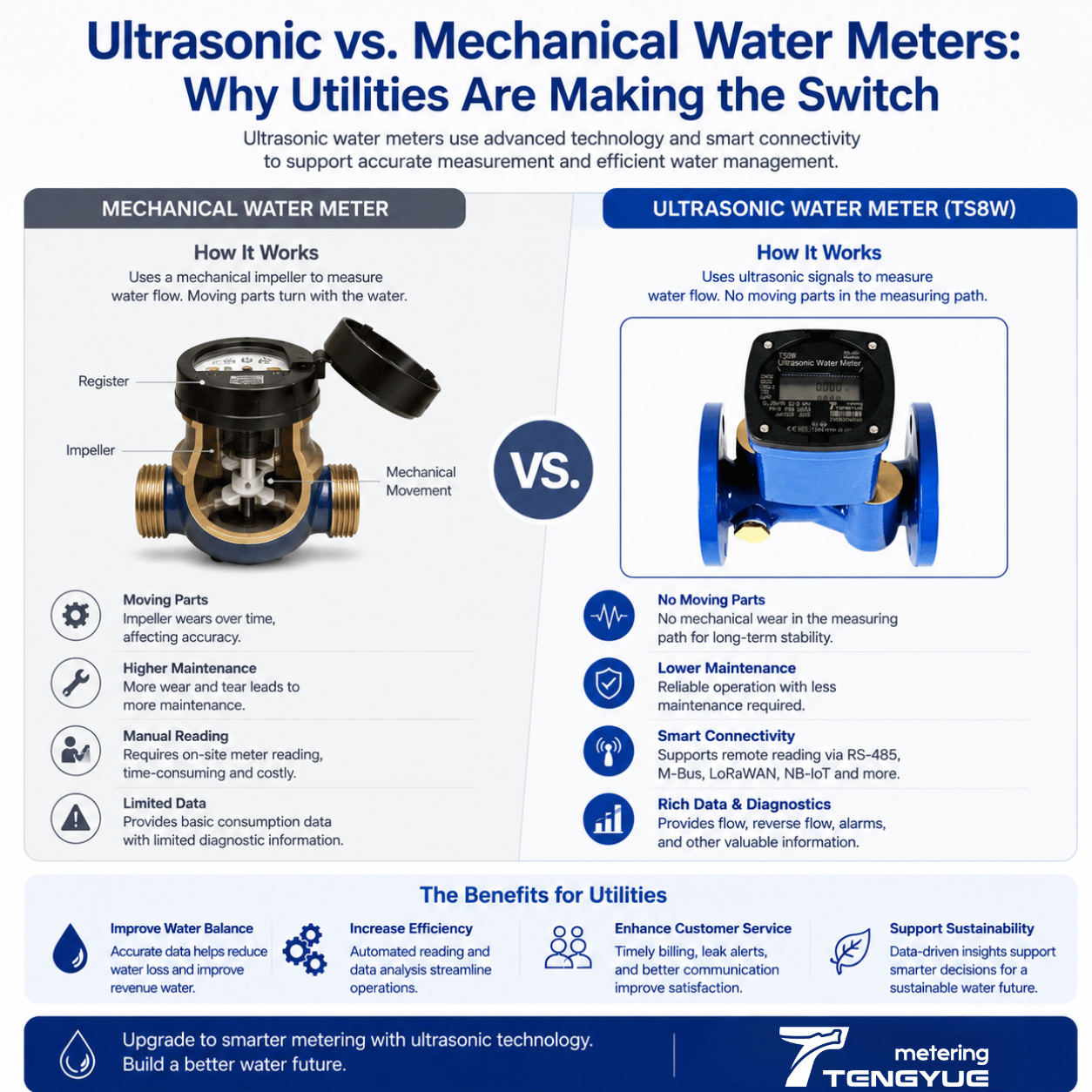
The choice between an ultrasonic vs mechanical water meter is no longer only a question of purchase price. Water utilities are under increasing pressure to improve measurement accuracy, reduce operational costs, and manage water distribution networks more efficiently. For many years, mechanical water meters have been widely used in residential, commercial, and industrial applications. However, as water management becomes more data-driven, ultrasonic water meters are attracting growing attention.
The difference is not that one technology is universally better. Mechanical meters remain a proven option for many applications. The real question is which measurement technology fits the project’s flow profile, installation conditions, data requirements, and long-term operating model. This guide compares the two technologies and sets out how to evaluate them.
Why Are Utilities Moving from Mechanical to Ultrasonic Water Meters?
Utilities are moving toward ultrasonic metering for several connected reasons: measurement stability without moving measuring parts, better low-flow resolution in some designs, and easier integration with smart metering and data platforms. None of these reasons applies equally to every project, and the business case should be tested against local conditions.
ISO 4064 and OIML R49 provide widely used frameworks for water meter requirements and testing. Both mechanical and ultrasonic meters can meet applicable accuracy classes, so the comparison should focus on how each technology performs across the actual flow range, installation conditions, and service life—not on technology labels alone.
A useful starting point is to define the project’s operating envelope: pipe size, expected minimum and maximum flow, pressure, water temperature, installation orientation, and data interval. The technology choice should follow that envelope.
How Do Ultrasonic and Mechanical Water Meters Measure Flow?
The main difference lies in how the two types of meters measure water flow.
Mechanical water meters use moving components, such as impellers or turbines, to measure the volume of water passing through the meter. Ultrasonic water meters use ultrasonic signals to measure water flow. In transit-time designs, the meter calculates flow based on the difference in the travel time of ultrasonic signals moving with and against the water flow. This electronic measurement approach eliminates the need for moving mechanical measuring parts.
| Comparison area | Mechanical meter | Ultrasonic meter |
|---|---|---|
| Measuring principle | Impeller or turbine rotation | Transit-time ultrasonic signals |
| Moving measuring parts | Yes | No moving measuring parts in the flow path |
| Low-flow performance | Depends on design and wear | Often strong low-flow resolution, model-dependent |
| Wear over time | Mechanical wear possible | No impeller or turbine wear in the measuring mechanism |
| Data capability | Pulse or communication module dependent | Often supports remote reading and diagnostics, configuration-dependent |
| Typical consideration | Proven, cost-effective for many applications | Suited to data-driven and low-flow-sensitive projects |
The table is a general comparison, not a product specification. Actual performance depends on the exact model, accuracy class, Q3/Q1 range ratio, installation conditions, and maintenance.
What Maintenance and Long-Term Operating Differences Matter?
One important feature of ultrasonic water meters is their measuring mechanism. Without moving measuring parts, there is no mechanical impeller or turbine inside the measurement mechanism that can wear through normal rotation. This can reduce concerns associated with mechanical wear and help support long-term measurement stability.
For utilities managing large numbers of meters, the measuring technology is an important factor when considering maintenance requirements and long-term operating costs. ISO 55000 asset management principles support risk-based decisions about critical assets. A bulk meter at a DMA boundary may justify a different maintenance and redundancy plan than a residential meter.
Mechanical meters are not inherently unreliable. Many mechanical meters deliver long service life when correctly sized, installed, and maintained. The comparison should therefore include expected service life, maintenance access, replacement cost, and the cost of measurement error—not only the purchase price.
How Do Smart Metering and Data Capabilities Compare?
Modern water management requires more than collecting a meter reading once in a while. Utilities increasingly need reliable data for consumption analysis, abnormal usage monitoring, billing, and network management. Depending on the model and configuration, ultrasonic water meters can support wired or wireless remote reading.
For example, Tengyue’s TS8W manual documents communication options including RS-485, M-Bus, pulse, LoRa, LoRaWAN, W-MBus, and NB-IoT. The available options depend on the selected configuration. The same principle applies to mechanical meters: a communication feature listed for one configuration should not be assumed to be available on every version.
IEC 62056 / DLMS-COSEM is common in smart metering communication, and data integration should be planned before procurement. A meter that records every 15 minutes may still be unsuitable for DMA water balance if identifier mapping and time synchronization are not defined.
Some ultrasonic meters also provide information beyond cumulative water consumption. Depending on the product, this may include reverse-flow indication, non-full-pipe detection, and alarms. These functions can help operators understand certain abnormal measurement conditions and investigate potential issues more efficiently. However, meter alarms should be treated as monitoring information rather than automatic confirmation of a specific pipeline leak.
When Should Utilities Choose Ultrasonic vs Mechanical Water Meters?
Ultrasonic technology is not automatically the best choice for every application. Before making a decision, utilities should evaluate the required flow range and measurement performance, pipe diameter and installation conditions, operating pressure and water temperature, communication infrastructure, data management requirements, and total cost over the expected service period.
Illustrative Scenario: Evaluating a DN200 Bulk Meter
Consider a desensitized example. A utility needs a DN200 bulk meter at a DMA boundary with an expected flow range of roughly 5–300 m³/h, normal pressure of 0.3–0.6 MPa, and a wet chamber. The utility wants 15-minute flow data for DMA water balance and minimum night flow review.
The evaluation compares a mechanical turbine meter and an ultrasonic meter on low-flow resolution, pressure loss, Q3/Q1 range ratio, IP68 suitability, communication protocol, and local support. A 28-day pilot tests data completeness and low-flow performance before full procurement. This example is illustrative and should not be read as a product specification for every site.
The right decision should be based on the project’s actual operating conditions rather than technology trends alone. In some applications, a correctly sized mechanical meter remains a sound choice. In others, the data and low-flow requirements make ultrasonic metering the better fit.
Tengyue supports different water measurement requirements, from smaller applications to bulk water metering projects, with its ultrasonic water meter portfolio and smart metering solutions. The appropriate model and configuration should be confirmed against the project’s technical requirements.
Frequently Asked Questions About Ultrasonic vs Mechanical Water Meters
What is the main difference between ultrasonic and mechanical water meters?
Mechanical meters use impellers or turbines to measure flow, while ultrasonic meters use transit-time signals. Ultrasonic designs have no moving measuring parts in the flow path, which can reduce mechanical wear concerns.
Are ultrasonic water meters always more accurate than mechanical meters?
No. Both technologies can meet applicable accuracy classes under ISO 4064 and OIML R49. Actual performance depends on the model, flow range, installation, and maintenance. The project’s low-flow and data requirements should drive the choice.
Do ultrasonic water meters require less maintenance?
Ultrasonic meters avoid impeller or turbine wear in the measuring mechanism, but they still require correct installation, power and communication checks, and periodic verification. Maintenance planning should follow the specific model and site conditions.
Can mechanical water meters support smart metering?
Yes, many mechanical meters can be fitted with pulse or communication modules. The available options depend on the exact model and configuration, so the quoted version should be confirmed in writing.
How should utilities decide between ultrasonic and mechanical meters?
Define the operating envelope, compare accuracy, low-flow performance, pressure loss, installation requirements, communication options, maintenance, and total cost over the service period. A pilot can test the critical details before scale-up.
If you are comparing ultrasonic vs mechanical water meters for a utility project, свяжитесь с нашими инженерами to review flow requirements, installation conditions, communication options, and lifecycle cost.