
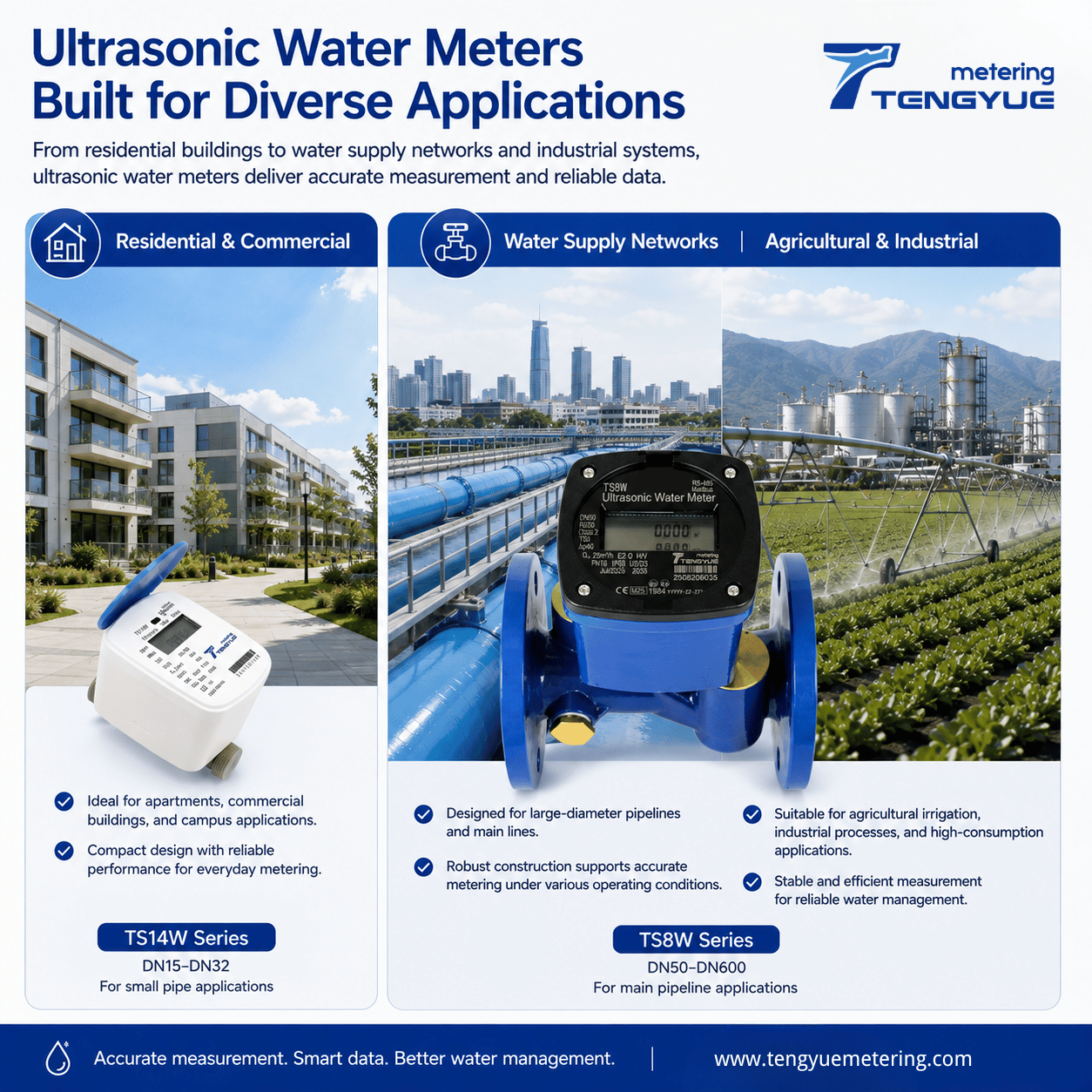
An ultrasonic water meter for utilities is designed to measure flow electronically, without moving measuring parts in the flow path, and to fit different application conditions across a distribution network. Water utilities operate across different environments, from residential distribution networks to commercial facilities and large water supply pipelines. Each application has its own measurement requirements. A suitable water meter must do more than record consumption. It should also fit the operating conditions and support the utility’s long-term management needs.
Ultrasonic water meters offer several features that make them worth considering for modern water utility projects. This guide sets out the application benefits, the conditions that determine suitability, and the questions utilities should answer before selection.
What Makes an Ultrasonic Water Meter for Utilities Different?
Ultrasonic water meters use ultrasonic signals to measure water flow. In transit-time designs, the meter calculates flow based on the difference in the travel time of ultrasonic signals moving with and against the water flow. The measuring mechanism does not rely on rotating mechanical components. This design avoids wear associated with moving measuring parts and is an important consideration for long-term operation.
For utilities, understanding the measurement technology helps when evaluating maintenance requirements and expected operating conditions. It also helps separate genuine application benefits from marketing claims. ISO 4064 and OIML R49 provide widely used frameworks for water meter requirements and testing; a meter should be evaluated against the applicable accuracy class, Q3/Q1 range ratio, pressure-loss characteristics, and installation requirements for the exact model being quoted.
Adaptability Across Meter Sizes and Applications
Water metering requirements vary significantly by pipe size and application. Small-diameter meters are commonly used in residential buildings, apartments, and commercial premises. Larger meters are used in water supply main lines, industrial facilities, and agricultural irrigation systems. A product portfolio covering different meter sizes allows utilities to select equipment according to actual flow conditions and project requirements.
For example, Tengyue’s TS14W is designed for household, apartment, and commercial metering scenarios, while TS8W is intended for larger-diameter applications such as water supply main lines, agricultural irrigation, and industrial water use. The appropriate model should be confirmed against the project’s flow range, pressure, temperature, and installation conditions.
| Application | Typical meter type | Key selection question |
|---|---|---|
| Household and apartment | Small-diameter ultrasonic meter | Does low-flow performance match typical demand? |
| Commercial premises | Small to medium ultrasonic meter | Are communication and data options sufficient? |
| DMA boundary | Medium to large bulk meter | Can it support 15-minute flow data for water balance? |
| Water supply main | Large bulk meter | Does it cover the expected flow range with acceptable pressure loss? |
| Agricultural irrigation | Medium to large meter | Does it handle the water quality and operating profile? |
The table is a general guide, not a product specification. Actual model selection depends on the exact configuration.
Installation Flexibility and Site Conditions
Installation conditions are an important part of meter selection. Utilities should consider pipe diameter, available installation space, pipeline orientation, operating pressure, and water temperature. The TS8W e TS14W product manuals document support for horizontal, vertical, or inclined installation orientations. However, the final installation should always follow the specific model’s manual and project requirements.
Installation flexibility is useful, but it is not a substitute for correct site preparation. Straight-pipe requirements, upstream and downstream conditions, grounding, and chamber access should be confirmed before work begins. A meter installed in conditions outside the manual’s requirements may not perform as specified. For chambers that may be wet, the protection rating and cable handling should also be checked.
Remote Data Reading and Smart Metering Integration
Remote meter reading can reduce the need for manual data collection and help utilities access consumption information more efficiently. Depending on the model and configuration, ultrasonic water meters may support wired or wireless communication. For example, the TS8W manual lists several communication options, including RS-485, M-Bus, pulse, LoRa, LoRaWAN, W-MBus, and NB-IoT.
Utilities should confirm the exact communication version, local network availability, and compatibility with their data collection system before procurement. IEC 62056 / DLMS-COSEM is common in smart metering communication, and data integration should be planned before the meter is ordered. A communication feature listed for one configuration should not be assumed to be available on every version.
Remote reading also depends on the data platform and operational workflow. A meter that transmits every 15 minutes may still be unsuitable for DMA water balance if identifier mapping and time synchronization are not defined.
How Do Smart Metering and Data Capabilities Compare?
Modern water management requires more than collecting a meter reading once in a while. Utilities increasingly need reliable data for consumption analysis, abnormal usage monitoring, billing, and network management. Depending on the model and configuration, ultrasonic water meters can support wired or wireless remote reading.
For example, Tengyue’s TS8W manual documents communication options including RS-485, M-Bus, pulse, LoRa, LoRaWAN, W-MBus, and NB-IoT. The available options depend on the selected configuration. The same principle applies to mechanical meters: a communication feature listed for one configuration should not be assumed to be available on every version.
IEC 62056 / DLMS-COSEM is common in smart metering communication, and data integration should be planned before procurement. A meter that records every 15 minutes may still be unsuitable for DMA water balance if identifier mapping and time synchronization are not defined.
Some ultrasonic meters also provide information beyond cumulative water consumption. Depending on the product, this may include reverse-flow indication, non-full-pipe detection, and alarms. These functions can help operators understand certain abnormal measurement conditions and investigate potential issues more efficiently. However, meter alarms should be treated as monitoring information rather than automatic confirmation of a specific pipeline leak.
When Should Utilities Choose Ultrasonic vs Mechanical Water Meters?
Ultrasonic technology is not automatically the best choice for every application. Before making a decision, utilities should evaluate the required flow range and measurement performance, pipe diameter and installation conditions, operating pressure and water temperature, communication infrastructure, data management requirements, and total cost over the expected service period.
Illustrative Scenario: Evaluating a DN200 Bulk Meter
Consider a desensitized example. A utility needs a DN200 bulk meter at a DMA boundary with an expected flow range of roughly 5–300 m³/h, normal pressure of 0.3–0.6 MPa, and a wet chamber. The utility wants 15-minute flow data for DMA water balance and minimum night flow review.
The evaluation compares a mechanical turbine meter and an ultrasonic meter on low-flow resolution, pressure loss, Q3/Q1 range ratio, IP68 suitability, communication protocol, and local support. A 28-day pilot tests data completeness and low-flow performance before full procurement. This example is illustrative and should not be read as a product specification for every site.
The right decision should be based on the project’s actual operating conditions rather than technology trends alone. In some applications, a correctly sized mechanical meter remains a sound choice. In others, the data and low-flow requirements make ultrasonic metering the better fit.
Tengyue supports different water measurement requirements, from smaller applications to bulk water metering projects, with its ultrasonic water meter portfolio and smart metering solutions. The appropriate model and configuration should be confirmed against the project’s technical requirements.
Supporting DMA Analysis, NRW, and Smarter Water Management
Meter data becomes more valuable when it can be organized and analyzed. When connected to an appropriate data platform, meter readings can support consumption analysis, abnormal usage investigation, and water balance management. For larger distribution networks, accurate inlet metering can also provide important data for DMA analysis and non-revenue water management.
The meter itself is only one part of the solution. Communication, data management, and operational processes all contribute to the final result. IWA water loss methodology and AWWA M36 provide widely used frameworks for interpreting water balance and leakage indicators. ISO 55000 asset management principles support risk-based decisions about critical assets such as DMA boundary bulk meters.
Some ultrasonic meters also provide information beyond cumulative consumption, such as reverse-flow indication, non-full-pipe detection, and alarms, depending on the product. These functions can help operators understand abnormal measurement conditions, but meter alarms should be treated as monitoring information rather than automatic confirmation of a specific pipeline leak.
Illustrative Scenario: Selecting Meters for a Mixed Utility Project
Consider a desensitized example. A utility plans to deploy about 800 small-diameter meters for apartments and commercial premises, plus 6 DN200 bulk meters at DMA boundaries. The small meters need daily readings and alarm reporting; the bulk meters need 15-minute flow data for DMA water balance and minimum night flow review.
The evaluation compares candidate models on Q3/Q1 range ratio, accuracy class, pressure loss, IP68 suitability for wet chambers, communication protocol, and local support. A 28-day pilot tests data completeness and low-flow performance at representative sites before full procurement. This example is illustrative and should not be read as a product specification for every utility.
When Is an Ultrasonic Water Meter for Utilities the Right Fit?
Ultrasonic technology is not automatically the best choice for every application. Before making a decision, utilities should evaluate the required flow range and measurement performance, pipe diameter and installation conditions, operating pressure and water temperature, communication infrastructure, data management requirements, and total cost over the expected service period.
A useful selection checklist includes: Does the meter cover the expected flow range with acceptable accuracy and pressure loss? Is the installation orientation and protection rating suitable for the site? Does the proposed communication configuration match the utility’s network and data platform? Are technical documentation, spare parts, and local support available? Can the meter’s data support the intended operational workflow, such as billing, DMA water balance, or MNF analysis?
Selecting an ultrasonic water meter for a utility project requires a clear understanding of application conditions, measurement requirements, communication options, and future data needs. By combining different ultrasonic water meter models with smart metering solutions, Tengyue aims to support utilities across a range of water measurement applications. The appropriate model and configuration should be confirmed against the project’s technical requirements.
Frequently Asked Questions About Ultrasonic Water Meter for Utilities
What makes an ultrasonic water meter suitable for utility applications?
Suitability depends on flow range, accuracy class, installation conditions, communication options, and data needs. Ultrasonic meters avoid moving measuring parts in the flow path and can support remote reading, but the exact model must match the project’s operating envelope.
Can one ultrasonic meter model cover both residential and bulk applications?
Usually not. Small-diameter meters suit apartments and commercial premises, while larger bulk meters suit DMA boundaries, mains, and industrial use. A portfolio approach allows utilities to select by flow range and installation conditions.
Do ultrasonic water meters support remote reading?
Many models support wired or wireless communication, but the available options depend on the exact configuration. Utilities should confirm the communication module, protocol, network availability, and platform compatibility before procurement.
How does an ultrasonic water meter support DMA water balance?
A bulk meter at a DMA boundary can provide inflow data for water balance and minimum night flow analysis. The value depends on data interval, time synchronization, identifier mapping, and integration with the utility’s platform.
What should utilities check before selecting an ultrasonic water meter?
Check the flow range, accuracy class, Q3/Q1 ratio, pressure loss, installation orientation, protection rating, communication options, data integration requirements, and lifecycle cost. A pilot can test critical details before scale-up.
If you are selecting an ultrasonic water meter for utilities, contact our engineers to review application conditions, flow requirements, communication options, and data integration needs.