
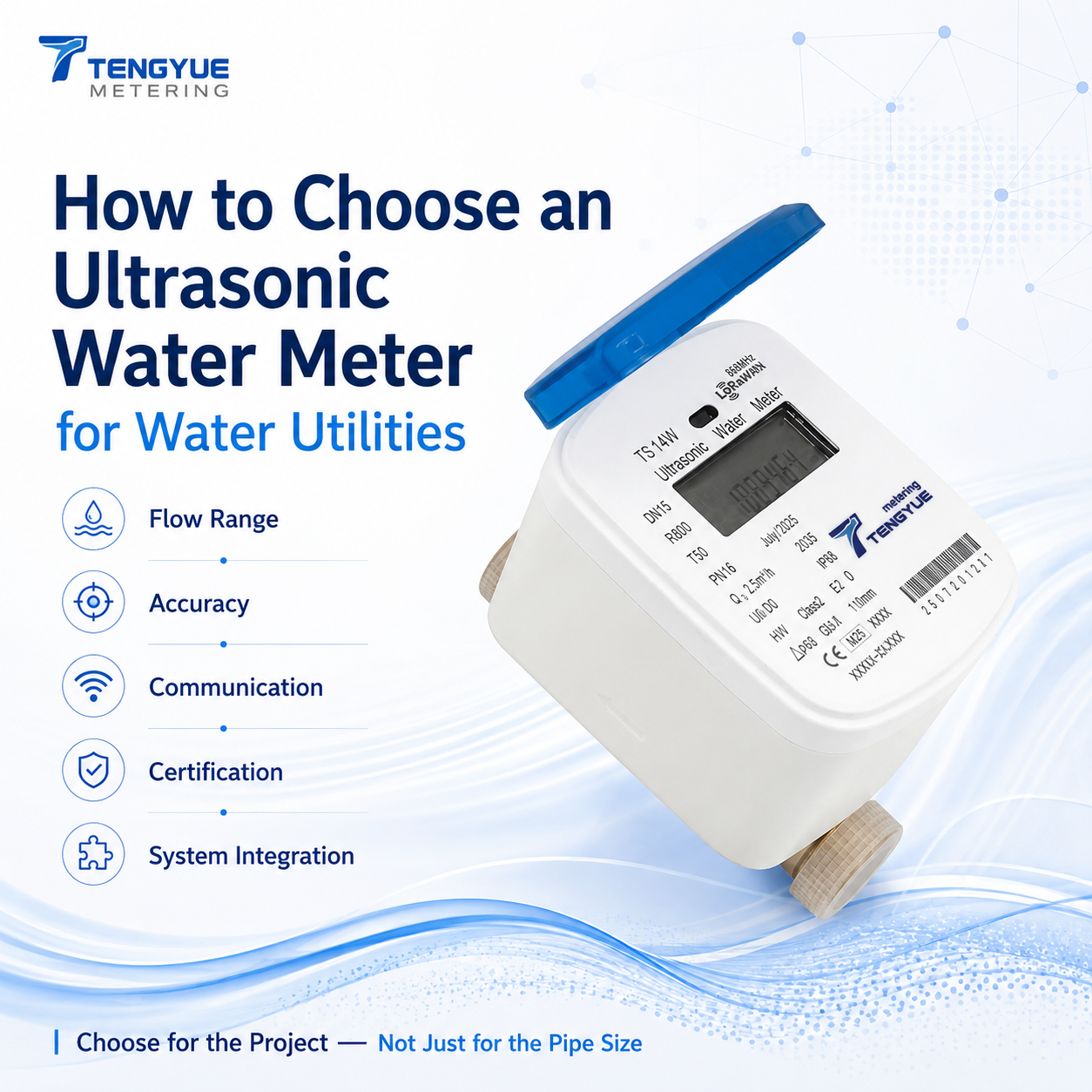
For water utilities, selecting a water meter is not simply a matter of choosing a product with the right pipe size.
A metering project needs to consider measurement performance, operating conditions, communication, installation, maintenance, data management, and future expansion.
This becomes especially important when utilities are moving from traditional meter reading toward smart water management.
So, what should a water utility consider when selecting an ultrasonic water meter?
1. Understand the Application First
Before comparing meter specifications, define where and how the meter will be used.
A residential customer meter, a commercial building meter, and a bulk distribution network meter may have very different requirements.
Important questions include:
What is the pipe diameter?
What is the expected flow range?
What is the minimum flow?
What is the maximum flow?
What are the water quality conditions?
Is remote data collection required?
Will the meter be integrated into an AMR or AMI system?
Are local certifications required?
A clear application definition makes the product selection process much more effective.
2. Look at the Measurement Range
Water flow changes over time.
A meter may experience relatively high flow during peak demand and much lower flow during off-peak periods.
Therefore, it is important to consider the complete operating range rather than looking at only one nominal flow value.
A wider usable measurement range can help utilities obtain more complete information about actual water consumption.
This can also become important when monitoring unusually low-flow conditions.
3. Consider Low-Flow Performance
Low-flow measurement deserves particular attention in modern water management.
Water consumption does not stop when demand is low.
Small flows may represent legitimate consumption, continuous usage, or potential leakage.
For utilities working on water loss reduction, reliable low-flow information can therefore contribute to better network analysis.
This is one reason ultrasonic technology is increasingly considered for smart water metering.
4. Evaluate Communication Requirements
A smart water meter should be evaluated not only as a measuring instrument but also as a data collection device.
Depending on the project, communication options may include technologies such as:
LoRaWAN、NB-IoT、GPRS、RS485、M-Bus、Pulse output
The right choice depends on the existing communication infrastructure and the objectives of the project.
For example, a utility planning large-scale remote meter reading may have very different requirements from a local commercial water monitoring project.
5. Check Smart Metering Compatibility
If the project is part of an AMR or AMI deployment, the water meter needs to work as part of the complete system.
The evaluation should therefore include:
Meter → Communication → Data Platform → Analysis
A meter with good measurement performance but limited system compatibility may create challenges during later deployment.
It is better to consider system integration at the beginning of the project.
6. Consider Installation Conditions
Installation conditions can affect metering performance.
Utilities should consider: Pipe configuration, Available installation space, Flow direction, Environmental conditions, Protection requirements, Power or battery requirements, Communication signal conditions
The meter should be selected according to the real installation environment rather than based only on laboratory specifications.
7. Evaluate Certification Requirements
Water metering projects often involve local or international regulatory requirements.
Depending on the market and application, buyers may need to consider standards or certifications such as: MID、OIML、CE、ISO
Local metrology requirements
The important point is to confirm that the certification applies to the specific product and configuration being supplied.
8. Think About the Future
A water meter may remain in service for many years.
Therefore, utilities should consider not only today’s requirements but also future digitalization plans.
For example:
Today: Remote Meter Reading
Next: Consumption Monitoring
Later: Leakage Analysis
Future: Integrated Water Network Management
Choosing a meter that can support future communication and data requirements can make a long-term digital water strategy easier to implement.
9. Evaluate the Manufacturer, Not Only the Meter
The supplier behind the product is also important.
For utility projects, buyers should consider:
Manufacturing capability, Testing capability, Technical support, Certification support, Communication integration, Product consistency, supply capacity, after-sales service
A successful water metering project requires cooperation beyond the initial purchase.
Selecting an ultrasonic water meter for a utility project should be treated as a system decision rather than a simple product purchase.
The right solution should combine:
Reliable Measurement + Suitable Communication + Practical Installation + System Compatibility + Long-Term Support
When these factors are considered together, water utilities can build a stronger foundation for smart metering and future digital water management.