
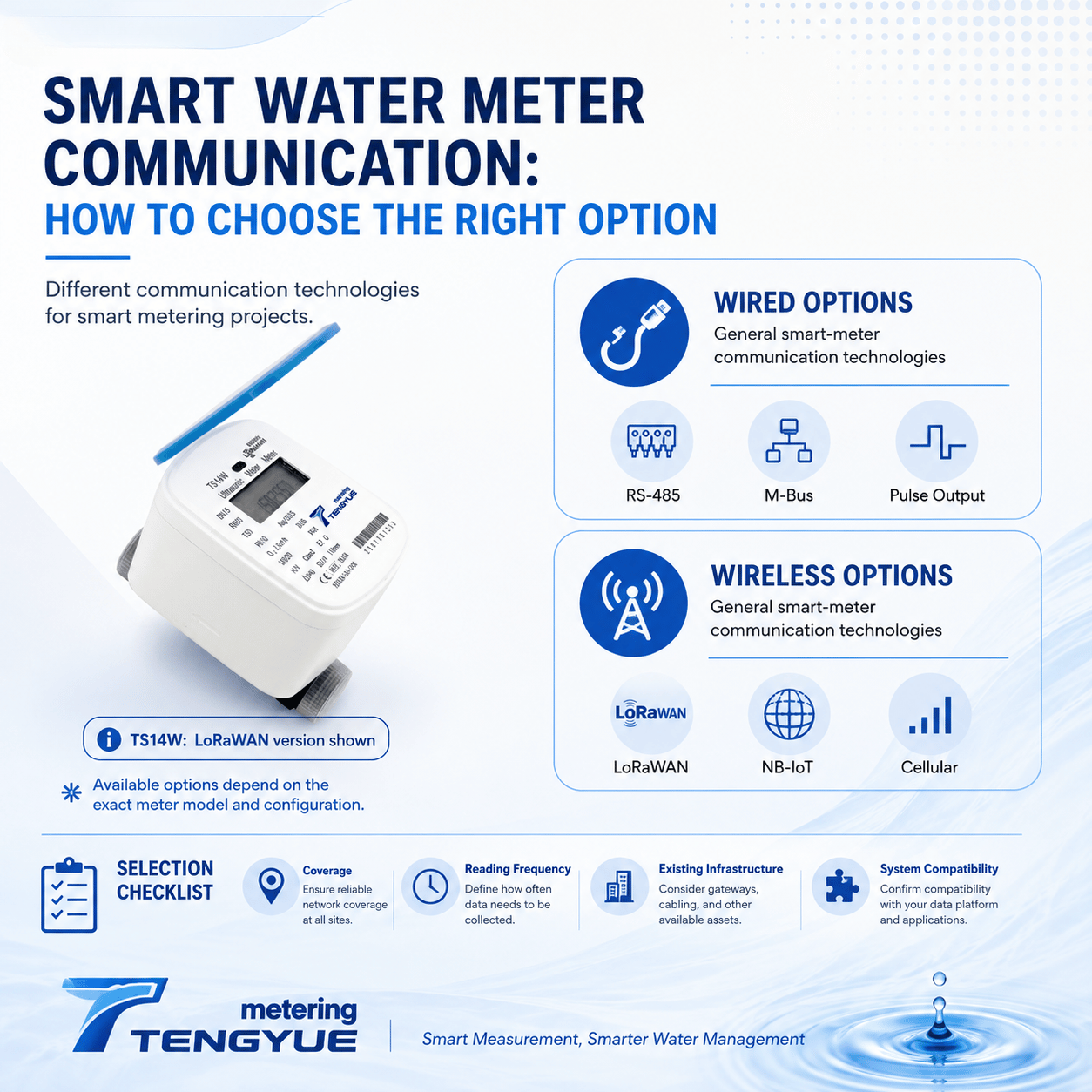
UM medidor de água inteligente can provide useful measurement data, but a metering project also needs a reliable way to collect and transfer that data.
A direita medidor de água inteligente communication option depends on the application, network coverage, required reading frequency, available infrastructure, and compatibility with the utility’s data platform.
1. Wired Communication
Wired interfaces may be appropriate where cable infrastructure is available, and the project requires a defined connection to a data collection device or control system.
Common options in the wider metering industry include RS-485, M-Bus, and pulse output. These options do not perform the same role: some provide data communication, while pulse output provides measurement pulses for a compatible receiving device.
Before selecting a wired interface, confirm cable distance, installation cost, electrical requirements, supported protocols, and compatibility with the receiving equipment.
2. Wireless Communication
Wireless communication can reduce the need to install communication cables, but its suitability depends on the project’s environment and network design.
LoRaWAN
LoRaWAN is commonly considered for low-power devices that transmit relatively small amounts of data. Coverage depends on factors such as gateway placement, terrain, buildings, interference, and local network configuration.
NB-IoT
NB-IoT is a cellular-based low-power technology used in connected devices. Its suitability depends on local operator availability, coverage, subscription arrangements, and device support.
Cellular communication
Cellular options can be useful when a project needs to use available mobile network infrastructure. The exact technology, frequency bands, power requirements, and service availability should be checked for the target market.
Other options
Depending on the product and project, additional communication methods may be available. A technology should only be specified when the selected meter and the receiving system both support it.
3. What Should Utilities Consider?
There is no single communication option that is best for every water utility.
Evaluate these factors before choosing:
Coverage: Is the network reliable at all meter locations?
Reading frequency: How often does the project need to collect readings?
Power consumption: How will communication affect the meter’s power requirements?
Infrastructure: Are gateways, cellular services, cabling, or other network components already available?
Integration: Can the data be received and used by the utility’s existing systems?
Total cost: Consider devices, communication infrastructure, service fees, installation, and maintenance.
Security: Review authentication, data protection, device management, and the security arrangements of the complete system.
4. Match the Communication Method to the Meter
Communication capability is model-specific.
For example, the TS8W product manual lists wired options including RS-485, M-Bus, and pulse, and wireless options including LoRa, LoRaWAN, W-MBus, NB-IoT, and 4G Cat.1 in the documented configurations.
O TS14W manual documents LoRaWAN for its specified version. These options should not be interpreted as meaning that every model supports every listed technology.
Before ordering, confirm the exact meter variant, frequency band, protocol, reading interval, and compatibility with the intended network.
Choosing medidor de água inteligente communication is not simply a decision between wired and wireless technology. It requires matching the meter, network, data collection system, and operating requirements.
Medição Tengyue provides different metering and communication options depending on the product configuration.
Entre em contato com nossa equipe. to discuss the communication requirements of your project.