
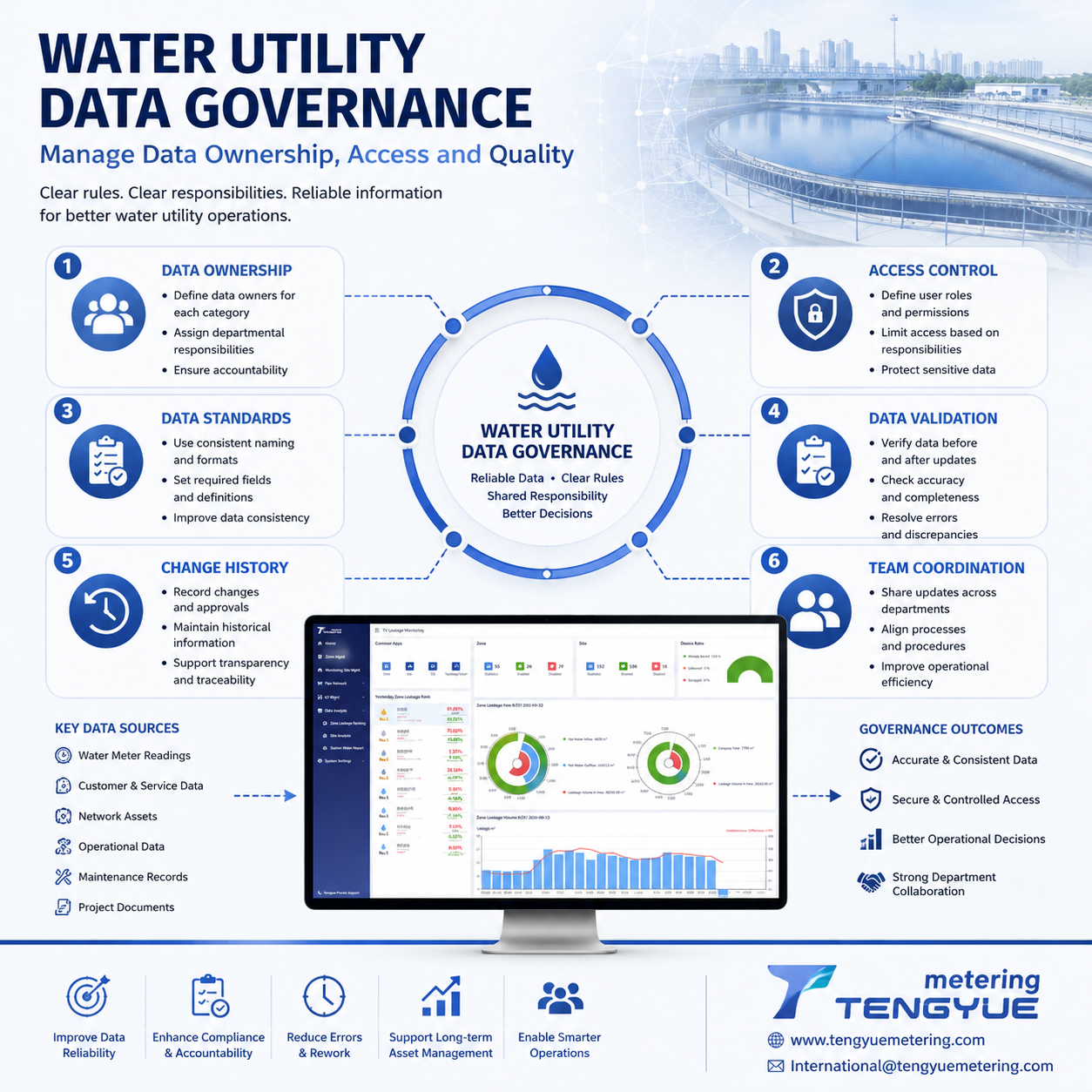
Water utility data governance is the set of policies, responsibilities, standards, and procedures that determine how operational information is created, recorded, maintained, accessed, and updated across an organization. Water utilities generate and manage a growing amount of operational information every day. This information may include water meter readings, customer records, network asset information, maintenance reports, consumption histories, and operational data collected from different areas of the water distribution system.
As utilities expand their digital operations, managing this information becomes increasingly important. However, having more data does not automatically lead to better decisions. Different departments may maintain separate records, use different data formats, or follow inconsistent procedures when updating information. In some cases, it may also be unclear who is responsible for maintaining a particular record or who should be allowed to access it. These challenges can affect operational coordination, reporting consistency, and the reliability of management decisions.
This is where water utility data governance becomes important. Rather than focusing only on software or data collection systems, data governance establishes the responsibilities, rules, and processes that determine how information is managed across an organization.
Why Water Utility Data Governance Matters
A digital platform may collect and display water meter readings, while an integration system may transfer information between different applications. Data governance addresses a different set of questions: Who is responsible for maintaining each type of information? Which department owns or manages a particular data record? Who is authorized to access or modify the information? How should records be updated and verified? What happens when information is incomplete or inconsistent? How should historical changes be documented?
These questions are particularly relevant for utilities that manage multiple departments, operational systems, and large metering infrastructures. ISO 55000 asset management principles support aligning asset information with risk-based decisions. ISO 8000 provides a framework for data quality, which is directly relevant to governance. IEC 62056 / DLMS-COSEM is common in smart metering communication, and the data it carries is only as useful as the governance around it.
A clear governance framework helps ensure that information is managed consistently rather than depending entirely on individual working habits. A useful principle is: every important data field should have a named owner, a defined standard, and a validation rule.
Identify Data Categories and Define Ownership
Before establishing governance rules, utilities should understand what information they manage. Different data categories have different operational purposes and maintenance requirements.
Common categories include metering data (meter identification, installation details, consumption readings, meter status), customer and service data (customer identification, service locations, account information), network asset data (pipelines, valves, meters, network zones), operational data (water supply operations, flow monitoring, pressure observations), maintenance data (inspection records, maintenance history, repair activities, equipment replacement), and project and administrative data (procurement documents, technical specifications, project records, supplier information, acceptance documentation).
Not every utility needs to manage these categories in exactly the same way. The important first step is to identify which information is used across departments and which records require clear ownership and maintenance responsibilities.
One of the most important parts of data governance is establishing who is responsible for each data category. When responsibilities are unclear, information may become outdated or inconsistent. For example, a metering department may be responsible for equipment information, while a customer service department manages customer account records. However, both departments may rely on the same meter identification and service location information. Without clear coordination, changes made by one department may not be reflected in the records used by another.
| Data category | Possible responsible team | Main responsibility |
|---|---|---|
| Meter records | Metering department | Maintain meter IDs, models, and installation information |
| Customer records | Customer service | Maintain customer and service account information |
| Network assets | Network operations | Maintain asset location and infrastructure records |
| Maintenance records | Maintenance team | Record inspections, repairs, and replacements |
| System access | IT or system administrator | Manage user permissions and system access |
The exact responsibilities should be adapted to the organizational structure of each utility. The objective is not to create unnecessary administrative procedures, but to make sure every important data category has an identifiable owner or responsible team.
Establish Data Standards and Access Control
Different departments may use different naming conventions, formats, or identification methods. This can make it difficult to compare records or combine information from different systems. For example, the same meter may be recorded under different identification formats in separate databases. An installation location may also be described differently by different teams. Over time, these inconsistencies can create confusion during reporting, maintenance, and operational reviews.
A practical water utility data governance framework should establish consistent standards for important information. These may include unique identification (consistent rules for meters, network assets, service connections), naming conventions (standard names for locations, network zones, equipment types), data formats (consistent formats for dates, measurement units, addresses), required fields (which information must be completed when a new record is created), and update rules (how changes should be recorded when equipment is replaced, relocated, or modified).
These standards make information easier to maintain and reduce unnecessary differences between departmental records.
Not every employee needs access to all utility information. Data governance should establish who can view, create, modify, approve, or export different categories of information. For example, field technicians may need to view equipment details and update inspection records, while system administrators may be responsible for managing user permissions. Managers may require access to operational reports without needing permission to modify the original equipment records.
| User role | Typical access requirement |
|---|---|
| Field technicians | View assigned asset records and submit inspection updates |
| Metering team | Maintain meter information and review metering records |
| Network operations | Access relevant network and operational information |
| Customer service | Access customer and service-related records |
| Department managers | Review relevant reports and approve designated changes |
| System administrators | Manage system configuration and user permissions |
These are illustrative examples. Actual access permissions should follow the utility’s internal policies, applicable privacy requirements, and information security procedures. Utilities should also review user access periodically, particularly when employees change roles or leave the organization. Clear permission rules help protect sensitive information and reduce the risk of unauthorized changes.
Build Validation, Change History, and Data Quality Procedures
Even when responsibilities and standards are defined, data can become inaccurate if there is no consistent process for checking and updating records. For example, a meter may be replaced, but the original equipment record remains unchanged. A customer service location may be modified without updating related records. An inspection report may contain incomplete equipment information. Different departments may continue using outdated versions of the same record.
To reduce these problems, utilities should establish basic validation procedures. A practical process may include: before creating a record, check whether the information already exists and confirm the required identification fields; when updating information, verify the change against an appropriate source such as a field inspection, approved project document, or authorized service record; after updating information, record who made the change and when it was completed; during periodic reviews, identify missing information, duplicate records, and outdated entries; when discrepancies are discovered, assign responsibility for investigation and correction.
The frequency and depth of these checks should reflect the importance of the information and the utility’s operational requirements.
Utility records often change over time. Meters are replaced, assets are relocated, customer information is updated, and maintenance activities are completed. If these changes are not documented, it can become difficult to understand why two records show different information or when a particular change occurred.
A reliable governance process should therefore maintain appropriate change records. Important information may include what information was changed, when the change was made, who made or approved the change, why the change was necessary, and which record or document supported the change. For example, when a water meter is replaced, the utility should maintain the relationship between the previous meter and the replacement meter. This helps preserve historical information and supports future reviews of consumption records, maintenance history, and equipment performance. Change history is especially useful when multiple departments work with the same operational information.
Coordinate Across Departments and Implement a Phased Framework
Data governance should not be treated as the responsibility of the IT department alone. Water utilities rely on cooperation between different teams, and each department contributes information that may be important to other parts of the organization. Metering teams maintain equipment information. Field teams provide installation and inspection updates. Network operations teams maintain infrastructure records. Customer service teams manage customer-related information. IT teams support system access, integration, and information security. Management teams define policies and review governance performance.
A practical governance framework should establish how these teams communicate when information needs to be created, changed, checked, or corrected. Regular coordination meetings, standardized update forms, and clearly defined approval procedures can help reduce inconsistent records. The objective is to make sure that information remains useful across the organization rather than becoming isolated within individual departments.
Water utilities do not need to introduce a complicated governance structure all at once. A phased approach can make implementation more manageable.
| Stage | Main activity | Expected outcome |
|---|---|---|
| 1. Identify | List major data categories and important records | Clear understanding of existing information |
| 2. Assign | Define data owners and departmental responsibilities | Clear accountability |
| 3. Standardize | Establish naming conventions and required fields | More consistent records |
| 4. Control | Define access permissions and approval procedures | Better control of information |
| 5. Validate | Introduce data checking and update processes | More reliable information |
| 6. Review | Monitor recurring issues and update governance rules | Continuous improvement |
Utilities can begin with the data categories that have the greatest impact on daily operations. For example, meter identification, installation information, and asset location records may be a practical starting point for a utility managing a large metering network. Once the basic responsibilities and procedures are established, the framework can gradually be extended to other operational information.
Illustrative Scenario: A Phased Governance Rollout for a 5,000-Meter Utility
Consider a desensitized example. A utility with about 5,000 meters across metering, customer service, and network operations departments starts governance with meter records and asset locations. The first phase defines a common meter ID format, assigns ownership to the metering department, and sets access rules for field technicians and customer service.
A 28-day review finds 3% of meter records with mismatched installation locations and 2% with duplicate entries. The team corrects the records, documents the causes, and adds validation rules to the update process. In the next phase, the framework extends to maintenance records and customer account data. This example is illustrative and should not be read as a universal specification.