Ultrasonic water meter data can support water network management when it is collected reliably, organized consistently, and interpreted with operational context. Water meters have traditionally been viewed as devices for measuring and recording water consumption. Today, their role is expanding. With remote reading and digital data management, water meter readings can become an important source of information for utility operations.
But how can this data help utilities manage their water networks more effectively? The answer is not simply “more readings.” The value comes from turning readings into usable information: consumption visibility, water balance analysis, DMA monitoring, pressure-flow review, and a clear process for investigation and follow-up.
Why Ultrasonic Water Meter Data Matters for Network Management
A meter that records every 15 minutes produces far more data than a monthly manual reading, but volume alone does not improve management. The data must be accurate, time-stamped, mapped to the correct asset or customer, and delivered to the teams that can act on it.
ISO 4064 and OIML R49 provide widely used frameworks for water meter accuracy and testing. IEC 62056 / DLMS-COSEM is common in smart metering communication. ISO 55000 asset management principles support aligning asset information with risk-based decisions. Together, these standards help utilities define what “reliable data” means for their project.
For ultrasonic meters specifically, the absence of moving measuring parts in the flow path can support long-term measurement stability, and some models provide diagnostics such as reverse-flow indication or non-full-pipe detection. These features are useful only if the data reaches the operational workflow.
Improve Consumption Visibility and Water Balance Analysis
Accurate consumption records help utilities understand how water is being used across different customers, buildings, and service areas. By organizing meter readings over time, operators can compare consumption patterns and identify unusual changes that may require further investigation. This creates a stronger information base for daily water management.
Water balance is an important part of understanding water distribution performance. Utilities can compare the volume of water entering a defined area with authorized consumption and other relevant components. Reliable metering data at network entry points and customer connections supports this analysis. However, water balance accuracy depends on the quality and completeness of all relevant data, not only the performance of one meter. IWA water loss methodology and AWWA M36 provide widely used frameworks for separating authorized consumption, apparent losses, real losses, and measurement uncertainty.
A useful practice is to review the balance at a defined interval, such as monthly, and use a rolling period such as 28 days for trend comparison. A single day’s difference is rarely enough to justify action.
Provide Data for DMA Management and Minimum Night Flow
District Metered Areas (DMAs) divide a distribution network into manageable zones. By monitoring inflow and comparing it with consumption data, utilities can better understand water movement within each zone. Meter readings can support DMA inflow monitoring, water balance calculations, consumption trend analysis, Minimum Night Flow (MNF) assessment, and investigation of abnormal flow patterns.
These activities help operators identify areas that may need further inspection. For MNF analysis, the meter’s low-flow performance and data interval matter. A bulk meter that is accurate at high flow but cannot resolve low nighttime flow may be less useful for identifying persistent background leakage. This is why water meter accuracy and range should be evaluated against the actual nighttime flow profile, not only the daytime maximum.
| Data application | What the data shows | Key data requirement |
|---|---|---|
| Consumption visibility | Usage patterns by customer or area | Correct meter-to-account mapping |
| Water balance | Inflow vs. accounted consumption | Complete and aligned billing data |
| DMA inflow monitoring | Zone-level flow trends | 15-minute interval and time sync |
| MNF assessment | Lowest nighttime flow | Low-flow resolution and stable readings |
| Pressure-flow review | Hydraulic changes with flow | Synchronized pressure and flow logs |
The table is a general guide. Actual requirements depend on the meter, platform, and operational objectives.
Connect Measurement with Smart Platforms and Operational Action
Remote meter reading becomes more valuable when data can be transferred to a suitable management platform. Depending on the meter configuration and system architecture, data can be collected through wired or wireless communication and then organized for monitoring and analysis. Tengyue’s smart metering solutions combine metering devices, communication infrastructure, and data management capabilities to support utility applications. The exact functions and integrations depend on the selected project configuration.
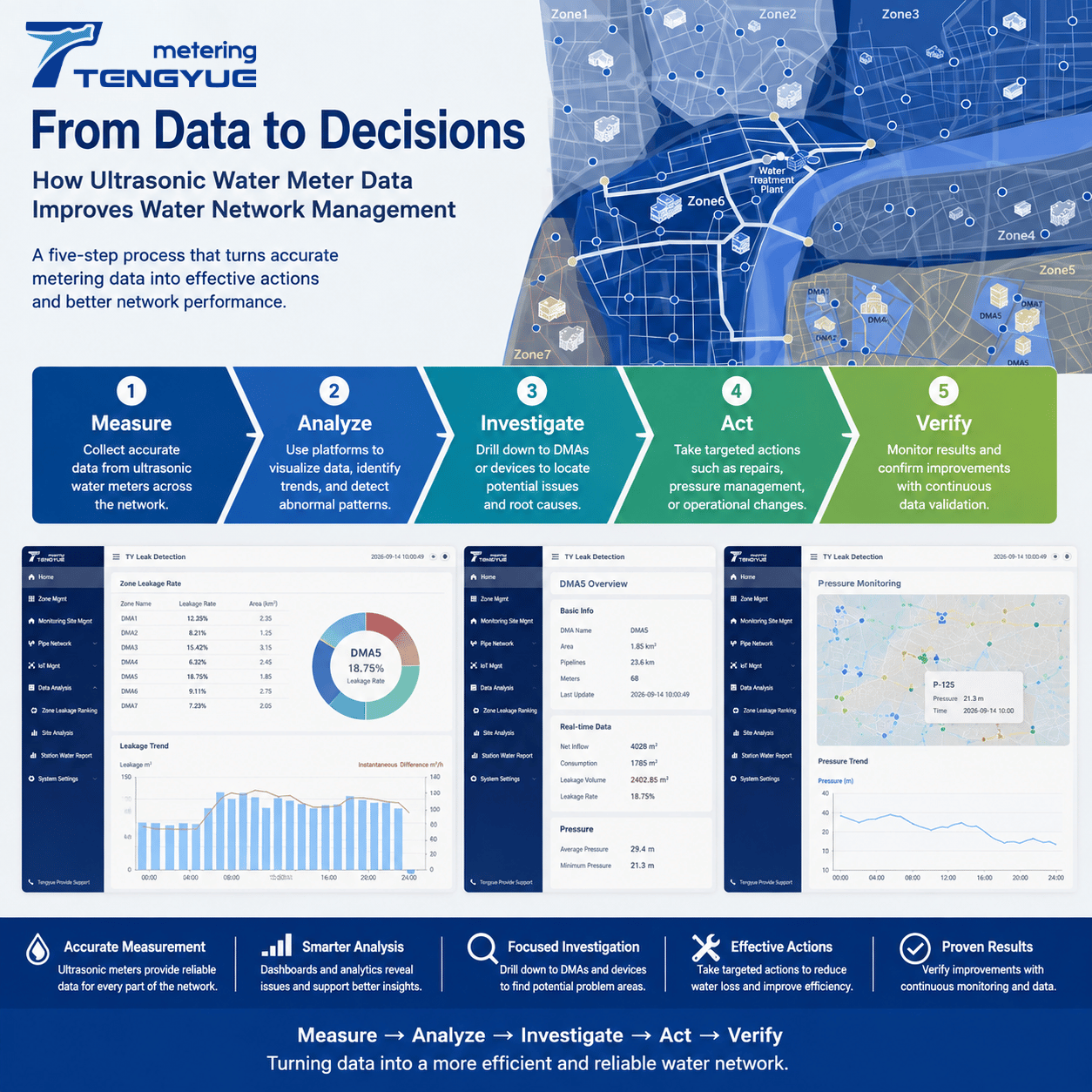
Data alone does not reduce water loss. Utilities need processes to review abnormal readings, investigate possible causes, arrange field inspections, and verify the results of corrective actions. For example, an unusual change in DMA inflow may trigger further analysis. Operators can then compare flow and pressure information, inspect the relevant network area, and determine whether maintenance is required.
This creates a practical cycle: Measure → Analyze → Investigate → Act → Verify. A data platform is useful only if this cycle has named owners, defined thresholds, and a recorded outcome.
Illustrative Scenario: From Meter Data to a Field Check
Consider a desensitized example. A DMA with about 1,200 connections has a 28-day nighttime baseline of 3.0 m³/h between 02:00 and 04:00. Over six consecutive nights, average flow rises to 4.2 m³/h—about a 40% increase—while pressure remains broadly stable. The DMA water balance also shows an unexplained difference of about 90 m³/day after known uses are reconciled.
The utility reviews ultrasonic meter data, pressure logs, and GIS asset information, then narrows the search area around a branch and valve. Field verification determines whether the cause is leakage, a valve issue, or an unrecorded night user. This example is illustrative and should not be read as a universal threshold.
Building a Practical Data Workflow
A practical workflow should define what data is collected, who reviews it, and what action follows. The following checklist can help utilities move from raw readings to operational decisions.
Confirm meter accuracy, range, and installation conditions for the intended application.
Verify meter-to-account and meter-to-asset mapping before relying on the data.
Define data validation rules for missing, duplicated, or delayed readings.
Set review intervals and thresholds for DMA inflow, water balance, and MNF trends.
Assign owners for alert review, field investigation, and corrective action.
Record the outcome and verify whether the action improved performance.
Ultrasonic water meter data can support more informed water network management when it is collected, organized, and interpreted effectively. From consumption visibility to DMA water balance and abnormal flow investigation, reliable measurement provides an important foundation for smarter utility operations.
Tengyue focuses on connecting accurate water measurement with smart metering and water management solutions, helping utilities make better use of their operational data.
Frequently Asked Questions About Ultrasonic Water Meter Data
What kind of data can an ultrasonic water meter provide?
Depending on the model and configuration, an ultrasonic water meter can provide cumulative consumption, flow-rate readings, reverse-flow indication, alarms, and diagnostic information such as non-full-pipe detection. The available fields should be confirmed for the exact model.
How does ultrasonic water meter data support DMA management?
DMA management uses inflow and consumption data to compare water entering a zone with accounted use. Ultrasonic bulk meters at DMA boundaries can provide 15-minute flow data for water balance and minimum night flow analysis, provided identifiers and time synchronization are correct.
Can meter data alone reduce water loss?
No. Data supports prioritization and investigation, but reducing water loss also requires field verification, repairs, pressure management, and follow-up. The value comes from the workflow that acts on the data.
How often should utilities review meter data?
Frequency depends on the application. Billing may use monthly cycles, while DMA water balance and MNF review often benefit from 15-minute data and a rolling 28-day comparison. Critical alerts may need daily review.
What data quality issues affect water network management?
Incorrect meter identifiers, missing or delayed readings, time synchronization errors, and incomplete billing data can all distort analysis. Validation rules and a named data owner help maintain reliability.
If you are planning to use ultrasonic water meter data for network management, Contacta con nuestros ingenieros to review data requirements, DMA monitoring, water balance, and operational workflows.