
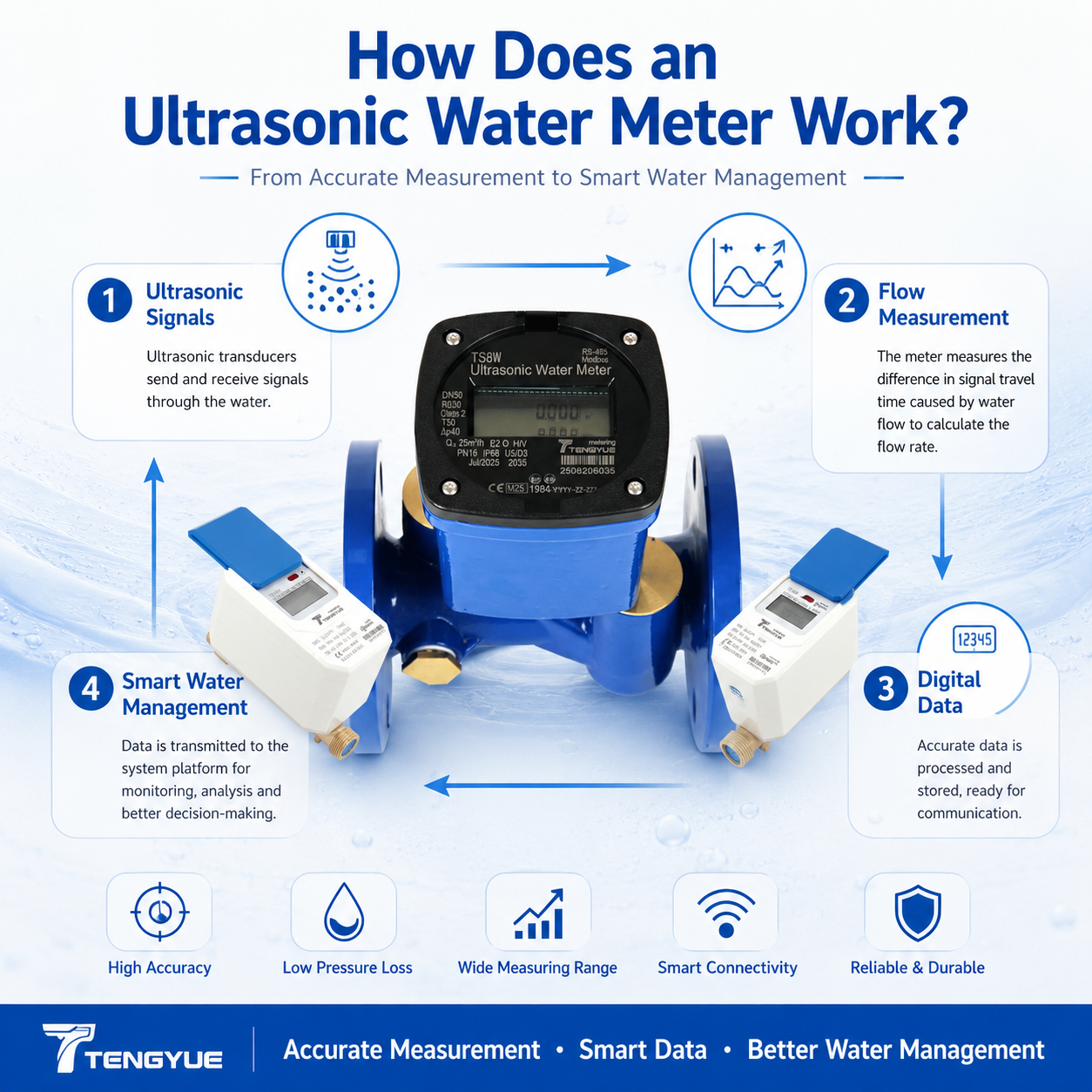
Water utilities, distributors, and system integrators are increasingly looking for more accurate and connected ways to measure water consumption. As water networks become more digital, the traditional water meter is evolving from a simple measuring device into an important source of operational data.
One technology receiving growing attention is the ultrasonic water meter.
But how does an ultrasonic water meter work, and why is it becoming an important part of modern water management?
What Is an Medidor de agua ultrasónico?
An ultrasonic water meter is a flow measurement device that uses ultrasonic signals to measure the velocity of water flowing through a pipe.
Unlike traditional mechanical water meters, ultrasonic meters do not need a rotating impeller or turbine to measure flow.
Instead, ultrasonic transducers send signals through the water. The meter analyzes the change in signal travel time caused by the movement of the water and uses this information to calculate flow.
The basic process can be simplified as:
Ultrasonic Signal → Flow Velocity → Flow Rate → Water Consumption
This electronic measurement principle makes ultrasonic technology suitable for a wide range of modern water metering applications.
How Does an Medidor de agua ultrasónico Work?
An ultrasonic water meter normally uses ultrasonic transducers installed within the meter body.
The transducers transmit and receive ultrasonic signals through the water.
When the water is flowing, the movement of the water affects the time required for the ultrasonic signal to travel between the transducers.
The meter analyzes this difference and calculates the water flow rate.
Because the measurement is electronic, the meter does not depend on mechanical components rotating inside the measuring tube.
Key Benefits of Medidores de agua ultrasónicos
1. No Mechanical Moving Parts
One of the main differences between ultrasonic and traditional mechanical meters is the measurement mechanism.
Mechanical meters use moving components. Ultrasonic meters use electronic measurement.
With fewer mechanical components involved in measurement, ultrasonic technology can provide a stable solution for long-term water metering applications.
2. Accurate Flow Measurement
Water utilities need reliable measurement across different operating conditions.
An ultrasonic water meter can provide accurate measurement across a wide range of flow rates, depending on the specific product design and metrological configuration.
This is particularly useful when a project requires both normal consumption measurement and visibility into lower flow conditions.
3. Low-Flow Measurement
Water consumption is not constant throughout the day.
Flow may be high during peak consumption periods and much lower during periods of low demand.
The ability to measure lower flow rates can provide additional information for water utilities, particularly when analyzing unusual consumption or potential leakage.
4. Low Pressure Loss
Because ultrasonic meters do not rely on a traditional mechanical impeller or turbine mechanism, they can be designed to create low resistance to water flow.
This can be valuable in water distribution systems where maintaining hydraulic efficiency is important.
5. Digital Data
Modern water management requires more than a meter reading.
Utilities increasingly need consumption data that can be transmitted, stored, and analyzed.
Depending on the product configuration, ultrasonic water meters can support communication technologies used in smart metering systems.
This allows the meter to become part of a larger digital water infrastructure.
Medidores de agua ultrasónicos and Smart Water Management
The role of the water meter is changing.
In a traditional system, a meter mainly answers one question:
How much water was consumed?
In a smart water management system, the meter can contribute to a much broader set of questions:
- When is water being consumed?
- Is consumption changing unexpectedly?
- Is there unusual flow during low-demand periods?
- How does consumption vary between areas?
- Can meter data support leakage analysis?
- Can data be integrated into an AMR or AMI platform?
This makes ultrasonic metering particularly relevant to the digital transformation of water utilities.
Where Are Ultrasonic Water Meters Used?
Ultrasonic technology can be applied across different water metering scenarios.
Typical applications include:
- Residential water metering
- Commercial buildings
- Industrial facilities
- Servicios de agua
- District metered areas
- Bulk water measurement
- Smart water metering
- AMR and AMI systems
- Water loss management
The appropriate meter configuration depends on factors such as pipe size, flow range, installation environment, communication requirements, and local regulatory requirements.
Medidor de agua ultrasónico vs. Traditional Mechanical Meter
The difference is not simply about replacing one type of meter with another.
Mechanical meters remain useful for many conventional applications.
However, ultrasonic technology becomes increasingly attractive when a project requires:
Accurate Measurement + Low-Flow Visibility + Digital Communication + Smart Data
This is particularly relevant to utilities that are moving toward remote meter reading, advanced metering, and data-driven water management.
From Measurement to Water Management
Accurate measurement is the foundation of effective water management.
Once reliable meter data is available, utilities can combine it with other information such as:
- Flow monitoring
- Pressure monitoring
- DMA data
- GIS
- Consumption patterns
- Minimum night flow
- Leakage analysis
The result is a transition from simply measuring water to understanding how water moves through the network.
An medidor de agua ultrasónico uses ultrasonic technology to measure water flow electronically rather than relying on traditional mechanical movement.
Its combination of measurement performance, low-flow visibility, digital capabilities, and compatibility with smart metering makes it an increasingly relevant technology for modern water management.
For water utilities, distributors, and system integrators, the value of ultrasonic metering is therefore not limited to the meter itself.
It can provide an important foundation for a more connected, measurable, and data-driven water network.