
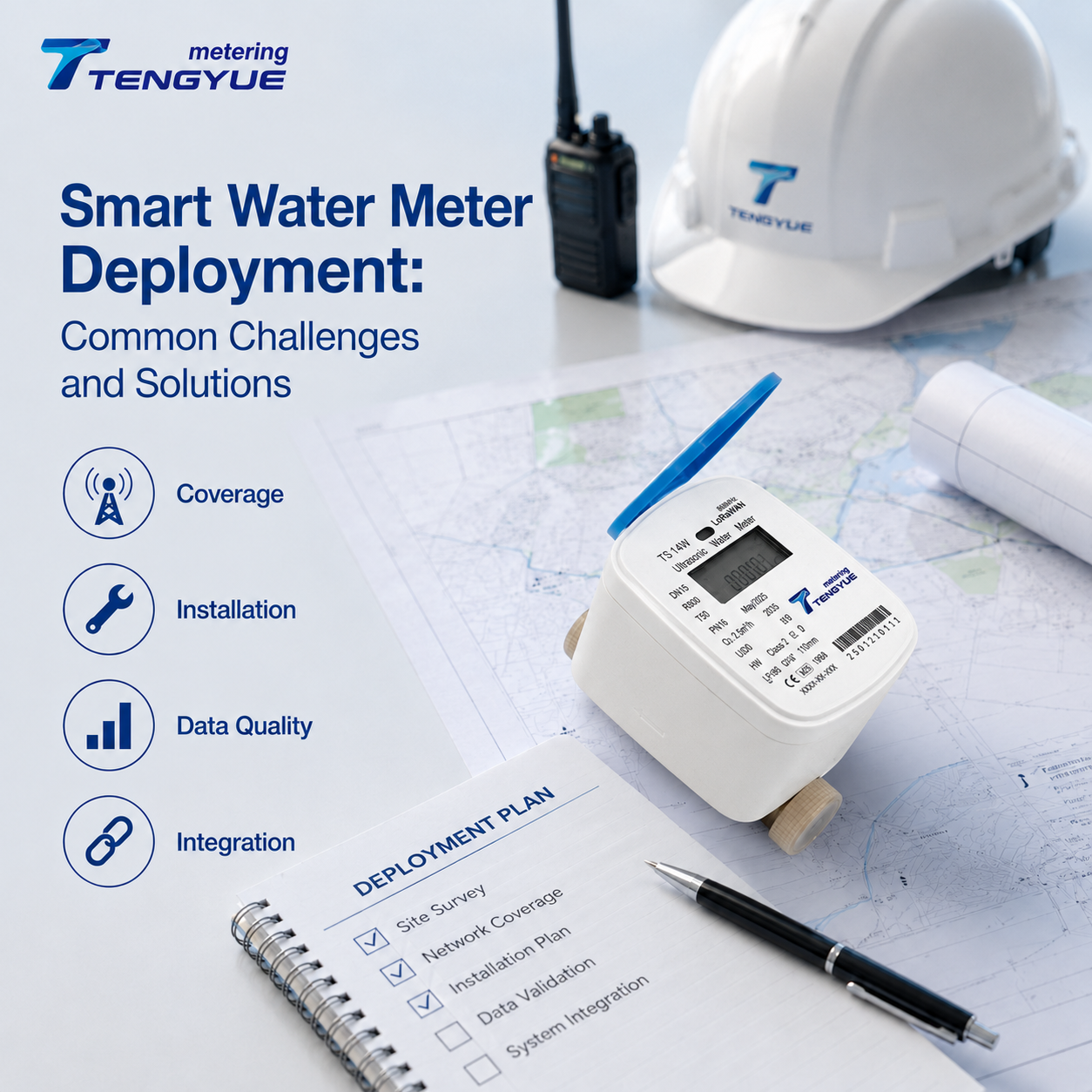
Smart water meter deployment involves more than replacing meters or installing communication devices. The project must also account for site conditions, network performance, data handling, system integration, and the people responsible for operating the solution. Identifying these issues early can help utilities plan a more reliable rollout.
A smart water meter deployment is a system project, not a hardware purchase. Meters, communication infrastructure, data platforms, and utility workflows must work together. When one layer is planned in isolation, problems often appear after installation—when they are more expensive to fix. This guide covers the most common challenges and practical ways to prepare for them.
Why Smart Water Meter Deployment Challenges Matter
Smart metering projects often fail for operational reasons rather than device reasons. A meter may meet ISO 4064 accuracy requirements and still produce unreliable operational data if identifiers are wrong, communication coverage is uneven, or the receiving platform is not ready.
ISO 55000 asset management principles support aligning asset information with risk-based decisions. For a deployment, that means defining what data each team needs, who owns each record, and how success will be measured before procurement. IEC 62056 / DLMS-COSEM is common in smart metering communication, but standards alone do not guarantee site performance. Representative testing is still required.
The challenges below are not unusual exceptions. They are predictable risks that a structured deployment plan should address.
Challenge 1: Communication Coverage and Site Conditions
Wireless coverage can vary between locations because of building materials, underground installations, terrain, network availability, and other site conditions. A communication option that works well at one location may not perform the same way elsewhere.
How to prepare: Confirm the communication technology and regional requirements, then test representative sites. Include difficult locations in the pilot instead of evaluating only the easiest installations. For a fixed-network deployment, test chamber installations, basement meter rooms, and sites with metal covers. For a drive-by or hybrid approach, test the actual reading routes and timing.
A useful pilot should include at least 10–20 difficult sites, not only convenient ones. If coverage fails in a basement meter room, the project team needs to know before ordering thousands of units.
Challenge 2: Installation Conditions and Data Quality
Existing pipework, available space, mounting orientation, water conditions, and environmental exposure can affect installation. Unexpected site conditions may create delays or require changes to the original plan.
How to prepare: Conduct a site survey, review the product manual, confirm the required fittings and installation orientation, and document any constraints before work begins. For ultrasonic meters, straight-pipe requirements, upstream and downstream conditions, and protection rating should be checked against the actual chamber. A meter rated IP68 may still require correct sealing and cable handling.
Data quality is often overlooked at the same time. A system may receive readings but still provide incomplete or inconsistent information. Incorrect meter identifiers, mismatched time periods, missing readings, or inconsistent customer records can affect subsequent analysis.
How to prepare: Define data validation rules and assign responsibility for correcting records. Test the relationship between meter identifiers, customer accounts, and network assets before scaling up. A 15-minute reading interval is useful for DMA water balance and minimum night flow review, but only if time synchronization and identifier mapping are correct.
| Challenge | Typical symptom | Preparation action |
|---|---|---|
| Uneven communication coverage | Missing readings at specific sites | Test difficult sites in the pilot |
| Installation constraints | Delays or rework | Site survey and manual review before work |
| Incorrect meter identifiers | Data matched to wrong account or asset | Master identifier scheme and mapping test |
| Missing or delayed readings | Gaps in trend analysis | Validation rules and exception process |
| Unclear data ownership | Records not maintained | Assign system owner per data field |
Challenge 3: Integration, Responsibilities, and Acceptance Criteria
Utilities may need meter data to support billing, customer service, GIS, maintenance, or water-loss analysis. If these requirements are considered only after equipment has been installed, additional work may be necessary.
How to prepare: Document the required data, interfaces, system owners, and acceptance criteria before procurement. Involve the relevant IT and operational teams during solution design. Ask which system is the master record for meter ID, customer account, and asset location. If DMA water balance or GIS leak localization is a goal, define those workflows early rather than after the data platform is live.
Responsibilities can also become unclear. Meter installers, communication providers, system integrators, suppliers, and utility staff may have different roles. If those responsibilities are unclear, issues can be passed between teams without a clear owner.
How to prepare: Establish a responsibility matrix covering installation, commissioning, network testing, data validation, troubleshooting, and final acceptance.
Success criteria are often too vague. A project may be described as successful simply because meters have been installed. But installation completion does not necessarily mean the data is reliable or that the intended operational workflow is working.
How to prepare: Define measurable acceptance criteria, such as reading completeness, communication performance, correct data mapping, alarm handling, and successful integration tests.
How a Pilot Reduces Smart Water Meter Deployment Risk
A pilot allows a utility to test the complete solution under representative operating conditions. It can help identify coverage gaps, installation issues, data inconsistencies, and integration requirements before they affect a larger deployment. The pilot should include clear objectives, test cases, responsible teams, and a process for recording and resolving issues.
Illustrative Scenario: A 28-Day Pilot Before Scaling Up
Consider a desensitized example. A utility plans to deploy about 1,000 smart meters and several DMA boundary bulk meters. The pilot covers 60 meters, including 15 difficult sites such as basement meter rooms and chambers with metal covers. The pilot runs for 28 days with 15-minute reading intervals.
Success criteria include data availability of at least 98%, correct meter-to-account and meter-to-asset mapping, communication performance at difficult sites, and a documented exception process for missing or delayed readings. If the criteria are met, the utility scales up; if not, the team fixes coverage, installation, or mapping issues first. This example is illustrative and should not be read as a universal specification.
Treat deployment as a complete system. Tengyue Metering’s smart metering approach includes ultrasonic meters and communication and analytics components. The exact deployment plan should be developed around the selected models, the utility’s existing infrastructure, and the project’s operational requirements. A well-planned rollout does not assume every site will be the same. It tests the critical details before scaling up.
Frequently Asked Questions About Smart Water Meter Deployment
What is the biggest challenge in smart water meter deployment?
There is no single biggest challenge, but communication coverage, data quality, and unclear system ownership are common. Projects often struggle when hardware is planned without representative site testing and defined operational workflows.
How should utilities test communication coverage before rollout?
Test representative and difficult sites, including basements, chambers, and metal-covered meter boxes. Include actual reading routes for mobile or hybrid approaches and define a minimum success rate before scaling up.
Why is data quality a deployment issue rather than an IT issue?
Because incorrect identifiers, missing readings, or mismatched periods make operational analysis unreliable. Data quality should be tested during the pilot and assigned to a named owner, not left until after go-live.
What acceptance criteria should a smart metering project use?
Use measurable criteria such as reading completeness, communication performance at difficult sites, correct meter-to-account and meter-to-asset mapping, alarm handling, and successful integration tests.
How long should a smart water meter pilot run?
A pilot should cover normal demand variation and exception cases. A 28-day period with 15-minute intervals is often useful for trend comparison, but the duration should match project risk and deployment size.
If you are planning a smart water meter deployment, contact our engineers to review site testing, data mapping, integration requirements, and pilot acceptance criteria for your utility.