A water meter has traditionally had one primary job: measure how much water passes through a pipeline.
But water management is becoming increasingly data-driven.
For utilities, property managers, and commercial water operators, knowing the total consumption is useful. Knowing when water is being consumed, how flow conditions are changing, and whether unusual conditions are occurring can provide much more value.
This is why the role of the modern smart water meter is changing.
Instead of being only a measurement instrument, an ultrasonic water meter can become a connected data point within a broader water management system.
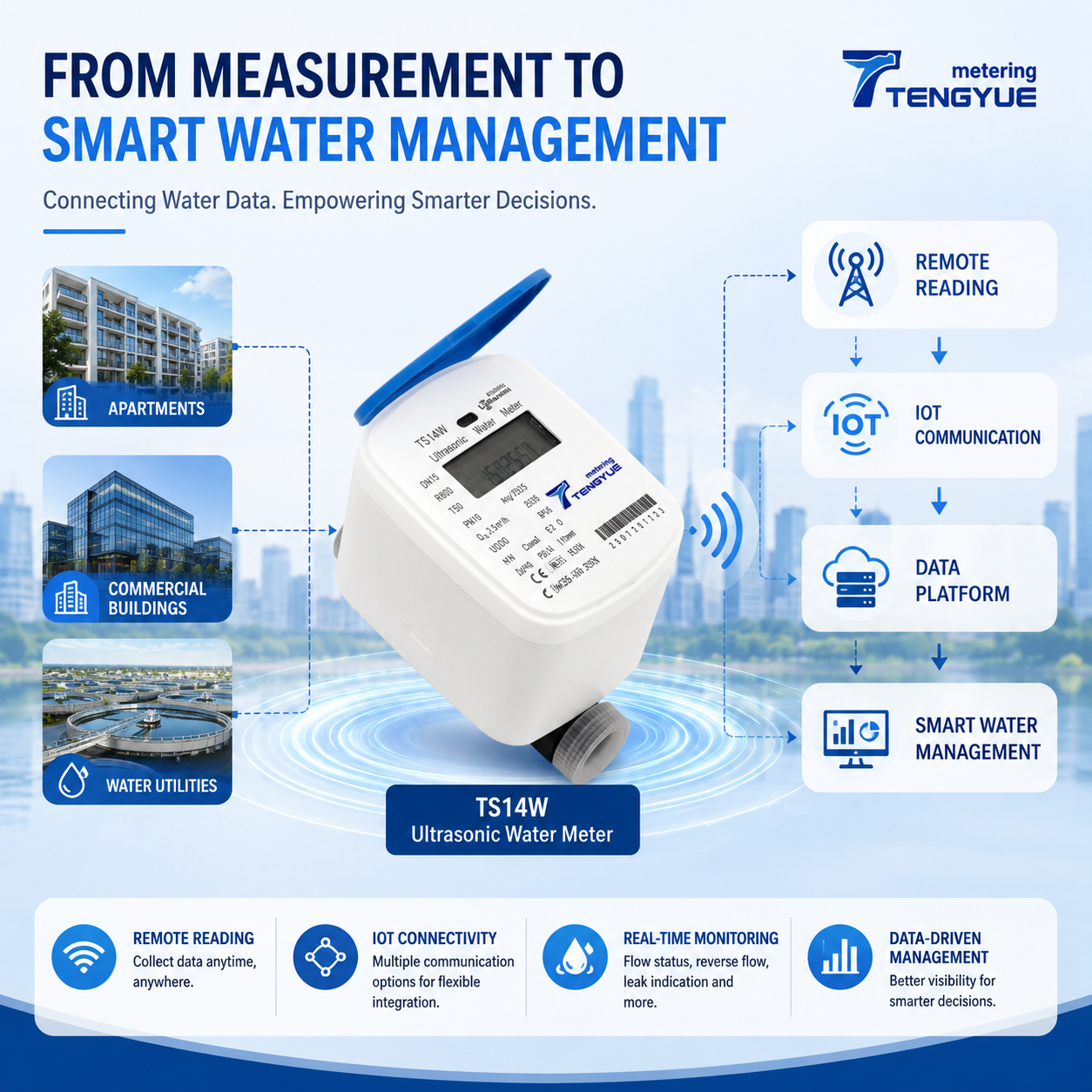
The Tengyue Medidor de agua ultrasónico TS14W is designed around this concept, combining ultrasonic measurement with monitoring functions and remote communication options.
A Smart Water Meter Starts with Reliable Measurement
Connectivity cannot compensate for unreliable measurement.
The first requirement is still accurate and consistent water measurement.
El TS14W uses the ultrasonic time-difference method to continuously measure, record, and display water volume. Its measuring mechanism has no moving parts, and the meter supports Accuracy Class 2.
El TS14W supports R250, R400, R630, and R800 measurement grades depending on configuration. It is available in DN15, DN20, DN25, DN32, and DN40 models.
This gives project customers different options when matching the meter to the actual application.
But measurement is only the first step.
What Changes When Meter Data Becomes Connected?
Consider a conventional meter installed in an apartment.
A user can read the accumulated consumption from the LCD.
Now consider a connected meter.
The same measurement data can potentially be transmitted remotely, allowing the relevant management system to collect information without requiring the operator to visit every meter.
El TS14W supports wired remote reading through RS-485 Modbus, M-Bus, and pulse, while its wireless specifications include LoRaWAN.
This creates the foundation for remote data collection, depending on the selected communication configuration and system architecture.
For utilities and property managers, this can change how consumption information is collected and managed.
From Manual Reading to Remote Reading
Manual meter reading can require repeated visits, particularly when a project contains a large number of customer meters.
Remote reading provides another approach.
With an appropriate communication network and management platform, meter data can be collected remotely and transferred into a centralized system.
For example, a connected water metering system can support:
Meter → Communication Network → Data Platform → Analysis → Management
El TS14W can serve as the measurement and data collection point at the beginning of this process.
The actual system architecture will depend on the selected communication technology, network environment, and third-party platform integration. The TS14W manual also notes that actual field performance can vary depending on site conditions, network topology, and third-party integration.
More Data Can Mean Better Visibility
A connected water meter can provide more than a monthly consumption number.
El TS14W LCD functionality includes water flow indication, positive and reverse flow status, drip/leak indication, water temperature, battery voltage, fault alarm, and signal strength.
This information can help users understand the operating status of the meter.
Apartment buildings are a good example of why connected water metering can be useful.
A property may contain dozens or hundreds of individual consumption points. Collecting meter readings manually can become time-consuming.
A connected smart water meter can provide a path toward centralized data collection.
Con TS14W, project customers can select different meter sizes and communication configurations according to their requirements.
The meter also supports vertical, horizontal, or inclined installation and has an IP68 protection rating.
This gives project designers additional flexibility when considering meter installation.
Commercial Buildings Need Visibility Too
Commercial properties can have different consumption patterns depending on operating hours, occupancy, equipment, and business activities.
A connected water meter can help operators move from occasional meter reading toward more continuous visibility.
For example, consumption data can be collected and analyzed to understand usage patterns and identify changes that may require investigation.
El TS14W’s remote communication capabilities and flow-related monitoring functions can provide useful data for this type of application.
Again, the meter itself does not replace a complete water analytics platform. Its role is to provide reliable measurement and relevant field data that can be used by the wider management system.
Supporting Modern Utility Operations
For water utilities, connected meters can also form part of a larger digital water strategy.
Customer-side metering can provide consumption information across different areas of a service network. When combined with other data sources, this information can support broader analysis.
Tengyue’s current smart water positioning extends beyond individual meters toward AMI and leak detection solutions, reflecting a broader approach to connecting metering data with water management.
This is important because a smart water meter should not be viewed in isolation.
Its real value increases when reliable measurement can become usable data.
For Tengyue, the goal is not simply to provide a meter that measures water.
It is to help customers build a more connected approach to water management.
Looking for a smarter water metering solution? Talk to Tengyue to explore how TS14W can support your project.