
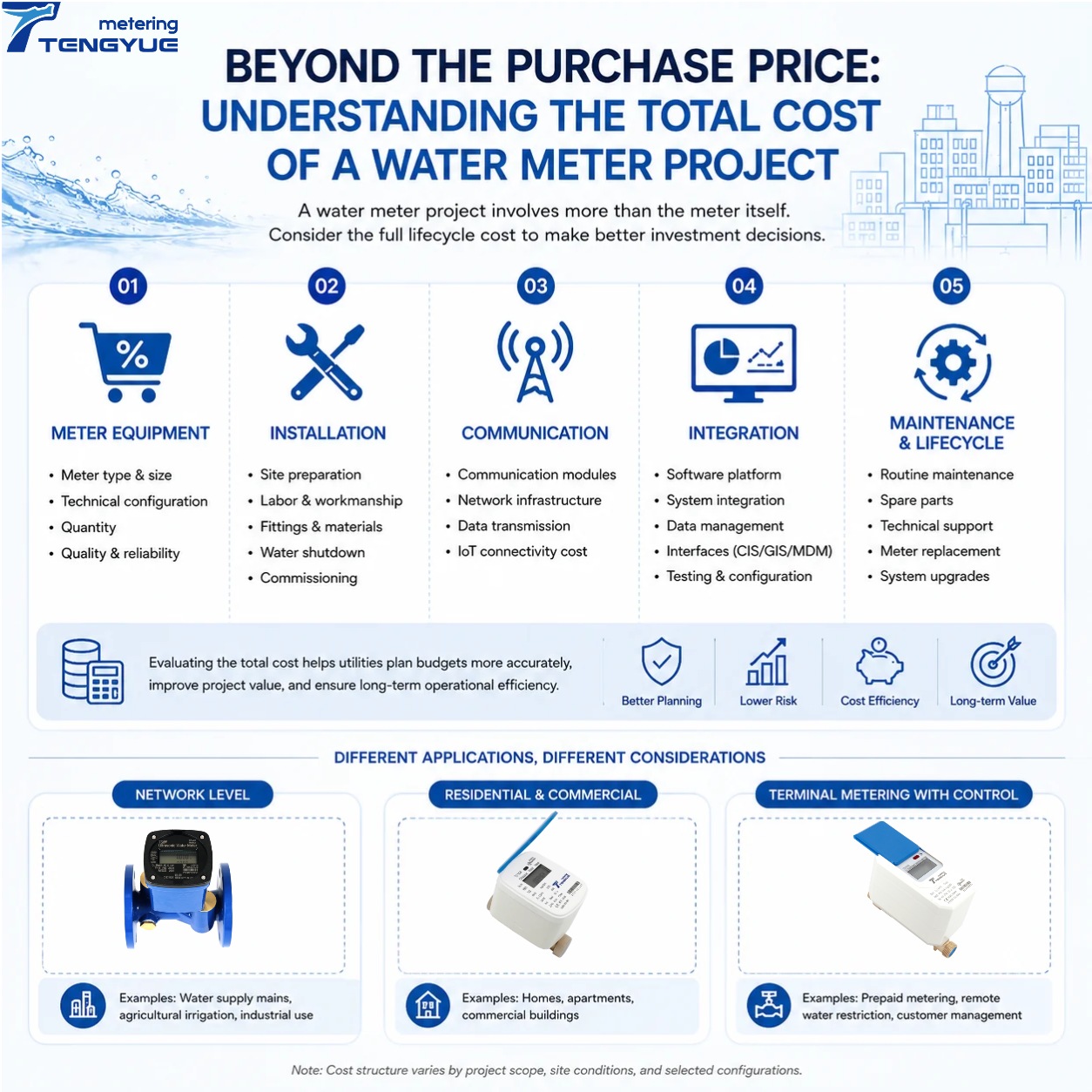
Water meter project cost is not the same as the lowest unit price in a quotation. When evaluating a water meter project, purchase price is often one of the first figures that procurement teams compare. However, the lowest unit price does not necessarily represent the lowest project cost. A water metering project may involve equipment, installation, communication infrastructure, system integration, commissioning, maintenance, and future replacement planning. If these factors are not considered early, the initial quotation may provide an incomplete picture of the investment required.
For water utilities, contractors, and distributors, a better approach is to evaluate the total project cost across the entire deployment process. This guide sets out six cost categories and the questions that should be answered before comparing supplier quotations.
Why Water Meter Project Cost Needs a Total View
A meter that is cheap to buy but expensive to install, integrate, or maintain can cost more over its service life than a higher-priced alternative. ISO 55000 asset management principles support evaluating assets over their lifecycle rather than by purchase price alone. ISO 4064 and OIML R49 provide frameworks for meter accuracy and testing, but they do not capture installation, communication, or integration costs.
A useful principle is: compare equivalent scopes, not equivalent product names. Two suppliers may quote different configurations even when the product names appear similar. A clear technical schedule helps procurement teams compare like with like.
The total-cost view also matters for water-loss projects. A bulk meter that cannot resolve low nighttime flow may save money at purchase but weaken DMA water balance and minimum night flow analysis.
Start with the Actual Project Scope and Meter Selection
Before comparing prices, define what the project needs to achieve. A project involving several large-caliber network meters will have a different cost structure from a residential metering program. Similarly, a project that requires remote reading or valve-control functionality may involve additional equipment, configuration, and system work.
The project scope should clarify the number of metering points, meter sizes and application types, required technical configurations, installation conditions, reading and communication requirements, existing system compatibility, commissioning and documentation requirements, and expected maintenance arrangements. Without this information, product quotations may not be directly comparable.
Different metering locations require different product types. The عداد المياه بالموجات فوق الصوتية TS8W is designed for large-caliber measurement, including water supply mains, agricultural irrigation, and industrial water use. Its selection may involve considerations such as nominal diameter, flange connection, pressure conditions, flow range, and communication configuration.
ال عداد المياه بالموجات فوق الصوتية TS14W is intended for small-diameter residential and commercial applications. Its cost evaluation should consider the required diameter, performance configuration, connection arrangement, and reading method. The عداد المياه بالموجات فوق الصوتية TS11FW includes a built-in ball valve for remote water restriction. When a project requires this functionality, procurement teams should evaluate both the metering requirement and the operational requirements associated with valve control.
These three products should not be compared as if they were interchangeable. The correct comparison is between products that meet the same application requirements.
Include Installation, Communication, and Integration Costs
Installation can represent a significant part of a water meter project. The cost depends on the physical conditions at each location. For network-level meters, installation may require work on larger pipelines, flange connections, supporting structures, or access arrangements. For residential and commercial meters, the main considerations may include meter location, connection compatibility, available space, and access to individual premises. For valve-controlled meters, additional operational checks may be needed to verify that the valve function works according to the approved project procedure.
A smart water meter project may also require more than the meter itself. Depending on the chosen architecture, the project may involve communication modules, gateways, network services, data collection equipment, software configuration, and integration work. The communication arrangement should be selected according to the project’s actual conditions. For example, a utility may choose a fixed communication network, mobile reading, or a hybrid approach. The most appropriate option depends on coverage, reading frequency, installation density, infrastructure availability, and operating requirements.
In a larger deployment, meter readings may need to connect with existing utility systems. These may include customer information systems, billing platforms, GIS, meter data management systems, or operational dashboards. The integration scope should be defined before procurement. Project teams should ask which data fields need to be collected, how meter identities will be matched to customer or asset records, which system will receive the data, whether existing interfaces are available, who is responsible for configuration and testing, and what documentation will be provided.
| Cost category | What to evaluate | Common hidden cost |
|---|---|---|
| Meter equipment | Model, size, configuration, quantity | Upgrading a lower-spec model later |
| تثبيت | Labor, fittings, site preparation | Pipe or flange modifications |
| Communication | Modules, gateways, network services | Coverage gaps requiring extra equipment |
| Integration | Software configuration, interfaces, testing | Identifier mapping and exception handling |
| Commissioning | Inspection, reading verification, documentation | Revisiting meters that fail checks |
| Maintenance and lifecycle | Support, spare parts, troubleshooting, replacement | Inconsistent asset records slowing repairs |
The table is a general guide. Actual cost structure depends on the project scope, site conditions, and selected configuration.
Evaluate Communication, Data Platform, and Integration Scope
Solutions such as TY WaterOne AMI combine smart metering devices, communication infrastructure, and analytics software. Its solution documentation also describes integration with systems such as CIS, GIS, and MDM through supported interfaces. For a project owner, the important question is how the proposed solution fits the existing operational environment. Integration work should be included in the project scope rather than treated as an afterthought.
The TS8W and TS11FW manuals describe multiple wired and wireless reading options, depending on configuration. The TS14W communication option should be confirmed for the exact model and version being quoted. It is important not to assume that every model supports every protocol.
IEC 62056 / DLMS-COSEM is common in smart metering communication. A project cost comparison should clearly list supported meter communication configuration, required network infrastructure, data collection method, platform or software requirements, integration scope, and ongoing communication service costs where applicable. This helps prevent a low initial meter price from hiding additional costs elsewhere in the project.
Look at Maintenance, Lifecycle, and Operational Preparation
A water meter is an operational asset, not simply a purchased component. Project teams should consider the maintenance arrangements that will be needed after installation. Important factors include availability of replacement units, spare-part planning, technical support, communication troubleshooting, installation and configuration records, maintenance responsibilities, and expected service-life requirements.
ال TS8W, TS14W، و TS11FW have different application roles. Their maintenance and replacement records should therefore be organized according to the relevant model and installation environment. For a large fleet, consistent asset records can reduce the time needed to identify a meter and understand its history. Lifecycle planning should also consider whether the utility has the technical resources to manage the selected communication and software architecture.
Illustrative Scenario: Comparing Two Quotations for a Mixed Project
Consider a desensitized example. A utility plans a project with 6 DN200 bulk meters, about 950 residential and commercial meters, and 40 terminal points with valve control. Supplier A quotes a lower unit price for the bulk meters but requires additional gateways and integration work. Supplier B quotes a higher unit price but includes commissioning, identifier mapping, and a documented integration scope.
The total-cost comparison includes meter equipment, installation, communication, integration, commissioning, maintenance, and lifecycle planning. Supplier A’s lower unit price is offset by additional communication and integration costs. Supplier B’s quotation is higher at purchase but covers more of the project scope. The utility chooses based on the full scope, not the unit price alone. This example is illustrative and should not be read as a universal comparison.
Compare Total Cost, Not Just Unit Price
A useful way to evaluate a water meter project is to divide costs into several categories: meter equipment, installation, communication, integration, commissioning, maintenance, and future planning. The exact cost structure will vary by project. A residential deployment may have a high number of individual installation points. A network-level project may involve fewer meters but more complex installation work. A valve-controlled application may require additional operational planning. The purpose of a total-cost assessment is to make these differences visible.
A suitable water meter project should balance technical requirements, operational needs, and budget. Selecting a product that is unnecessarily complex can increase costs. Selecting a product that does not meet the actual application requirements can create additional work and replacement expenses later. The best procurement process starts with the application, confirms the technical configuration, and then compares the full project scope.
Tengyue Metering offers different ultrasonic water metering options for large-caliber, residential and commercial, and valve-controlled applications. By evaluating TS8W, TS14W، و TS11FW according to their intended roles, project teams can build a more realistic cost assessment. The appropriate configuration should be confirmed against the project’s technical requirements.