
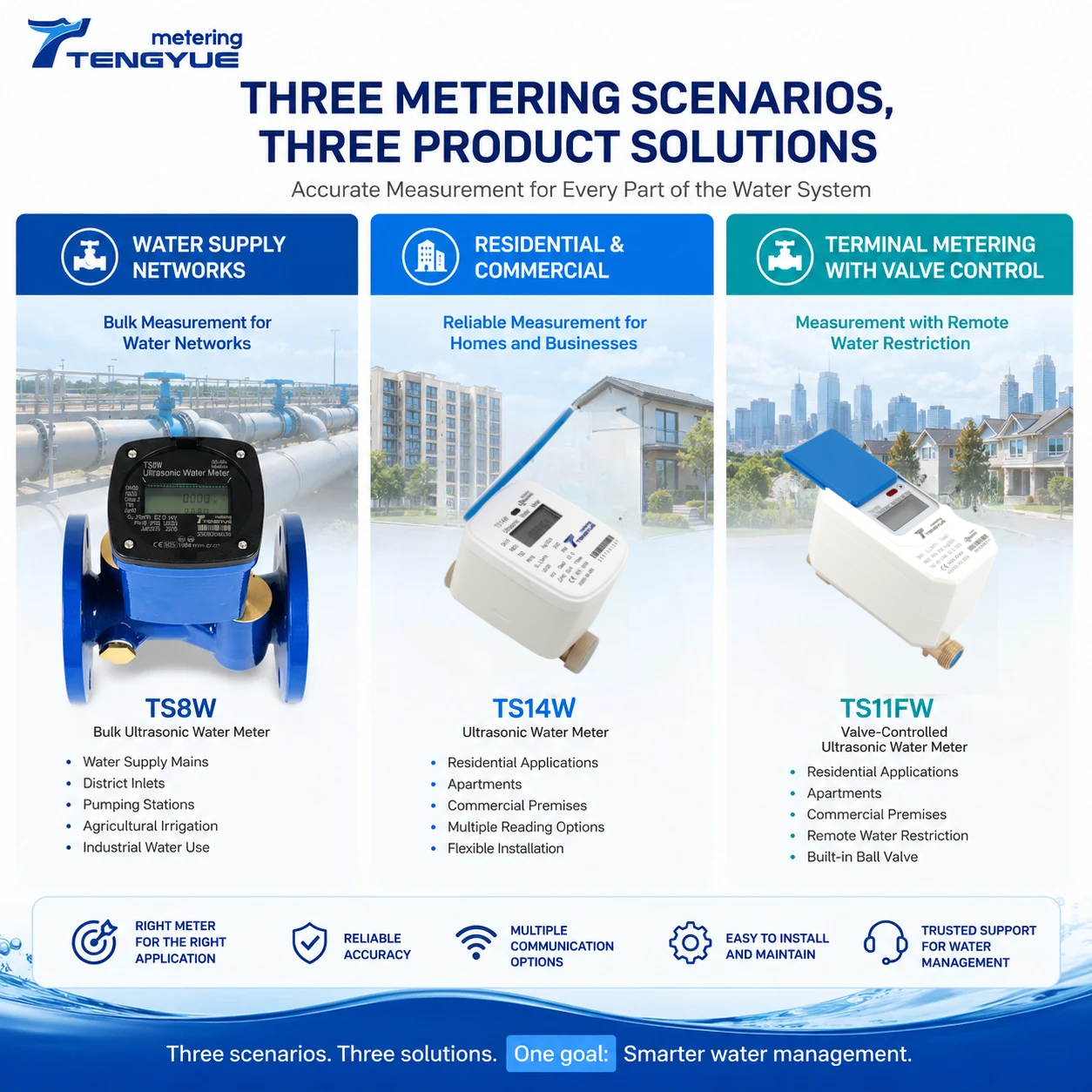
Water meter applications rarely involve just one type of measurement point. A municipal water network may require large-diameter meters at supply inlets, smaller meters for residential and commercial consumption, and additional control capabilities at selected customer connections. Agricultural and industrial applications introduce further differences in flow requirements, installation conditions, and operational priorities.
This is why choosing a water meter should begin with understanding the application rather than selecting a product based on a single specification. For utilities, distributors, and project contractors, a practical approach is to divide metering requirements into three broad scenarios: network-level measurement, residential and commercial metering, and terminal metering with valve-control functionality. The goal is to match each meter to its actual role.
Why Water Meter Applications Should Drive Product Selection
A common procurement mistake is to compare meters by nominal diameter or price alone. Two DN200 meters may have different Q3/Q1 range ratios, accuracy classes, pressure-loss characteristics, and communication options. A meter that suits a supply main may be a poor fit for a residential connection, and vice versa.
ISO 4064 and OIML R49 provide widely used frameworks for water meter requirements and testing. ISO 55000 asset management principles support risk-based decisions about critical assets. For a mixed utility project, the practical question is not “Which meter is best?” but “Which meter configuration matches this application’s flow range, installation conditions, and data requirements?”
A useful planning sequence is: define the application; record the operating envelope; confirm the required data and communication; then compare exact model configurations. The three scenarios below follow that sequence.
| Scenario | Typical location | Main requirement | Product to evaluate |
|---|---|---|---|
| Network-level measurement | Supply mains, district inlets, pumping facilities | Large-diameter flow measurement and diagnostics | TS8W |
| Residential and commercial | Households, apartments, offices, commercial premises | Small-diameter consumption measurement | TS14W |
| Terminal metering with valve control | Selected customer connections with control needs | Measurement plus remote valve control | TS11FW |
The table is a general guide, not a product specification. Actual selection depends on the exact model, size, and configuration.
Scenario 1: Water Supply Networks and Network-Level Measurement
Water supply networks need reliable measurement at important points throughout the distribution system. These points may include water supply mains, district inlets, pumping facilities, and other locations where operators need to understand how much water enters or moves through a particular section of the network.
For these applications, the meter must be selected according to the pipeline diameter, expected flow range, pressure conditions, and installation environment. The عداد المياه بالموجات فوق الصوتية TS8W is designed for large-caliber water measurement. Its product manual describes transit-time ultrasonic measurement and applications including water supply mains, agricultural irrigation, and industrial water use.
ال TS8W has no moving parts in its measuring mechanism. It also supports reverse-flow detection and non-full-pipe detection, according to the product manual. Depending on the selected configuration, remote meter reading can be supported through wired or wireless communication options. These characteristics make it relevant to projects where utilities need to monitor water movement at important network locations.
However, the meter itself is only one part of network management. Its readings become more valuable when combined with network information, consumption records, and operational analysis. For example, a utility may use inlet meter data to compare the volume entering a district with the authorized consumption recorded within that area. This comparison can support further investigation when unusual differences appear.
Important selection questions include: What is the nominal pipeline diameter? What are the expected minimum, normal, and peak flow rates? What pressure and environmental conditions apply? What installation arrangement is available? Which communication method is compatible with the existing system? A suitable bulk meter should match the actual operating conditions rather than simply having the largest possible measurement range.
Scenario 2: Residential and Commercial Water Meter Applications
Residential and commercial metering has a different set of priorities. A household, apartment building, office, or commercial property generally requires measurement at a smaller connection point. Installation space, consumption patterns, reading arrangements, and billing requirements all influence the selection.
ال عداد المياه بالموجات فوق الصوتية TS14W is positioned for small-diameter applications. It can be considered for residential and commercial metering projects where the required meter size and configuration match the installation. When selecting a small-diameter meter, project teams should pay attention to more than nominal diameter.
The actual flow profile matters. A meter should be evaluated against the expected consumption range, including periods of low demand and higher usage. The required range ratio, pressure rating, temperature class, and installation conditions should also be checked against the relevant model configuration.
For multi-unit buildings, another important consideration is how meter readings will be collected. Manual reading may be sufficient for some small installations. Larger projects, however, may benefit from a planned remote-reading arrangement that reduces repeated site visits and makes consumption information easier to organize. The communication option should be selected according to local network availability, reading frequency, system compatibility, and project budget. It should not be assumed that every meter configuration supports every communication protocol.
A well-planned residential or commercial metering project therefore considers both the individual meter and the wider reading process. IEC 62056 / DLMS-COSEM is common in smart metering communication; the exact module and protocol should be confirmed in writing for the quoted configuration.
Scenario 3: Terminal Metering with Valve Control
Some metering projects require more than consumption measurement. For prepaid applications, selected customer-management programs, or installations where water supply control is part of the operating model, the ability to manage a valve may also be important.
ال عداد المياه بالموجات فوق الصوتية TS11FW is a valve-control model. According to its product manual, it incorporates a built-in ball valve that allows remote water restriction. The manual also describes ultrasonic transit-time measurement, reverse-flow detection, non-full-pipe detection, and remote meter reading through supported wired or wireless configurations. This makes the TS11FW relevant to applications where measurement and valve-control functionality need to be considered together.
Before selecting a valve-controlled meter, project teams should define the operating policy clearly. For example: Under what conditions can water restriction be initiated? Who is authorized to issue a control command? How will valve status be checked? What procedures apply when communication is interrupted? What customer-service process is required before and after a control action?
These questions are important because remote valve functionality should operate within a clearly defined management process. A meter with a built-in valve does not automatically define the utility’s service policy. The project owner still needs to establish authorization, communication, customer notification, and exception-handling procedures.
One Project May Need More Than One Water Meter Application
A common mistake in water metering projects is assuming that one product can meet every measurement requirement. In reality, different locations within the same project may have different operating conditions. A municipal network may use a عداد المياه بالموجات فوق الصوتية TS8W at a larger supply point, TS14W meters for residential or commercial connections, and TS11FW meters at selected terminal points where valve-control functionality is required.
This does not mean that every project needs all three models. The appropriate combination depends on the project scope, pipeline sizes, operating requirements, and budget. The goal is to match each meter to its actual role.
Illustrative Scenario: Matching Meters to a Mixed Municipal Project
Consider a desensitized example. A utility plans a project with 6 DN200 supply inlets, about 1,200 residential and commercial connections, and 40 selected terminal points requiring remote valve control. The supply inlets need 15-minute flow data for DMA water balance; the residential meters need daily readings; the terminal points need valve status monitoring and an authorized control process.
The evaluation compares the TS8W for bulk measurement, the TS14W for small-diameter connections, and the TS11FW for valve-control points on Q3/Q1 range ratio, accuracy class, pressure loss, protection rating, communication protocol, and local support. A 28-day pilot tests data completeness and valve-control procedures before full procurement. This example is illustrative and should not be read as a product specification for every project.
Think in Terms of a Complete Metering Portfolio
For water utilities and distributors, product selection is not only about one project. A distributor may serve several customer types, while a utility may operate different metering environments across its service area. A well-organized product portfolio makes it easier to address these different requirements.
The most useful approach is to define the application first, confirm the technical requirements, and then match the appropriate meter configuration. Tengyue Metering provides ultrasonic water metering options for different application levels, from large-caliber network measurement to small-diameter and valve-controlled terminal metering. The appropriate model and configuration should be confirmed against the project’s technical requirements.
The key is not to use one meter everywhere. It is to build a metering solution that reflects how water is supplied, measured, and managed throughout the project.