
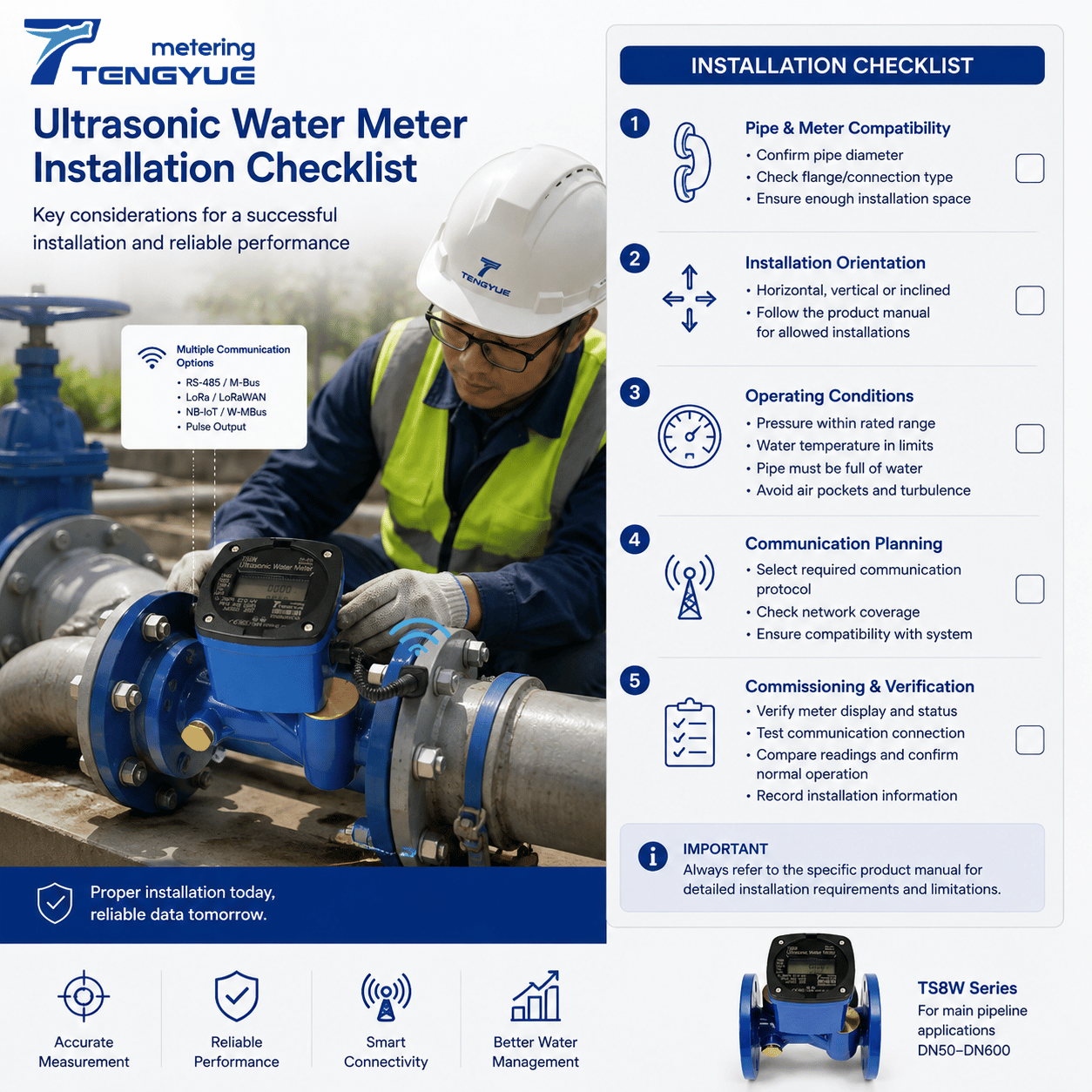
Ultrasonic water meter installation is more than placing a meter into a pipeline. Selecting the right water meter is only the first step in a successful metering project. Installation conditions can affect the performance, reliability, and long-term operation of a water measurement system. For water utilities, proper installation planning helps reduce avoidable problems and supports more reliable data collection.
A practical checklist covers pipe compatibility, installation orientation, operating conditions, communication planning, and commissioning. Each item should be verified before work begins, not after the meter is in the ground. This guide sets out the key considerations and the questions utilities should answer before installation.
Why Ultrasonic Water Meter Installation Planning Matters
Poor installation can create measurement problems that look like meter faults. A meter installed with insufficient straight pipe, entrained air, or a distorted flow profile may produce unstable readings even if the meter itself meets ISO 4064 accuracy requirements. A meter installed in a wet chamber without appropriate protection may fail prematurely.
OIML R49 and ISO 4064 provide widely used frameworks for water meter requirements and testing, but field conditions rarely match laboratory conditions exactly. Installation planning is the bridge between the meter’s specified performance and the actual operating environment. It also affects the utility’s ability to use the data for billing, DMA water balance, and minimum night flow analysis.
Confirm Pipe Size, Meter Compatibility, and Installation Orientation
The meter’s nominal diameter and connection type must match the pipeline and project design. Before installation, check the nominal pipe diameter, connection and flange specifications, available installation space, pipeline layout, and required maintenance access. A suitable meter should be selected according to the actual pipeline and expected flow conditions.
Installation orientation is another important consideration. Some ultrasonic water meters support horizontal, vertical, or inclined installation. However, the permitted orientations and installation conditions must be confirmed in the relevant product manual. For example, Tengyue’s TS8W and TS14W manuals document support for multiple installation orientations. Always follow the model-specific instructions rather than assuming that all meters have identical installation requirements.
| Installation item | What to verify | Common problem if missed |
|---|---|---|
| Pipe diameter and connection | DN, flange, and gasket match | Leaks, rework, or wrong meter size |
| Installation orientation | Manual-approved orientation | Measurement error or invalid warranty |
| Straight-pipe requirements | Upstream and downstream distances | Distorted flow profile |
| Available space | Access for reading and maintenance | Meter inaccessible for service |
| Protection rating | IP rating matches chamber conditions | Water ingress or premature failure |
| Grounding and cabling | Correct cable handling and sealing | Communication or safety issues |
A common installation error is to assume that a meter’s orientation flexibility removes the need for straight-pipe conditions. The manual’s requirements should be checked for the exact model and configuration.
Review Pipeline and Operating Conditions Before Installation
Before commissioning, check the pipeline condition and operating environment. Important considerations include whether the pipe is properly filled during normal operation, whether the operating pressure is within the meter’s rated range, whether water temperature is suitable, whether the installation environment meets the product’s protection requirements, and whether the pipeline can be operated under stable conditions.
Air in the pipeline or abnormal flow conditions may affect measurement and should be investigated according to the manufacturer’s guidance. Non-full-pipe conditions can be a particular issue in some ultrasonic meter designs, depending on the model’s diagnostics. If the site has a history of air entrainment or low-pressure conditions, the installation design should address it before the meter is installed.
Operating pressure also affects measurement and meter life. A meter rated for PN16 should not be installed on a line that may see pressure surges above that rating. Water temperature should be checked against the meter’s rated range, especially in industrial or agricultural applications.
Plan Communication and Data Collection Before Installation
For smart metering projects, communication planning should not be postponed until after the meters have been installed. Utilities should confirm the required communication protocol, network coverage, data collection frequency, gateway or communication device requirements, and compatibility with the existing platform.
The selected meter configuration must match the project’s communication infrastructure. IEC 62056 / DLMS-COSEM is common in smart metering communication, and the exact communication module should be confirmed in writing. A communication option listed for one configuration should not be assumed to be available on every version.
Data collection frequency also matters. A meter recording every 15 minutes may support DMA water balance and minimum night flow review, but only if time synchronization and identifier mapping are correct. The installation team should verify that the meter ID is recorded and mapped to the correct customer account or network asset before the meter is commissioned.
Include Commissioning and Data Verification
After installation, the project team should verify that the meter is operating correctly. A practical commissioning checklist may include: confirm the meter model and installation position; check the pipeline and connections; verify the meter display and operating status; confirm communication with the data collection system; compare collected readings with the expected operating conditions; and record installation and commissioning information.
These steps help create a reliable starting point for future monitoring and maintenance. A meter that is installed but not commissioned is not yet a working measurement point. The commissioning record should include the meter ID, installation date, site conditions, communication test result, and any exceptions noted.
Illustrative Scenario: Commissioning a DN200 DMA Boundary Meter
Consider a desensitized example. A utility installs a DN200 ultrasonic bulk meter at a DMA boundary. The expected flow range is 5–300 m³/h, normal pressure is 0.3–0.6 MPa, and the chamber may be wet. The meter is configured for 15-minute flow data and NB-IoT communication.
The commissioning checklist includes: confirm the meter model and DN; check flange and gasket connections; verify the meter is installed in a manual-approved orientation; confirm the IP68 sealing and cable handling; check communication with the platform; compare the first 24 hours of readings with expected DMA flow; and record the meter ID and asset mapping. A 28-day review then checks data completeness before the meter is accepted into routine operation. This example is illustrative and should not be read as a universal specification.
Frequently Asked Questions About Ultrasonic Water Meter Installation
What should utilities check before installing an عداد المياه بالموجات فوق الصوتية?
Check pipe diameter and connection, installation orientation, straight-pipe requirements, available space, protection rating, operating pressure and temperature, communication options, and data mapping. Confirm the exact model’s manual before work begins.
Can عدادات المياه بالموجات فوق الصوتية be installed vertically or horizontally?
Many models support multiple orientations, but the permitted orientations depend on the exact model and manual. For example, the TS8W و TS14W manuals document support for horizontal, vertical, or inclined installation; the final installation should follow the model-specific instructions.
How does air in the pipeline affect ultrasonic meter accuracy?
Entrained air can distort ultrasonic signals and cause unstable readings. If the site has a history of air entrainment, the installation design and meter diagnostics should be reviewed with the manufacturer’s guidance.
What communication checks should be done at installation?
Confirm the communication module, protocol, network coverage, reading interval, and platform compatibility. Verify that the meter ID is mapped correctly and that the first readings reach the data platform before commissioning is complete.
What should a commissioning checklist include?
Include meter model and position, pipeline and connection checks, display and operating status, communication test, comparison of initial readings with expected conditions, and a record of installation and commissioning information.