For water utilities, producing and distributing water is only part of the challenge.
The next question is: How much of that water actually reaches customers and becomes authorized consumption?
Water lost between production and consumption is a major concern for utilities around the world.
This is where non-revenue water (NRW) becomes an important water management issue.
Reducing NRW requires more than repairing visible leaks.
Utilities need reliable measurement, network visibility, data analysis, and a structured process for identifying and managing water losses.
Smart water metering can become an important part of that process.
What Is Non-Revenue Water?
Non-revenue water refers broadly to water that enters a distribution system but does not generate corresponding revenue.
It can include different types of losses, such as: Physical water leakage, Metering inaccuracies, Unauthorized consumption
, Data and billing-related losses.
These different causes require different management strategies.
However, one common requirement connects them: Utilities need reliable data to understand where the losses are occurring.
Why Does Measurement Matter?
Imagine a utility knows how much water enters a distribution network but has limited information about how much water is actually consumed in different areas.
It becomes difficult to answer: Where is water being lost?
Which district has abnormal consumption?
Is nighttime flow unusually high?
Has a repair reduced water loss?
Is a particular area becoming less efficient?
Without reliable measurement, NRW management becomes largely reactive.
Smart metering can provide the data foundation required for more systematic analysis.
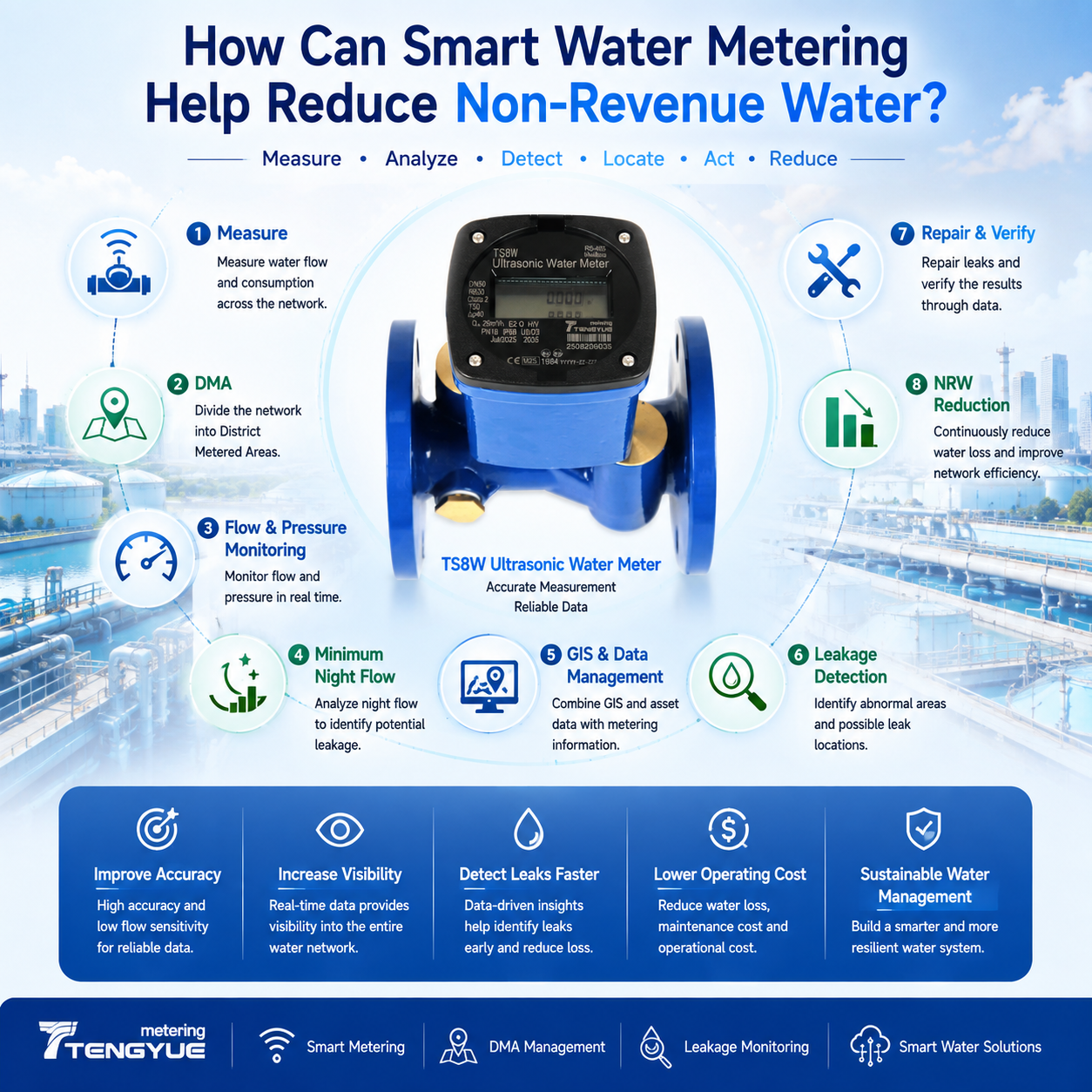
Step 1: Measure Water Flow
The first step is to establish reliable measurement.
Water meters can be deployed at appropriate points throughout the network to measure inflow, consumption, or district-level flow.
For example: Water Source → Distribution Network → DMA → Customers
The more clearly water movement can be measured, the easier it becomes to establish a water balance.
Step 2: Divide the Network into DMAs
A District Metered Area (DMA) divides a distribution network into smaller, measurable zones.
Each DMA can have defined boundaries and monitored inflows.
This creates a more manageable unit for analyzing water consumption and potential losses.
Instead of asking: Where is the leakage somewhere in the entire network?
The utility can first ask: Which DMA is showing abnormal water loss?
This significantly narrows the problem.
Step 3: Monitor Flow and Pressure
Flow data is important, but it is not always enough.
Pressure data can provide additional information about network conditions.
Combining Flow + Pressure can help utilities understand how the network behaves under different operating conditions.
Changes in pressure and flow patterns may provide useful indicators for further investigation.
Step 4: Analyze Minimum Night Flow
During periods when legitimate water consumption is relatively low, usually at night, network flow can provide useful information.
This is commonly referred to as Minimum Night Flow (MNF) analysis.
If a DMA continues to show unexpectedly high flow during a low-demand period, the utility may need to investigate potential leakage or other abnormal consumption.
However, MNF should always be interpreted according to local consumption patterns and network conditions.
Step 5: Use GIS to Understand the Network
Water distribution networks are physical systems.
Knowing where pipes, valves, meters, DMAs, and other assets are located is important when investigating water losses.
GIS can help utilities create a digital representation of the network.
This can connect: Network Assets + Meter Data + Flow Data + Pressure Data into a more complete view of the distribution system.
Step 6: Identify Potential Leakage
Once abnormal areas have been identified, utilities can combine different sources of information.
For example: Flow Data, Pressure Data, DMA Information, GIS, and Historical Data:can help narrow down potential problem areas.
The objective is not simply to collect more information.
It is to turn information into an actionable investigation.
Step 7: Repair and Verify
Leakage management should not stop when a problem is repaired.
After maintenance, utilities should continue monitoring the affected area.
The process can therefore become: Measure → Analyze → Detect → Locate → Repair → Monitor
If flow patterns improve after the repair, the utility gains evidence that the intervention has had an effect.
This creates a continuous improvement cycle.
Where Do Smart Water Meters Fit?
Smart water meters provide one of the important data sources in this process.
Depending on the project configuration, smart meters can provide: Consumption data, Flow information, Time-based usage patterns, Remote meter readings, Alarm information, Communication with central platforms
This data can then be combined with other monitoring systems.
The meter itself does not solve NRW.
Instead, it provides the measurement foundation needed for broader water loss management.
Smart Metering Is Only One Part of NRW Management
An effective NRW strategy may involve several technologies and processes working together:
Smart Water Metering→DMA Management→Flow Monitoring→Pressure→Monitoring→MNF Analysis→GIS→Leakage Detection→Field Repair→Continuous Monitoring
This creates a more systematic approach to water loss reduction.
This shift is important for utilities looking to improve network visibility and operational efficiency.
Instead of treating each meter as an isolated device, utilities can use metering data as part of a larger digital water management system.
Reducing non-revenue water requires visibility.
And visibility begins with measurement.
Smart water meters can provide valuable consumption and flow data, while DMA management, pressure monitoring, MNF analysis, GIS, and intelligent data analysis can help utilities turn that data into actionable water management information.
The objective is not simply to install more meters.
It is to create a connected process:
Measure → Analyze → Detect → Locate → Act → Reduce
This is how smart metering can become part of a broader strategy for reducing water loss and building more efficient water networks.