
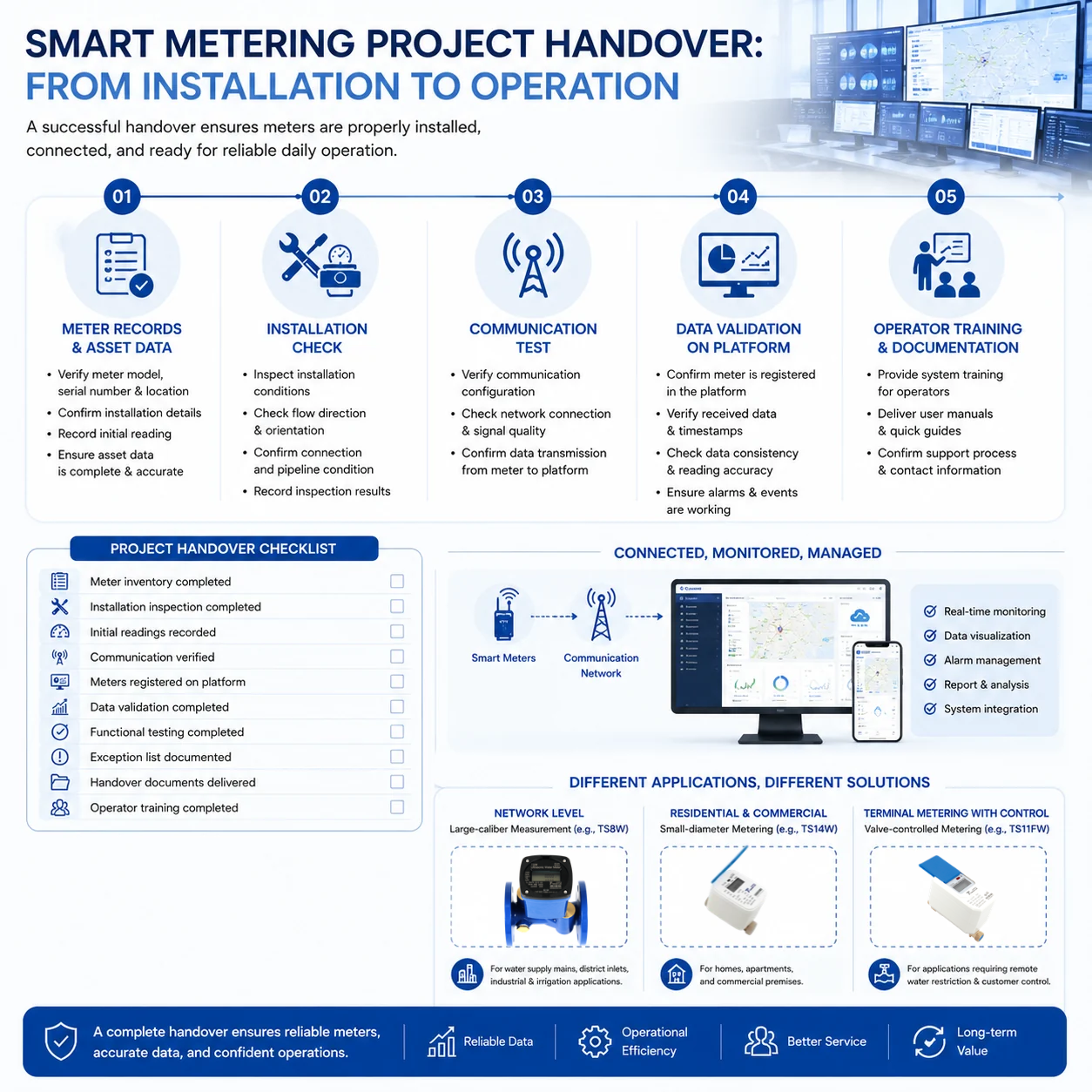
Smart metering project handover is the structured process of moving from installation completion to confirmed operational readiness. Delivering water meters to a project site does not mean that a smart metering project is complete. A successful deployment requires more than equipment delivery and installation. The utility must also be able to identify each meter, verify its operation, receive the expected data, and understand how to manage the system after the project team leaves.
This final stage is often referred to as project handover. For water utilities and system integrators, a structured handover process helps connect installation work with daily operation. Without it, a project may appear physically complete while important operational information remains unclear.
Why Smart Metering Project Handover Matters
Handover is where installation work becomes an operational asset. If the handover is incomplete, the utility may receive meters but not the records, data, or procedures needed to manage them. Common symptoms include meters that are installed but not communicating, readings that cannot be matched to the correct customer account, and valve-control functions that no one is authorized to use.
ISO 55000 asset management principles support aligning asset information with risk-based decisions; handover is the point where that alignment is either confirmed or lost. ISO 4064 provides a framework for meter accuracy, and IEC 62056 / DLMS-COSEM is common in smart metering communication. These standards help define requirements, but they do not replace project-specific handover checks.
A useful principle is: a meter is not handed over until its identity, installation, communication, data, and operational procedure have all been confirmed. This guide sets out six practical stages.
Stage 1: Build Complete Asset Records and Verify Installation
The first requirement is accurate meter identification. Each installed meter should be associated with a record that identifies the device and its location. A standard asset record may include product model, serial number or meter address, nominal diameter, installation location, installation date, initial reading, communication configuration, relevant technical parameters, and installation and inspection records. These details should be consistent with the project’s asset database.
For a project using multiple meter types, product identification is especially important. For example, TS8W may be installed at larger network measurement points, TS14W at residential or commercial connections, and TS11FW at selected locations where valve-control functionality is required. The handover documents should preserve these distinctions. A meter should not be recorded only as a generic smart water meter if its model and operational role are important to future maintenance.
Installation verification should consider the meter’s physical arrangement and the conditions at the measurement point. Depending on the application, checks may include correct model and nominal diameter, connection and installation arrangement, flow direction, meter orientation, pipeline condition, accessibility for inspection, display operation, and initial reading record. For large-caliber installations, the project team should also verify the relevant pipeline and flange connection details. For small-diameter installations, the connection arrangement and available installation space should be checked. For TS11FW, the built-in ball valve introduces an additional functional consideration; its status and operation should be verified according to the approved project procedure. Installation records should be completed at the time of inspection rather than reconstructed after the work has finished.
Stage 2: Confirm Communication and Validate Data Platform Delivery
A smart metering project depends on more than the physical meter. Where remote reading is included, the project team must confirm that each meter is configured for the intended communication arrangement. This may involve communication method, meter address, network parameters, gateway or network association, data collection settings, upload interval, and platform registration. The exact requirements depend on the selected product configuration and project architecture.
For example, the TS8W و TS11FW manuals describe supported wired and wireless communication options. The actual communication configuration should be checked against the purchased meter version. A communication test should confirm that the device can transmit data through the intended network and that the receiving system can identify the correct meter. A successful installation without communication verification is not sufficient for a remote-reading deployment.
After communication has been checked, the next step is data validation. The purpose is to confirm that the information received by the platform corresponds to the correct physical meter and installation location. The project team should check whether the meter is registered in the platform, whether its address matches the asset record, whether readings are received, whether the timestamp and reading information are consistent, whether missing or abnormal data can be identified, and whether the relevant dashboard or reporting function is available.
For larger smart metering projects, this stage may also involve checking integration with existing systems. TY WaterOne AMI is described as a solution combining smart water meters, communication infrastructure, and analytics software. Its documentation describes dashboard visualization, data analysis, and integration options for systems such as CIS, GIS, and MDM. For project handover, the important task is to verify the functions that are included in the actual project scope. The handover should not assume that every function described in a solution overview has been included in every deployment.
Stage 3: Test Operational Functions by Meter Type
Different meters may require different functional checks. A large-caliber network meter may require confirmation of its measurement display, flow direction, and remote-reading status. A residential or commercial meter may require checks of its reading process, meter identity, and communication status. A valve-controlled TS11FW installation requires additional attention to valve-related functions.
ال TS11FW manual describes a built-in ball valve, remote water restriction, and display indicators related to valve status. Where valve control is part of the project scope, the handover should confirm whether the valve status can be identified, whether the authorized control process is configured, whether the approved functional test has been completed, whether the operator understands the control procedure, and what steps should be followed if communication or control fails. Remote control should always be managed according to the utility’s approved operational and customer-service policies.
The purpose of testing is to ensure that the delivered configuration works as intended and that operators know how to manage it. A functional test that is not documented is difficult to repeat or audit. The handover record should identify which tests were performed, by whom, and with what result.
| Handover item | What to verify | Evidence to record |
|---|---|---|
| Asset record | Model, serial number, DN, location, application category | Asset database entry and signed record |
| تثبيت | Orientation, connections, flow direction, accessibility | Inspection checklist and photos where appropriate |
| Initial reading | Reading value and timestamp | Commissioning sheet |
| Communication | Module, protocol, address, platform registration | Communication test result |
| Data validation | Readings matched to correct meter and account | Platform screenshot or report |
| Functional test | Meter functions per model, including valve status for TS11FW | Functional test record |
| Exception register | Outstanding issues and responsible team | Open-item log with closure record |
| Training | Relevant personnel briefed on procedures | Training attendance and materials |
The table is a general guide. The checklist should be adapted to the actual project scope and meter types.
Stage 4: Manage Exceptions and Train Operations Teams
Not every installation will be completed without issues. Some meters may have communication problems, incomplete asset records, unexpected installation conditions, or data that requires further verification. These items should be recorded in a handover exception register.
A useful register includes meter ID, location, issue description, responsible team, current status, required action, and closure record. This prevents unresolved items from disappearing after the installation team leaves the site. It also gives the utility a clear picture of what has been completed and what still requires attention.
A smart metering system is only useful when the people responsible for it understand how to operate it. Project handover should include training appropriate to the system and the responsibilities of each user group. Metering and field teams need to understand meter identification, installation records, and basic inspection procedures. Operations teams need to understand how to review readings, identify missing data, and follow up on abnormal conditions. System administrators need to understand user permissions, meter records, configuration, and relevant system-management functions. Customer-service teams, where applicable, need to understand the information available to them and the procedures for handling customer enquiries. For valve-controlled installations, the relevant personnel should also understand the authorization and operating procedures. Training should be supported by practical documentation rather than relying only on a one-time demonstration.
Stage 5: Complete Handover with a Structured Checklist
A practical handover checklist can help the project owner confirm that all essential tasks have been addressed. The checklist should cover meter inventory, installation inspection, initial readings, communication configuration and transmission, platform registration, data validation, functional testing, exception register, documentation delivery, and training.
The checklist should be adapted to the actual project scope. A small deployment may need a simple record set, while a large utility project may require more detailed asset, communication, integration, and training documentation.
Illustrative Scenario: Handover of an 800-Meter Mixed Project
Consider a desensitized example. A utility completes installation of about 800 meters: 6 DN200 bulk meters at DMA boundaries, about 760 residential and commercial meters, and 34 terminal points with valve control. The handover team uses a common asset record structure and model-specific functional tests.
Success criteria include data availability of at least 98% over a 28-day review, correct meter-to-account and meter-to-asset mapping, communication at difficult sites confirmed, valve-control procedures documented and tested, and an exception register with no unresolved critical items. The utility accepts the project only after the exception register is reviewed and the operations team confirms training completion. This example is illustrative and should not be read as a universal specification.
Stage 6: Handover as the Start of Daily Operation
The purpose of project handover is not simply to close a contract. It is to make sure that the utility can take responsibility for the deployed assets and use the system in daily operations. A complete handover connects five important elements: accurate meter identification, verified installation, confirmed communication, validated data, and trained operational personnel.
Tengyue Metering provides ultrasonic water metering products and smart metering solutions for different application environments. From TS8W network-level measurement to TS14W residential and commercial metering and TS11FW valve-controlled terminal applications, product selection and project delivery should be supported by clear installation and handover records. The appropriate configuration should be confirmed against the project’s technical requirements.
A handover that is well documented also supports the next phase: performance evaluation. Once the project is operational, the utility can compare actual data availability, reading consistency, and exception rates against the agreed criteria. That comparison is only possible if the handover record is complete.