
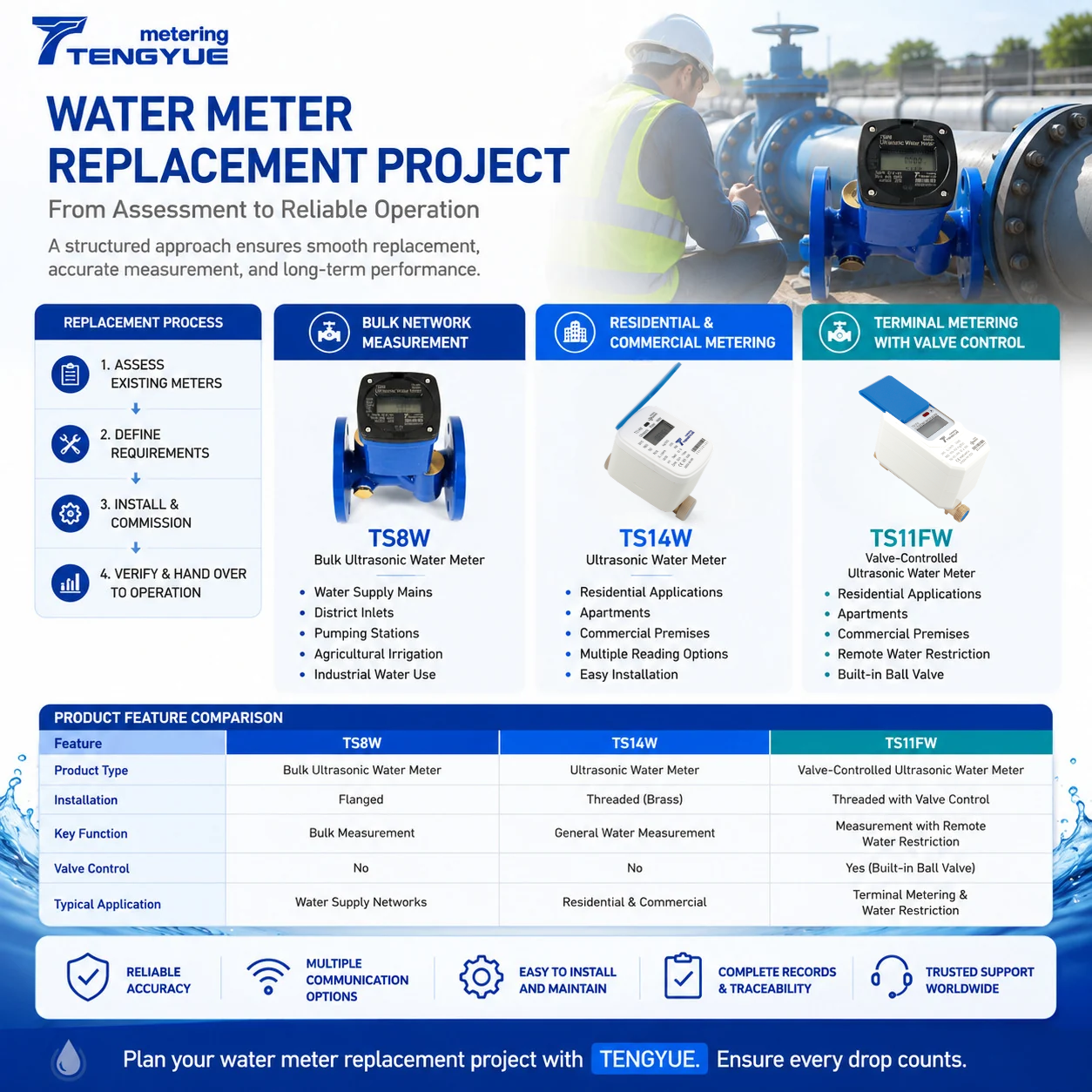
A water meter replacement project is not simply a matter of removing old devices and installing new ones. Replacing water meters across a utility network can involve hundreds or thousands of measurement points, different pipeline sizes, varying installation conditions, communication requirements, customer coordination, and operational constraints. Without proper planning, even a technically suitable meter can become difficult to deploy at scale.
For water utilities and project contractors, the most effective approach is to treat meter replacement as a structured project. The process should begin with an assessment of existing assets and continue through product selection, installation planning, commissioning, and operational follow-up. This guide sets out six practical stages.
Why a Water Meter Replacement Project Needs Structured Planning
A replacement project touches several utility functions at once: field operations, customer service, billing, asset records, and network monitoring. A meter that is technically suitable may still cause problems if the connection dimensions do not match, the reading route is impractical, or the data cannot be integrated with the billing system.
ISO 4064 and OIML R49 provide widely used frameworks for water meter requirements and testing. IEC 62056 / DLMS-COSEM is common in smart metering communication. ISO 55000 asset management principles support aligning asset information with risk-based decisions. These standards help define requirements, but they do not replace a project-specific inventory and installation plan.
A useful principle is: replace by application, not by product alone. Different locations have different flow ranges, installation conditions, and data needs.
Stage 1: Assess the Existing Metering Network
Before choosing replacement meters, utilities should understand what is currently installed. An existing meter inventory provides the foundation for planning. It helps identify where replacement is necessary, which locations require additional investigation, and whether different meter types are needed.
Useful information includes existing meter type and nominal diameter, installation location and connection arrangement, available upstream and downstream space, operating pressure and temperature, typical and peak consumption, current reading method, existing communication infrastructure, and meter condition and maintenance history.
This assessment should also identify whether the project involves a complete replacement program or only selected locations. For example, replacing meters in residential buildings is different from replacing large-caliber meters at network inlets. The equipment, installation work, and commissioning process may differ significantly. A structured inventory can prevent the project team from treating every replacement point as identical.
Stage 2: Segment the Project by Application
Once the existing network has been reviewed, the next step is to divide the replacement scope into application groups. A practical project may include three categories.
Large-caliber network measurement. Water supply mains and major distribution points require meters that match the pipeline diameter and expected flow conditions. The TS8W Bulk Ultrasonic Water Meter is designed for large-caliber applications, including water supply mains, agricultural irrigation, and industrial water use. Its manual describes transit-time ultrasonic measurement, reverse-flow detection, non-full-pipe detection, and remote reading options depending on configuration. When considering TS8W for replacement, the project team should verify the actual pipeline diameter, flange dimensions, pressure conditions, flow range, and installation arrangement.
Residential and commercial metering. Smaller connections require a different selection process. The TS14W Ultrasonic Water Meter can be evaluated for residential and commercial applications. The appropriate diameter and performance configuration should be confirmed against the existing installation and expected consumption profile. Before replacement, check the connection size, available installation space, meter orientation, and communication requirements. A product that fits the nominal pipe size may still require additional checks for connection compatibility and installation conditions.
Terminal metering with valve control. Some projects include locations where water restriction or valve management is part of the operating requirement. The TS11FW Ultrasonic Water Meter incorporates a built-in ball valve and supports remote water restriction according to its product manual. This functionality may be relevant for selected residential, apartment, and commercial applications. However, the project team should define how valve control will be managed, including authorization, customer communication, control procedures, and status verification. Not every replacement point requires a valve-controlled meter. The decision should follow the project’s operational requirements.
| Application group | Typical location | Main requirement | Product to evaluate |
|---|---|---|---|
| Large-caliber network measurement | Supply mains, major distribution points | Large-diameter flow measurement and diagnostics | TS8W |
| Residential and commercial | Households, apartments, commercial premises | Small-diameter consumption measurement | TS14W |
| Terminal metering with valve control | Selected customer connections with control needs | Measurement plus remote valve control | TS11FW |
The table is a general guide, not a product specification. Actual selection depends on the exact model, size, and configuration.
Stage 3: Define Technical Requirements Before Finalizing the Product List
A replacement project should not rely on the existing meter’s label alone. The new meter must be suitable for the actual operating conditions. Key parameters to verify include nominal diameter, flow range, pressure rating, temperature class, installation conditions, communication, and system compatibility.
The project team should maintain a technical schedule that records the required specifications for each application group. This makes it easier to compare proposed products and reduces the risk of ordering an unsuitable configuration.
| Parameter | What to verify | Common replacement risk |
|---|---|---|
| Nominal diameter | Existing pipeline size and connection arrangement | Flange mismatch or rework |
| Flow range | Expected minimum, normal, and peak flows | Meter unable to resolve low nighttime flow |
| Pressure rating | Normal operating pressure and possible variations | Rating below surge conditions |
| Температурный класс | Cold-water or hot-water application | Wrong model configuration |
| Installation conditions | Straight pipe length, orientation, accessibility | Poor flow profile or inaccessible meter |
| Communication | Local reading, wired, or wireless remote reading | Protocol or platform incompatibility |
The table is a general checklist. Actual requirements depend on the exact model and site conditions.
Stage 4: Plan Installation and Commissioning
Installation planning has a direct effect on project efficiency. For a large replacement program, it is usually helpful to organize work by geographic area, building, network zone, or meter type. A practical installation schedule should consider site access and customer availability, water supply interruption requirements, required installation tools and materials, existing pipe and connection conditions, meter identification and recording, installation inspection, and reading and communication checks.
For network-level meters, installation work may require coordination with engineering and maintenance teams. For residential or commercial meters, access arrangements and customer notification may become more important. The project should also define how unexpected installation conditions will be documented. Damaged pipework, incorrect connection dimensions, or unsuitable installation spaces should be recorded rather than handled through undocumented substitutions.
Installation does not automatically mean that a replacement meter is ready for operation. Commissioning should confirm that the meter has been installed correctly and that the required functions are available. Depending on the project, checks may include meter model and serial number, installation location and orientation, initial reading, flow direction, display operation, communication status, data collection and record matching, and valve status where applicable.
For remote-reading projects, a meter should not be considered fully commissioned merely because it has been installed. The project team should verify that the expected data can be received and associated with the correct meter record. For TS11FW installations, valve-control functionality should also be tested according to the project’s approved procedures.
Illustrative Scenario: A Mixed Replacement Program
Consider a desensitized example. A utility plans to replace about 1,000 meters: 6 DN200 bulk meters at supply inlets, about 950 residential and commercial meters, and 40 terminal points requiring remote valve control. The bulk meters need 15-minute flow data for DMA water balance; the residential meters need daily readings; the terminal points need valve status monitoring and an authorized control process.
The project team segments the work by application, confirms connection dimensions and flow ranges for each group, and runs a 28-day pilot covering 60 meters, including 15 difficult sites. Commissioning checks include meter ID recording, communication verification, and initial reading comparison. This example is illustrative and should not be read as a product specification for every project.
Stage 5–6: Maintain Records and Plan Post-Installation Operations
A replacement project creates important asset information. Each installed meter should be associated with a record that includes its model, serial number, location, installation date, initial reading, and relevant communication configuration. Where a meter replaces an existing device, the previous meter’s final reading and removal information should also be recorded. This helps utilities maintain continuity between historical consumption records and the new metering asset. It also makes future maintenance, troubleshooting, and replacement planning easier.
The final stage is operational follow-up. During the initial operating period, utilities should review whether the new meters are producing the expected readings and whether communication is stable. Any unusual readings, missing data, or installation issues should be documented and investigated. A replacement project should also include a clear process for handling maintenance requests, communication failures, and meter-related customer enquiries.
The objective is not simply to complete installation work. It is to ensure that the new metering assets can support daily operations. A successful water meter replacement project connects several activities: assess existing assets; segment replacement points by application; confirm technical requirements; select suitable meter configurations; organize installation and commissioning; verify readings and communication; and maintain accurate asset records.
Tengyue Metering offers different ultrasonic water metering options for network-level, residential, commercial, and valve-controlled applications. By matching TS8W, TS14W, and TS11FW to their respective roles, project teams can plan a more structured replacement program instead of applying a single product to every location.