
A smart water metering project involves more than replacing traditional meters with digital devices. For water utilities, successful implementation requires coordination between meter selection, communication infrastructure, data platforms, system integration, and daily operational processes. A clear deployment strategy helps reduce project risks and ensures that the new system can support long-term management needs.
A smart metering project is a system project. Meters, communication networks, data platforms, and utility workflows must be planned together. When one layer is planned in isolation, problems often appear after installation—when they are more expensive to fix. This guide sets out five practical stages from requirements assessment to full deployment.
Why Smart Water Metering Project Implementation Needs Planning
A smart metering system connects field devices with communication networks and data management platforms. If these elements are not planned together, utilities may encounter problems such as poor network coverage, incompatible interfaces, incomplete data, or difficulties integrating with existing systems.
Project planning should therefore begin with the utility’s operational requirements rather than with a single product specification. ISO 55000 asset management principles support aligning asset information with risk-based decisions; for a metering project, that means defining what data each team needs, who owns each record, and how success will be measured.
ISO 4064 provides a framework for meter accuracy, and IEC 62056 / DLMS-COSEM is common in smart metering communication. These standards help set requirements, but they do not replace project-specific testing. A meter that meets accuracy requirements may still produce unreliable operational data if communication coverage, identifier mapping, or platform integration is weak.
Stage 1–2: Assess Requirements and Select Metering Devices
The first step is to understand the existing metering environment and define the project’s objectives. Utilities should review residential, commercial, and bulk metering requirements; existing meter types and installation conditions; communication coverage and infrastructure; billing and customer management systems; and network monitoring and water loss management needs. The project scope should distinguish between immediate requirements and capabilities that may be added in later phases.
Different applications may require different meter sizes, measurement ranges, communication options, and installation arrangements. For example, a small-diameter meter used in residential applications has different requirements from a bulk meter installed at a water supply network boundary. Utilities should verify the specifications of each selected model, including flow range, pressure rating, temperature class, protection rating, and supported communication interfaces. The selected device should match the actual project conditions.
A useful practice is to define the operating envelope for each meter type before comparing products: expected minimum and maximum flow, pressure, temperature, installation orientation, and data interval. The technology and model choice should follow that envelope, not the other way around.
Stage 3: Test Communication and Data Collection in a Pilot
Before large-scale deployment, the project team should verify whether the selected communication method works under real installation conditions. Pilot testing should evaluate network coverage and signal quality, data transmission intervals, reading completeness and consistency, meter identification and device management, and data transfer to the central platform. The purpose is to identify technical or operational issues before expanding the deployment.
A pilot should include difficult sites, not only convenient ones. Basement meter rooms, chambers with metal covers, and sites with poor signal should be tested alongside normal installations. For a fixed-network deployment, test the actual gateway or concentrator placement. For a drive-by or hybrid approach, test the real reading routes and timing.
| Stage | Main objective | Key output |
|---|---|---|
| 1. Requirements assessment | Define scope and operational needs | Documented requirements and success criteria |
| 2. Device selection | Match meter to application | Exact model and configuration list |
| 3. Communication pilot | Test coverage and data collection | Pilot report with exception cases |
| 4. Platform integration | Connect data to utility systems | Interface and mapping documentation |
| 5. Full deployment | Scale up and establish operations | Operational procedures and owners |
The table is a general guide. The depth of each stage should reflect project size, risk, and existing infrastructure.
Stage 4: Integrate the Data Platform with Existing Systems
A smart metering project becomes more useful when data can be accessed by the teams and systems that need it. Depending on the project architecture, integration may involve billing systems, Customer Information Systems (CIS), GIS, Meter Data Management (MDM), and other operational platforms.
Tengyue’s TY WaterOne AMI solution is designed around smart metering devices, communication infrastructure, and a data platform. Its solution documentation describes integration capabilities involving DLMS/COSEM and RESTful APIs, with connections to systems such as CIS, GIS, and MDM. Actual compatibility should be confirmed against the utility’s existing software and interface requirements. [internal link: TY WaterOne AMI solution]
Integration planning should define which system is the master record for meter ID, customer account, and asset location. A pilot should test incorrect and missing identifier scenarios before scale-up. Data integration is not only a technical task; it also requires agreement on data ownership, validation rules, and exception handling.
Stage 5: Expand Deployment and Establish Operations
Once the pilot has been evaluated, utilities can develop a phased deployment plan. A practical rollout may prioritize specific districts, customer groups, or network areas before expanding to the wider service region.
After deployment, the utility should establish procedures for device and communication monitoring, data quality review, alarm investigation, meter maintenance and replacement, user training and technical support, and performance evaluation. This helps ensure that the project continues to deliver operational value after installation.
Illustrative Scenario: A 28-Day Pilot Before Full Deployment
Consider a desensitized example. A utility plans to deploy about 1,000 smart meters and several DMA boundary bulk meters. The pilot covers 60 meters, including 15 difficult sites such as basement meter rooms and chambers with metal covers. The pilot runs for 28 days with 15-minute reading intervals.
Success criteria include data availability of at least 98%, correct meter-to-account and meter-to-asset mapping, communication performance at difficult sites, and a documented exception process for missing or delayed readings. The utility also tests integration with billing and GIS before scale-up. If the criteria are met, the utility expands; if not, the team fixes coverage, installation, or mapping issues first. This example is illustrative and should not be read as a universal specification.
From Smart Meter Reading to Water Network Management
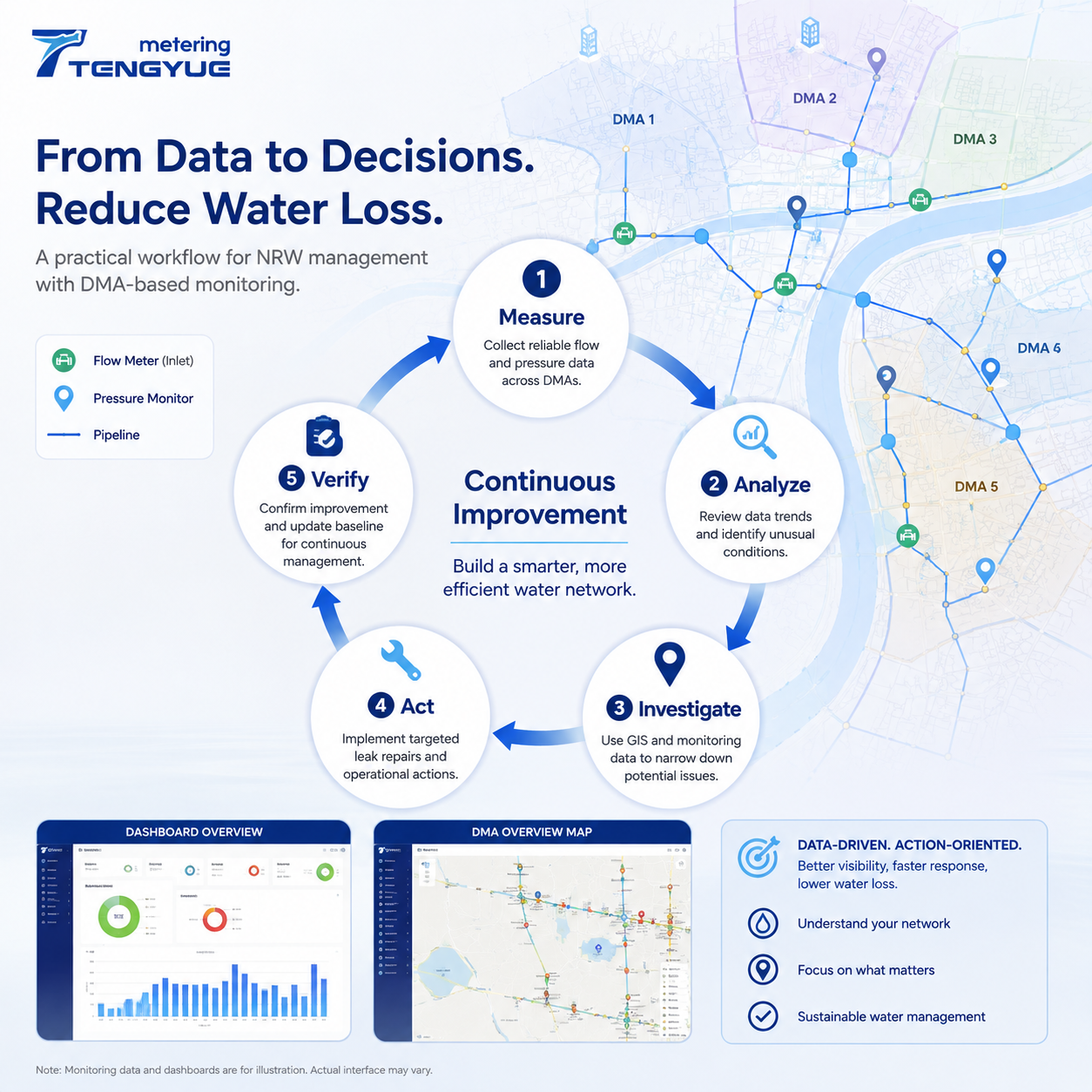
Smart metering can provide more frequent and accessible consumption information. When combined with other monitoring systems, it can also support broader water management activities. For example, meter data can contribute to consumption analysis, while bulk metering, DMA monitoring, pressure data, and GIS can help utilities investigate water loss across distribution networks.
A smart metering project is not only about automatic reading. It is about building a data foundation that supports billing, customer service, network operations, and water-loss management. The value depends on how consistently the utility uses the data and how well the system is maintained after go-live.
Tengyue provides smart metering products and system-level solutions, including TY WaterOne AMI e Monitoramento de Vazamentos TY, to support different stages of water utility digitalization. The appropriate configuration should be confirmed against the project’s technical requirements and deployment objectives.