Water meter data quality determines whether a utility can trust its readings for billing, consumption analysis, network monitoring, and long-term infrastructure planning. For water utilities, reliable data is the starting point for effective water management. Meter readings influence billing, consumption analysis, network monitoring, and long-term infrastructure planning. However, collecting more data does not automatically mean making better decisions. The quality of that data matters just as much as its quantity.
A smart metering project can generate thousands of readings per day. Without accurate measurement, reliable communication, correct identifiers, and a clear validation process, those readings may create more work rather than better decisions. This guide explains what water meter data quality means, what affects it, and how utilities can validate and improve it.
Why Water Meter Data Quality Matters for Utilities
Water meter data quality affects several operational areas at once. Billing depends on accurate consumption records. DMA water balance depends on complete and time-aligned inflow and consumption data. Minimum night flow analysis depends on low-flow resolution and stable readings. Asset planning depends on correct meter-to-asset mapping.
ISO 4064 and OIML R49 provide widely used frameworks for water meter accuracy and testing. IEC 62056 / DLMS-COSEM is common in smart metering communication. ISO 55000 asset management principles support aligning asset information with risk-based decisions. These standards help define requirements, but they do not replace project-specific validation.
A useful principle is: data quality is a process, not a product feature. A meter may meet accuracy requirements and still produce unreliable operational data if installation, communication, or identifier mapping is poor.
What Does Water Meter Data Quality Mean?
Water meter data quality refers to how accurately, consistently, and reliably water consumption information is measured, transmitted, stored, and interpreted. For a utility, useful data should be accurate, consistent, complete, traceable, and usable.
| Quality dimension | What it means | Example check |
|---|---|---|
| Accurate | Readings reflect actual water consumption | Compare with a reference meter or known flow |
| Consistent | Data follows reliable measurement and reporting intervals | Check 15-minute interval completeness |
| Complete | Missing readings and communication interruptions are identified | Review data availability rate |
| Traceable | Meter status and abnormal records can be reviewed | Check meter ID, time stamp, and audit log |
| Usable | Data is accessible to the systems and teams responsible for operations | Confirm platform access and workflow ownership |
These factors help turn meter readings into information that supports operational decisions. A dataset can be large but still fail on one or more of these dimensions. Water utility data management should therefore define acceptance criteria for each dimension before procurement.
What Factors Affect Water Meter Data Quality?
Meter Selection, Measurement Conditions, and Installation
A meter should match the application, expected flow range, pipe size, pressure conditions, and installation environment. An unsuitable meter or incorrect installation may affect measurement performance. Utilities should therefore review technical specifications and project conditions before procurement.
Installation and commissioning also matter. Incorrect installation, unsuitable pipe conditions, or incomplete commissioning records can create problems later. A structured commissioning process should verify meter identity, installation position, communication status, and whether readings are being received as expected. [internal link: ultrasonic water meter installation checklist]
Communication Reliability and Data Validation
Smart meters depend on communication networks to transfer readings to a central system. Network coverage, signal conditions, transmission intervals, and protocol compatibility can all affect data availability. A communication failure does not necessarily mean that the meter has stopped measuring. It means the utility needs a way to identify missing data and understand the cause.
Unusual consumption patterns should be reviewed rather than automatically treated as leakage or meter failure. For example, reverse flow, continuous flow, missing readings, and unexpected consumption changes may require different investigations. Utilities should compare meter records with operating conditions and other available information.
A practical validation rule set includes: flag missing readings after a defined interval; flag duplicate readings; flag impossible values; flag reverse flow; and flag a sustained change against a rolling baseline. Each flag should have a named owner and a documented response.
How Can Utilities Validate and Improve Water Meter Data Quality?
Validation should happen at several points: at the meter, at the communication layer, at the data platform, and at the application. A practical workflow includes the following steps.
Confirm the meter model, accuracy class, and installation conditions match the project requirements.
Verify meter-to-account and meter-to-asset mapping before relying on the data.
Define data availability and completeness targets for the reading interval.
Check time synchronization between flow, pressure, and billing data.
Review missing, duplicated, delayed, and out-of-range readings.
Assign owners for validation, correction, and field follow-up.
Record the outcome and update the baseline after corrective action.
Data quality is not only an IT task. Operations, billing, and field teams all contribute. A validation rule without an operational owner tends to produce alerts that nobody resolves.
Illustrative Scenario: A 28-Day Data Quality Pilot
Consider a desensitized example. A utility plans to deploy about 1,000 smart meters and several DMA boundary bulk meters. The pilot covers 60 meters, including 15 difficult sites such as basement meter rooms and chambers with metal covers. The pilot runs for 28 days with 15-minute reading intervals.
Success criteria include data availability of at least 98%, correct meter-to-account and meter-to-asset mapping, communication performance at difficult sites, and a documented exception process for missing or delayed readings. The team also checks time synchronization between flow and pressure logs and reviews a sample of reverse-flow and continuous-flow alerts. If the criteria are met, the utility scales up; if not, the team fixes coverage, installation, or mapping issues first. This example is illustrative and should not be read as a universal specification.
How Does Smart Metering Support Better Data Management?
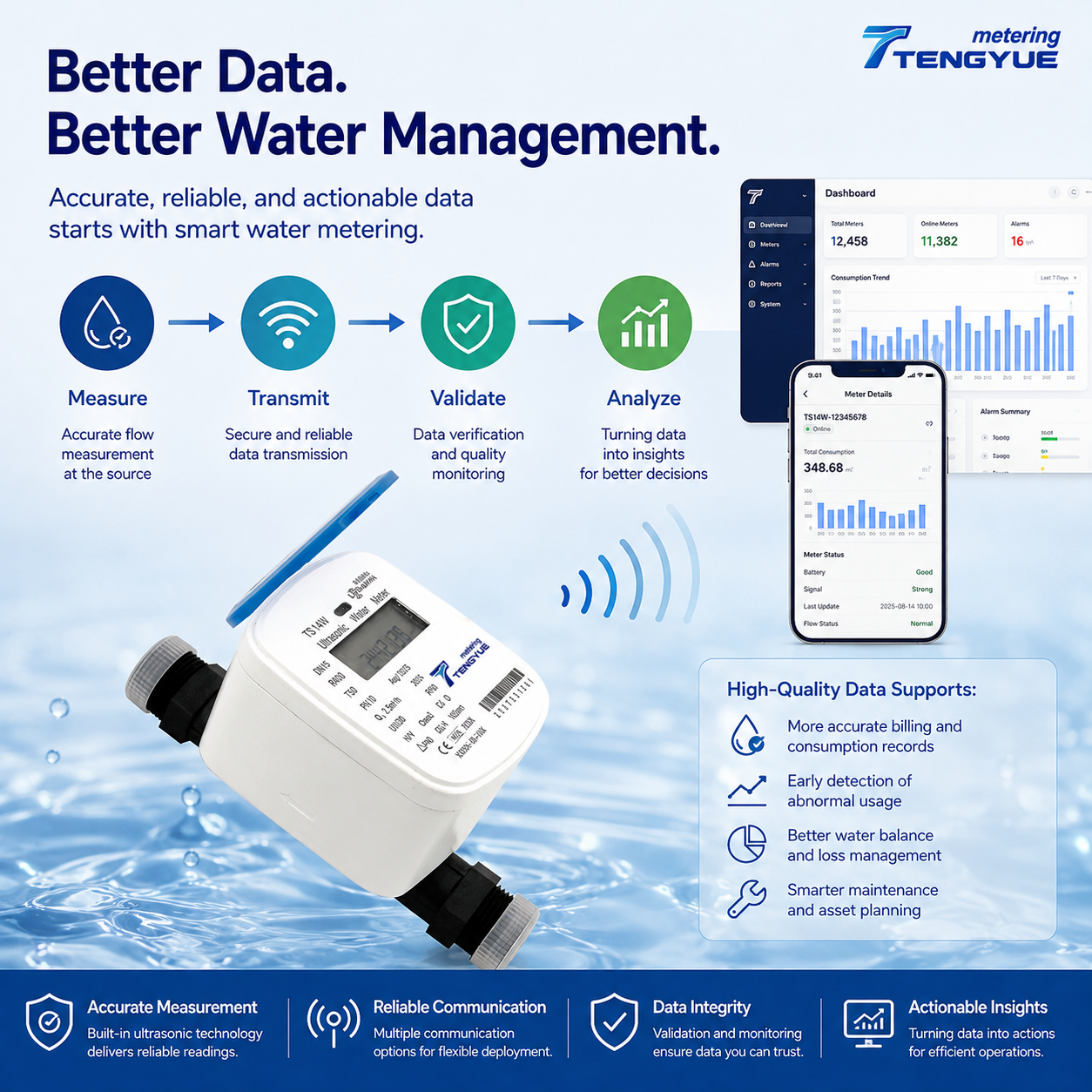
Smart water metering can improve the availability of consumption data by reducing dependence on manual reading and supporting remote data collection. Depending on the meter configuration and system architecture, utilities may access consumption records, meter status, and abnormal-event information through a centralized platform.
Tengyue’s ultrasonic water meter range includes models with documented functions such as reverse-flow detection and remote reading options. The exact communication interfaces and supported functions depend on the selected model and configuration.
Smart water meter data becomes more useful when it is integrated with billing, GIS, DMA water balance, and maintenance workflows. Integration should be planned before procurement, not after installation. The data platform should define which system is the master record for meter ID, customer account, and asset location.
Frequently Asked Questions About Ultrasonic Water Meter Data
What kind of data can an ultrasonic water meter provide?
Depending on the model and configuration, an ultrasonic water meter can provide cumulative consumption, flow-rate readings, reverse-flow indication, alarms, and diagnostic information such as non-full-pipe detection. The available fields should be confirmed for the exact model.
How does ultrasonic water meter data support DMA management?
DMA management uses inflow and consumption data to compare water entering a zone with accounted use. Ultrasonic bulk meters at DMA boundaries can provide 15-minute flow data for water balance and minimum night flow analysis, provided identifiers and time synchronization are correct.
Can meter data alone reduce water loss?
No. Data supports prioritization and investigation, but reducing water loss also requires field verification, repairs, pressure management, and follow-up. The value comes from the workflow that acts on the data.
How often should utilities review meter data?
Frequency depends on the application. Billing may use monthly cycles, while DMA water balance and MNF review often benefit from 15-minute data and a rolling 28-day comparison. Critical alerts may need daily review.
What data quality issues affect water network management?
Incorrect meter identifiers, missing or delayed readings, time synchronization errors, and incomplete billing data can all distort analysis. Validation rules and a named data owner help maintain reliability.
How Does Smart Metering Support Better Data Management?
Smart water metering can improve the availability of consumption data by reducing dependence on manual reading and supporting remote data collection. Depending on the meter configuration and system architecture, utilities may access consumption records, meter status, and abnormal-event information through a centralized platform.
Tengyue’s ultrasonic water meter range includes models with documented functions such as reverse-flow detection and remote reading options. The exact communication interfaces and supported functions depend on the selected model and configuration.
Smart water meter data becomes more useful when it is integrated with billing, GIS, DMA water balance, and maintenance workflows. Integration should be planned before procurement, not after installation. The data platform should define which system is the master record for meter ID, customer account, and asset location.
What Should Utilities Check Before a Smart Metering Project?
Before implementing a smart metering project, utilities should ask: Does the selected meter match the project’s operating conditions? Which communication options are supported by the specific model? How are missing or abnormal readings identified? Can the data be integrated with existing billing, GIS, or management systems? What commissioning and technical support will be provided?
High-quality meter data can support more consistent billing and consumption records, better visibility into abnormal consumption patterns, more informed water balance analysis, improved planning for meter maintenance and replacement, and stronger data foundations for smart water management systems.
However, meter data alone does not explain every operational problem. Utilities should combine measurement information with network records, pressure data, customer information, and field investigation. Reliable water management starts with reliable measurement data. By selecting suitable meters, planning communication infrastructure, and establishing clear data validation procedures, water utilities can build a stronger foundation for operational efficiency and network management.
Frequently Asked Questions About Water Meter Data Quality
What is water meter data quality?
Water meter data quality describes how accurately, consistently, completely, traceably, and usably consumption information is measured, transmitted, stored, and interpreted. It is a process that spans meter selection, installation, communication, validation, and operational use.
What are the most common causes of poor meter data quality?
Common causes include unsuitable meter selection, incorrect installation, communication coverage gaps, missing or delayed readings, incorrect meter-to-account mapping, time synchronization errors, and unclear data ownership.
How can utilities measure data completeness?
Data completeness is the proportion of expected readings received during a defined period. For a 15-minute interval deployment, utilities can compare received readings with the expected count and review gaps by site, meter type, and communication path.
Can smart meters guarantee high data quality?
No. Smart meters can improve data availability and remote reading, but data quality also depends on installation, communication, identifier mapping, validation rules, and operational ownership. A pilot should test these factors before scale-up.
How should utilities handle abnormal meter readings?
Abnormal readings should be reviewed with supporting data rather than automatically treated as leakage or meter failure. Reverse flow, continuous flow, missing readings, and unexpected consumption changes may require different investigations and field checks.
If you are improving water meter data quality across a metering project, contact our engineers to review meter selection, communication planning, validation rules, and pilot criteria.