
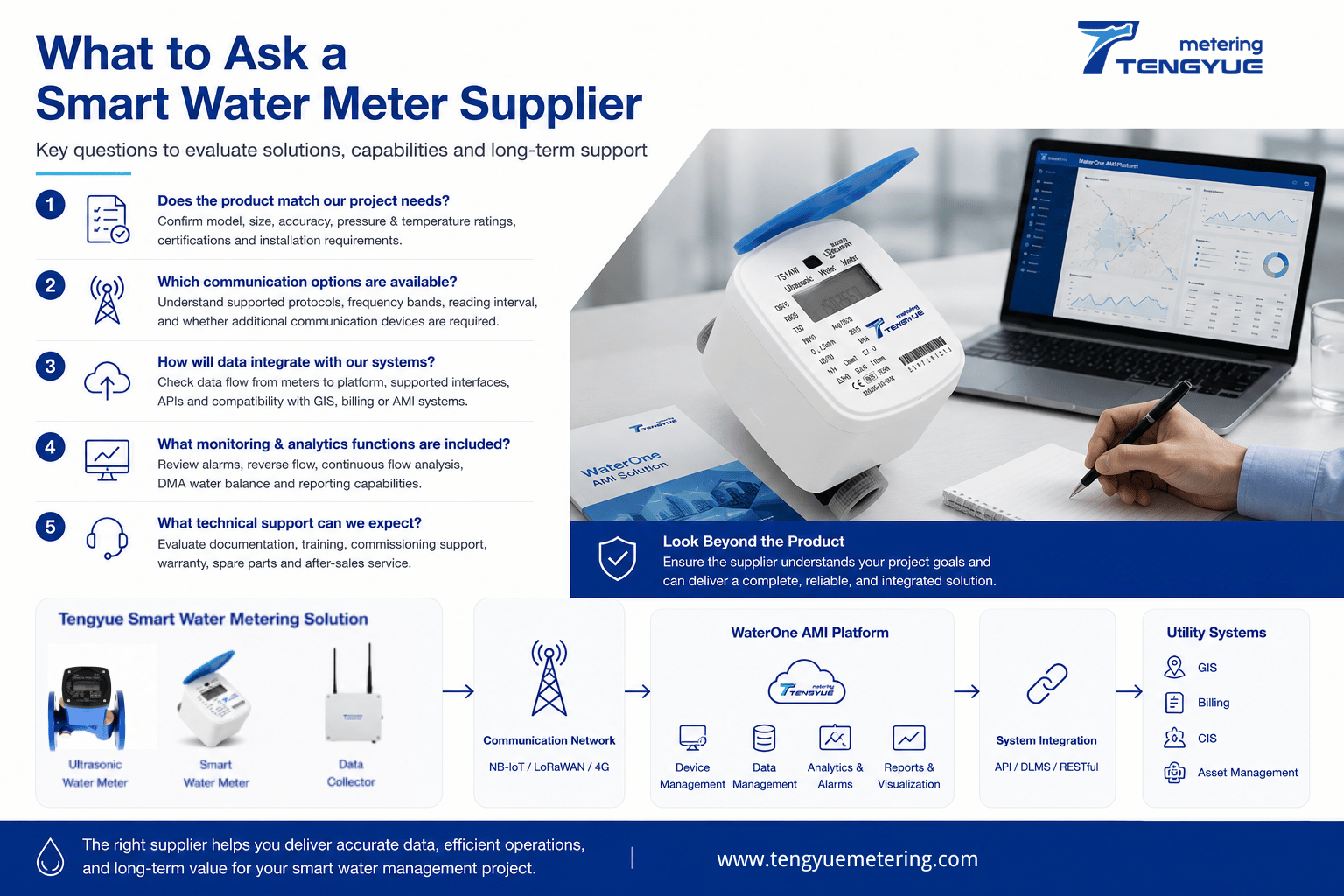
Choosing a smart water meter supplier is not simply a product comparison. The supplier’s technical documentation, configuration options, communication capabilities, project support, and ability to explain data workflows can all affect the outcome of a deployment. Before placing an order, procurement and engineering teams should ask clear questions and request evidence to support the answers. A structured supplier review helps separate standard features from optional configurations and turns a sales discussion into verifiable project requirements.
Why the Right Smart Water Meter Supplier Matters
A smart water meter is part of a system: the meter, communication network, data platform, and operational workflow. A supplier that understands only hardware may leave integration gaps. A supplier that can document exact model configurations, protocol options, and support responsibilities helps reduce deployment risk.
ISO 55000 asset management principles support risk-based decisions about critical assets. A bulk meter at a DMA boundary may justify stronger support and spare-parts planning than a non-critical internal meter. The same logic applies to supplier selection: the question is not only “Which meter is cheapest?” but “Which supplier can support the required measurement, data, and operational outcomes?”
Which Product Configuration Does the Supplier Recommend?
Start with the intended application and operating conditions. Ask the supplier to confirm the relevant meter model, nominal diameter, flow range, pressure and temperature ratings, installation requirements, and applicable certifications. Request the technical datasheet and product manual for the exact version being quoted. Avoid relying only on a general product brochure, especially when the project specification includes detailed performance requirements.
ISO 4064 and OIML R49 provide widely used frameworks for water meter requirements and testing. Project teams should ask for the applicable accuracy class, Q3/Q1 range ratio, pressure-loss characteristics, and test evidence for the exact model being quoted.
| Question to ask | Why it matters | Evidence to request |
|---|---|---|
| What is the exact model and nominal diameter? | Prevents quoting a different configuration | Datasheet with model code and DN |
| What is the flow range and Q3/Q1 ratio? | Affects low-flow and high-flow performance | Test certificate and range ratio |
| What are the pressure and temperature ratings? | Must match site operating conditions | PN rating and temperature range |
| What are the installation requirements? | Poor installation can cause measurement error | Manual section on orientation and straight pipe |
| What is the protection rating? | Chambers may be wet or flooded | IP rating and installation instructions |
| Which certifications apply? | Local compliance and procurement requirements | Certificate for the exact model |
Which Communication and Data Integration Options Are Available?
A smart meter’s communication capability must match the project’s network and data collection plan. Ask which wired or wireless options are available for this exact model, which regional frequency bands or network requirements apply, what data-reading interval the proposed configuration can support, whether additional communication equipment is required, and how communication performance will be checked at the installation site.
The answer should distinguish standard features from optional configurations. A protocol supported by one product should not automatically be assumed to be available on another. Ask the supplier to explain the proposed architecture from meter to communication network, data platform, and operational applications. Clarify supported interfaces, data formats, integration requirements, user permissions, firmware or configuration management, and how the solution can work with existing systems.
If GIS, customer information, billing, or asset management integration is required, define those requirements early. For DMA monitoring and water balance analysis, the data interval and time synchronization should also be agreed before procurement.
What Monitoring, Analysis, and Support Should Be Confirmed?
Ask which functions are provided by the meter itself and which depend on the platform or a wider solution. For example, reverse-flow indication, continuous-flow anomaly analysis, alarm handling, DMA water balance, and GIS visualization are different functions. Their availability and behavior should be confirmed against the proposed hardware and software configuration. Request a demonstration or documented workflow where appropriate, rather than assuming that every feature is included in the quoted package.
For larger deployments, the supplier should be able to explain the support process before, during, and after installation. Discuss product documentation and configuration guidance, installation and commissioning support, troubleshooting and warranty procedures, spare parts and replacement arrangements, software updates and system maintenance, training, and communication with the project team. Agree on responsibilities between the supplier, system integrator, installer, and utility.
How Can Utilities Evaluate a Smart Water Meter Supplier Before Full Deployment?
Where practical, consider a pilot or staged rollout before scaling up. Define success criteria in advance, such as data availability, reading consistency, communication performance, integration results, and the effort required to resolve exceptions. A pilot should reflect realistic operating conditions. It can help identify configuration or workflow issues before they affect a larger deployment.
Illustrative Scenario: A 28-Day Pilot Before Scaling Up
Consider a desensitized example. A utility plans to deploy about 1,000 smart meters and several DMA boundary bulk meters. The supplier pilot runs for 28 days with 15-minute reading intervals. Success criteria include data availability of at least 98%, consistent readings against a reference meter, stable communication, a successful integration test with the utility platform, and a documented process for resolving exceptions.
If the pilot meets the agreed criteria, the utility scales up. If not, the team reviews configuration, installation, communication, and support issues before committing to full deployment. This example is illustrative and should not be read as a universal specification.
A useful supplier review should confirm that product specifications match the project requirements, the quoted communication configuration is clearly identified, data interfaces and system responsibilities are documented, monitoring and analytics functions are explained accurately, technical support and warranty terms are clear, and the proposed solution can be evaluated against measurable criteria.
Tengyue Metering offers ultrasonic water meters and smart metering solutions, including the TY WaterOne AMI solution. Product selection and system capabilities should be reviewed against the utility’s technical specification and deployment objectives.
Frequently Asked Questions About Smart Water Meter Supplier Selection
What should utilities ask a smart water meter supplier first?
Start with the application, exact model, flow range, pressure and temperature ratings, installation requirements, and certifications. Request the datasheet and manual for the exact version being quoted, not only a general brochure.
How can utilities confirm communication compatibility?
Ask for the exact communication module, protocol, regional band, reading interval, additional equipment, and site test method. Confirm how the data will integrate with the utility’s platform and distinguish standard features from optional configurations.
Should a utility run a pilot before buying smart water meters?
Where practical, yes. Define success criteria such as data availability, reading consistency, communication performance, integration results, and exception-resolution effort. A 28-day pilot is often useful for trend comparison, but the duration should match project risk.
What support terms should be agreed with a supplier?
Document product documentation, commissioning support, troubleshooting, warranty procedures, spare parts, software updates, training, and responsibilities among the supplier, integrator, installer, and utility.
How can utilities avoid paying for unnecessary features?
Map each feature to an operational use, such as billing, DMA water balance, MNF analysis, pressure monitoring, or GIS visualization. Confirm whether the function is in the meter, the platform, or a wider solution, and price the exact configuration.
If you are evaluating a smart water meter supplier, contact our engineers to review product configuration, communication options, integration requirements, and pilot criteria for your utility.