
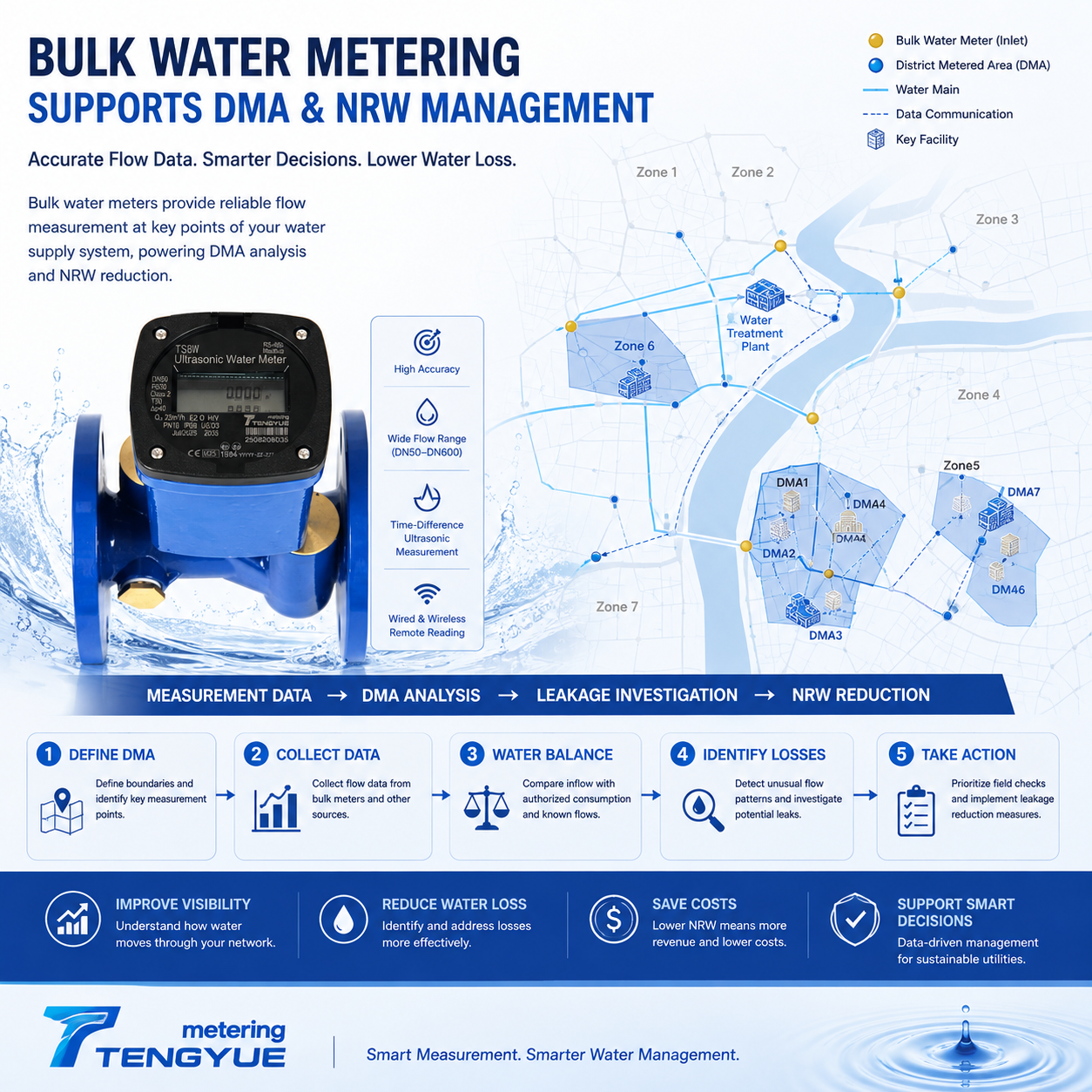
For water utilities, reducing non-revenue water (NRW) requires more than installing accurate meters. Utilities also need reliable information about how water enters and moves through the distribution network.
Bulk water metering can provide important flow data at key points in a water supply system. When used alongside district metered areas (DMAs), pressure monitoring, and network analysis, this data can help utilities investigate water losses more systematically.
1. What Is Bulk Water Metering?
Bulk water metering measures water flow at larger points in a water supply system, such as network inlets, supply connections, or other designated measurement locations.
These meters help utilities understand how much water enters a particular part of the network. The measurements can then be compared with downstream consumption data or other relevant records.
The usefulness of this comparison depends on the quality, timing, and coverage of the available data.
2. How Does Bulk Metering Support DMA Management?
A district metered area is a defined section of a water distribution network where water entering and leaving the area can be measured or estimated.
Bulk meters installed at appropriate DMA boundaries provide flow data that can help utilities assess the water balance of the area.
A simplified workflow is:
Define the DMA boundary and identify the relevant measurement points.
Collect flow data from the inlet and any other required locations.
Compare the measured inflow with authorized consumption and other known flows.
Investigate unexplained differences and unusual flow patterns.
Use field checks and additional evidence to determine the likely cause.
A meter reading alone does not identify the exact location of a leak. It provides measurement data that can guide further analysis and investigation.
3. Why Is Minimum Night Flow Important?
Minimum night flow (MNF) is the lowest measured flow during a defined nighttime monitoring period.
In many distribution networks, legitimate water consumption is lower at night. For this reason, night-flow patterns can provide useful clues about possible leakage or other unusual water use.
However, MNF should not be interpreted in isolation. Legitimate nighttime consumption, industrial operations, storage behavior, pressure changes, and measurement uncertainty can all affect the results.
Utilities should evaluate MNF alongside other available data and local operating conditions.
4. From Measurement Data to NRW Investigation
A structured NRW investigation may combine several information sources:
Bulk water metering: Measures flow at key network points.
DMA analysis: Helps compare inflow and consumption within a defined area.
Pressure monitoring: Helps utilities understand pressure conditions and investigate abnormal patterns.
GIS network information: Provides the mapped network and asset context needed to plan field investigations.
Data analysis: Helps identify unusual flow patterns and prioritize areas for further inspection.
These elements perform different roles. Bulk meters provide measurements, DMA defines the area being assessed, pressure monitoring adds hydraulic context, and GIS helps teams understand the physical network.
The exact workflow depends on the utility’s network design, data availability, and operational procedures.
5. Why Choose the Right Bulk Water Meter?
For a bulk metering point, selection should consider the expected flow range, nominal diameter, pressure conditions, installation environment, required accuracy, and communication needs.
The meter should be suitable for both normal operating flow and the range of conditions that the project needs to measure. Installation requirements and data collection arrangements should also be reviewed before deployment.
De Tengyue TS8W ultrasonic water meter is designed for larger-diameter water measurement applications. Its product manual describes ultrasonic time-difference measurement, reverse-flow detection, non-full-pipe detection, and wired or wireless remote-reading options depending on the configuration.
Confirm the exact diameter, range ratio, communication option, and operating specifications against the relevant TS8W documentation before selecting a model.
Bulk water metering provides an important measurement foundation for DMA water balance and NRW investigation. When flow data is combined with pressure information, GIS network records, and systematic field checks, utilities can make better-informed decisions about where to investigate potential losses.
Medição Tengyue supports water utilities with bulk ultrasonic water metering and broader smart water management solutions.
Entre em contato com nossa equipe. to discuss your DMA measurement requirements and NRW management objectives.