
Pressure monitoring in water distribution networks gives utilities a second view of network behavior: not only how much water is moving, but how the network is operating hydraulically. Water flow tells utilities how much water is moving through a network. Pressure provides another important perspective: how the network is operating.
Changes in pressure can be associated with demand fluctuations, valve operations, pump conditions, pipe restrictions, or possible bursts. For this reason, pressure monitoring is an important part of modern water distribution management. It does not confirm a leak by itself, but it helps teams interpret flow anomalies, prioritize field checks, and evaluate pressure management actions.
Why Pressure Monitoring in Water Distribution Networks Matters
Water distribution networks operate under changing conditions throughout the day. Demand increases and decreases, pumps start and stop, valves are adjusted, and different areas experience different hydraulic conditions. Without sufficient pressure information, utilities may struggle to understand why flow patterns change or why certain areas experience repeated operational problems.
Pressure monitoring helps teams observe these conditions and identify areas that require further analysis. It also supports water network management in a broader sense: pressure data can inform service-level decisions, pressure-reducing valve (PRV) settings, pump scheduling, and asset risk assessment.
IWA water loss methodology and AWWA M36 both recognize pressure as a factor in leakage and network performance. ISO 55000 asset management principles support using pressure data in risk-based decisions about critical mains, valves, and DMA boundaries. IEC 60770 provides a common framework for pressure transmitter performance, which is relevant when selecting pressure sensors for a monitoring project.
What Does Pressure Monitoring Reveal?
Pressure measurements at selected points help utilities understand how pressure varies across different areas and operating periods. This information can support routine network assessment and help identify locations where pressure conditions differ from expected operating ranges.
Sudden pressure changes may occur during pump switching, valve operation, or other hydraulic events. Monitoring pressure at critical locations can help utilities understand when these events occur and assess whether operational adjustments are needed. A 15-minute logging interval is often useful for trend review, but transient events may require faster sampling if the project objective includes surge or water-hammer analysis.
Pressure data also helps separate different causes of a flow anomaly. A nighttime flow increase with stable pressure suggests a change in consumption or leakage. A nighttime flow increase with higher pressure may point to a pressure-driven effect or a PRV setting change. The two situations call for different follow-up.
Four Key Applications of Pressure Monitoring
1. Understanding network operating conditions. Pressure measurements at selected points help utilities understand how pressure varies across different areas and operating periods. This information can support routine network assessment and help identify locations where pressure conditions differ from expected operating ranges.
2. Supporting leakage investigation. Leakage and pressure are related. In some situations, changes in pressure may influence leakage rates. Pressure data can therefore provide useful context when utilities investigate unusual flow patterns or rising MNF. However, pressure changes alone do not confirm a leak. They should be evaluated together with flow data, network configuration, and field observations.
3. Identifying pressure transients. Sudden pressure changes may occur during pump switching, valve operation, or other hydraulic events. Monitoring pressure at critical locations can help utilities understand when these events occur and assess whether operational adjustments are needed.
4. Supporting pressure management. Pressure management aims to maintain suitable service conditions while avoiding unnecessary pressure stress on the network. By reviewing pressure patterns across zones, utilities can make more informed decisions about operating strategies and PRV settings. Pressure management can also change the MNF baseline, so flow and pressure should be reviewed together after any adjustment.
| Data type | What it helps utilities understand | Typical use |
|---|---|---|
| Flow | Water entering or moving through a monitored area | DMA inflow, water balance |
| Pressure | Hydraulic conditions at selected network locations | Transients, PRV settings, service levels |
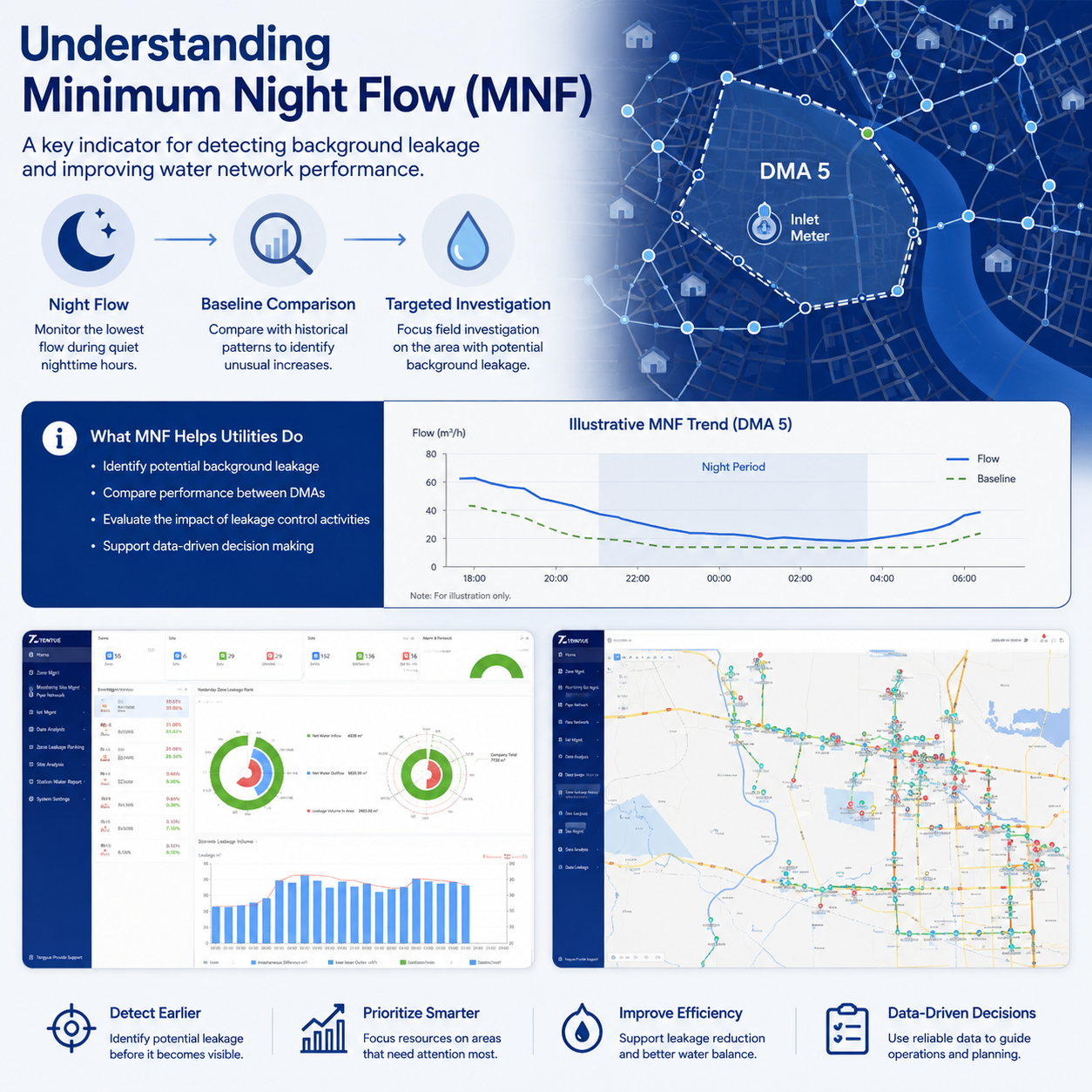
| MNF | Nighttime flow behavior and possible background leakage | Leakage investigation prioritization |
| GIS | Where meters, sensors, pipes, and zones are located | Spatial context and field planning |
The table is a general guide. The value of each data type increases when they are reviewed together rather than in isolation.
Why Combine Flow, Pressure, MNF, and GIS Data?
Flow and pressure provide different but complementary information. For example, if a DMA experiences an unusual increase in nighttime flow, pressure records may help engineers understand whether the change coincides with a pressure event or a wider network operating change. This combined analysis can help narrow the scope of field investigation.
A practical review sequence is: confirm the flow anomaly is sustained; check pressure at the same time stamps; review known nighttime users and valve status; use GIS to identify nearby assets; then plan field verification. Pressure-leakage correlation is most useful when flow and pressure data share time synchronization and a common DMA boundary definition.
GIS adds spatial context. A pressure drop near a closed valve or a newly installed PRV may have a clear operational explanation. A pressure change without an obvious asset event may deserve a field check. The combination of flow, pressure, MNF, and GIS is stronger than any single indicator.
Pressure Monitoring Within a DMA Framework
A DMA provides a defined area for measuring and analyzing water entering a distribution zone. When pressure sensors are installed at selected critical points, utilities can compare flow and pressure behavior within the same management area.
TY Leakage Monitoring combines DMA boundary metering, pressure data acquisition, water balance reconciliation, MNF trend analytics, and GIS visualization. Its platform supports pressure-leakage correlation analysis to help utilities review pressure conditions and leakage patterns. The actual monitoring points and sensor configurations should be determined according to the network layout and project requirements.
Illustrative Scenario: Using Pressure Data to Interpret a Flow Anomaly
Consider a desensitized example. A DMA with about 1,200 connections has a 28-day nighttime baseline of 3.0 m³/h between 02:00 and 04:00. Over six consecutive nights, average flow rises to 4.2 m³/h—about a 40% increase. Pressure at the DMA inlet remains broadly stable, moving only from 0.45 MPa to 0.44 MPa.
Because pressure is stable, a pressure-driven flow increase is less likely. The utility reviews known nighttime users, valve status, and GIS asset information, then plans a field check around a branch and valve. In a second scenario, the same flow increase coincides with pressure rising from 0.50 MPa to 0.58 MPa after a PRV adjustment; in that case, the utility would first review the pressure management change before assuming a new leak. This example is illustrative and should not be read as a universal threshold.
What Should Utilities Consider Before Deployment?
Before implementing pressure monitoring, project teams should evaluate:
Which locations are hydraulically important?
What pressure range and measurement accuracy are required?
How frequently should data be collected?
How will pressure data be transmitted?
Can the data be viewed alongside flow, DMA, and GIS information?
Who will review alarms and respond to abnormal conditions?
A well-planned deployment is more valuable than simply installing sensors across a large area without a clear monitoring strategy. Pressure sensors should be selected for the actual pressure range, with appropriate accuracy and protection rating. Installation points should be accessible for maintenance and representative of the zone’s hydraulic behavior.
Pressure monitoring gives water utilities a clearer understanding of distribution network behavior. When combined with flow measurement, MNF analysis, and GIS information, it supports more informed leakage investigation and pressure management.