
Water meter accuracy and range determine whether a meter can measure the flows a utility actually sees—not just the flows on a datasheet. When evaluating a water meter, buyers often focus on nominal diameter and price. However, these two factors alone cannot determine whether a meter is suitable for a particular application. Measurement performance is equally important.
For water utilities, understanding accuracy class, flow rate, and measurement range helps ensure that the selected meter matches actual operating conditions. A meter that is accurate at high flow but cannot resolve low nighttime flow may be a poor fit for DMA monitoring. A meter with a wide range ratio but unsuitable installation conditions may still underperform. This guide explains the key parameters and how to compare them.
Why Water Meter Accuracy and Range Matter for Utilities
Accuracy and range affect billing, water balance analysis, leak investigation, and asset planning. A meter with unsuitable low-flow performance can distort minimum night flow (MNF) analysis and DMA water balance. A meter with excessive pressure loss can increase pumping energy. A meter with an inappropriate range ratio may not cover seasonal demand variation.
ISO 4064 and OIML R49 provide widely used frameworks for water meter requirements and testing. These standards define flow-rate parameters, accuracy classes, and test conditions. Utilities should use them as a common vocabulary, but still confirm the exact model’s declared values and test documentation.
What Do the Flow-Rate Parameters Q1–Q4 Mean?
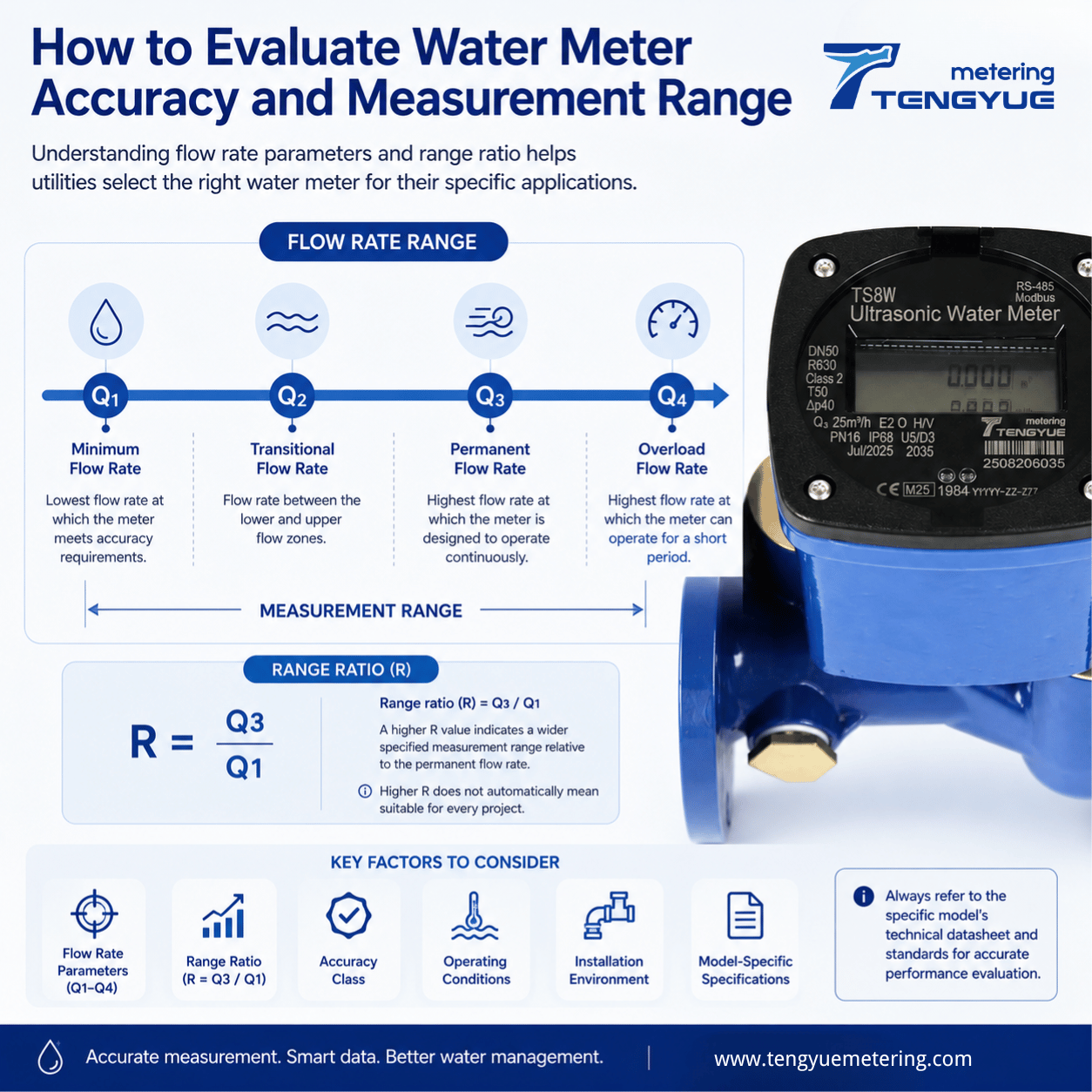
Water meters are commonly evaluated using several defined flow-rate parameters.
| Parameter | Definition | Why it matters |
|---|---|---|
| Q1 – Minimum flow rate | Lowest flow at which the meter must operate within specified accuracy | Determines low-flow performance, important for MNF and small leaks |
| Q2 – Transitional flow rate | Flow separating the lower and upper flow-rate zones | Helps interpret accuracy across the range |
| Q3 – Permanent flow rate | Highest flow at which the meter is designed to operate continuously | Defines normal maximum operating flow |
| Q4 – Overload flow rate | Highest flow for a short period within specified accuracy | Covers occasional peaks without damage |
These values provide a more complete picture of the meter’s measurement capability than nominal diameter alone. A DN200 meter with a narrow Q3/Q1 ratio may not resolve the low nighttime flows that DMA analysis depends on. Conversely, a very wide range ratio may come with trade-offs in cost, pressure loss, or installation requirements.
What Does Range Ratio (R) Mean, and How Does It Differ from Accuracy Class?
Range ratio is calculated as:
R = Q3 / Q1
A higher R value indicates a wider specified measurement range relative to the permanent flow rate. For example, a meter with Q3 = 250 m³/h and Q1 = 1.25 m³/h has R = 200. Another meter with Q3 = 250 m³/h and Q1 = 0.5 m³/h has R = 500. The second meter has a wider specified range, but that does not automatically make it the better choice for every project.
Utilities should compare the expected minimum and maximum flow rates with the meter’s actual Q1 and Q3 values. If the DMA’s nighttime flow is around 3 m³/h, a meter with Q1 = 1.25 m³/h may be adequate; if low flows approach 0.5 m³/h, a wider range ratio may be needed.
Accuracy class describes the permitted measurement error under specified conditions. It is a different concept from range ratio. A meter can have a wide range ratio and a lower accuracy class, or a narrower range ratio and a higher accuracy class. When comparing products, buyers should check the applicable standards, declared accuracy class, and test documentation. It is also important to distinguish between a meter’s accuracy class and its range ratio; they describe different aspects of measurement performance.
Which Operating Conditions Affect Water Meter Accuracy and Range?
A meter’s performance must be evaluated in the context of the installation environment. Important factors include operating pressure, water temperature, installation orientation, flow profile and upstream/downstream conditions, pipe size and connection type, and water quality and potential air in the pipeline.
The selected meter should match the actual conditions of the project. For example, a meter installed downstream of a valve or bend may see a distorted flow profile. A meter in a wet chamber needs appropriate protection rating and cable handling. A meter on a line with entrained air may show measurement instability. These are installation and operating issues, not only meter specifications.
ISO 4064 test conditions provide a reference, but field conditions rarely match laboratory conditions exactly. Utilities should therefore review the manual’s installation requirements and, where practical, test representative sites before full procurement.
How Should Utilities Compare Specifications by Model?
Tengyue’s ultrasonic water meter manuals provide model-specific technical parameters. For example, the TS14W series includes different nominal diameters and documented range-ratio options. The available combinations vary by model and size. The TS8W series also provides different flow-rate specifications across its large-diameter models.
Buyers should always check the exact model’s technical table instead of assuming that one specification applies to the entire product series. A common procurement error is to compare a brochure’s headline accuracy figure without checking the Q1, Q3, range ratio, pressure loss, and installation requirements for the exact configuration being quoted.
A practical comparison checklist includes: Does the meter’s Q1 match the lowest flow the utility needs to measure? Does Q3 cover the expected maximum continuous flow? Is the range ratio adequate for seasonal variation? Does the accuracy class meet the project’s requirements? Are pressure loss and installation conditions acceptable? Is the exact model documented with test evidence?
Illustrative Scenario: Evaluating a DN200 DMA Boundary Meter
Consider a desensitized example. A utility needs a DN200 bulk meter at a DMA boundary. The expected flow range is 5–300 m³/h, normal pressure is 0.3–0.6 MPa, and nighttime flow may fall to around 3 m³/h. The utility wants 15-minute flow data for DMA water balance and MNF review.
The evaluation compares candidate models on Q1, Q3, range ratio, accuracy class, pressure loss, IP68 suitability, communication protocol, and local support. A meter with Q3 = 250 m³/h and Q1 = 1.25 m³/h (R = 200) covers the daytime flow but may be marginal at the lowest nighttime flows. A model with a wider range ratio may be preferred if low-flow resolution is critical. A 28-day pilot tests data completeness and low-flow performance before full procurement. This example is illustrative and should not be read as a product specification for every site.
¿Cómo se comparan la medición inteligente y las capacidades de datos?
La gestión moderna del agua requiere más que simplemente tomar una lectura del contador de vez en cuando. Las empresas de servicios públicos necesitan cada vez más datos fiables para el análisis del consumo, la monitorización de usos anómalos, la facturación y la gestión de la red. Según el modelo y la configuración, los contadores de agua ultrasónicos pueden admitir lectura remota por cable o inalámbrica.
Por ejemplo, el manual del TS8W de Tengyue documenta opciones de comunicación como RS-485, M-Bus, pulsos, LoRa, LoRaWAN, W-MBus y NB-IoT. Las opciones disponibles dependen de la configuración seleccionada. El mismo principio se aplica a los medidores mecánicos: no se debe asumir que una función de comunicación listada para una configuración esté disponible en todas las versiones.
IEC 62056 / DLMS-COSEM es común en la comunicación de contadores inteligentes, y la integración de datos debe planificarse antes de la adquisición. Un contador que registra cada 15 minutos aún puede no ser adecuado para Balance hídrico de la DMA si no se han definido la asignación de identificadores y la sincronización horaria.
Algunos medidores ultrasónicos también proporcionan información más allá del consumo acumulado de agua. Según el producto, esto puede incluir indicación de flujo inverso, detección de tuberías incompletas y alarmas. Estas funciones pueden ayudar a los operadores a comprender ciertas condiciones de medición anómalas e investigar posibles problemas con mayor eficacia. Sin embargo, las alarmas del medidor deben considerarse información de monitoreo y no una confirmación automática de una fuga específica en la tubería.
¿Cuándo deberían las empresas de servicios públicos elegir contadores de agua ultrasónicos en lugar de mecánicos?
La tecnología ultrasónica no es automáticamente la mejor opción para todas las aplicaciones. Antes de tomar una decisión, las empresas de servicios públicos deben evaluar el rango de caudal y el rendimiento de medición requeridos, el diámetro de la tubería y las condiciones de instalación, la presión de operación y la temperatura del agua, la infraestructura de comunicación, los requisitos de gestión de datos y el costo total durante el período de servicio previsto.
Escenario ilustrativo: Evaluación de un medidor de caudal DN200
Consideremos un ejemplo desensibilizado. Una empresa de servicios públicos necesita un medidor de caudal DN200 en el límite de un DMA con un rango de flujo esperado de aproximadamente 5–300 m³/h, presión normal de 0,3–0,6 MPa y una cámara húmeda. La empresa de servicios públicos quiere datos de flujo de 15 minutos para Revisión del balance hídrico y del caudal mínimo nocturno en la DMA.
La evaluación compara un medidor de turbina mecánica y un medidor ultrasónico en cuanto a resolución de bajo caudal, pérdida de presión, relación de rango Q3/Q1, idoneidad IP68, protocolo de comunicación y soporte local. Una prueba piloto de 28 días verifica la integridad de los datos y el rendimiento de bajo caudal antes de la adquisición definitiva. Este ejemplo es ilustrativo y no debe interpretarse como una especificación del producto para todas las instalaciones.
La decisión correcta debe basarse en las condiciones operativas reales del proyecto, y no únicamente en las tendencias tecnológicas. En algunas aplicaciones, un medidor mecánico del tamaño adecuado sigue siendo una buena opción. En otras, los requisitos de datos y de bajo caudal hacen que la medición ultrasónica sea la más apropiada.
Tengyue ofrece soluciones para diversas necesidades de medición de agua, desde aplicaciones de pequeña escala hasta proyectos de medición a gran escala, gracias a su gama de contadores ultrasónicos y soluciones de medición inteligente. El modelo y la configuración adecuados deben confirmarse en función de los requisitos técnicos del proyecto.
Frequently Asked Questions About Water Meter Accuracy and Range
What is the difference between Q1, Q2, Q3, and Q4?
Q1 is the minimum flow within accuracy requirements, Q2 is the transitional flow, Q3 is the permanent continuous flow, and Q4 is the short-term overload flow. Together they describe the meter’s specified measurement range.
Is a higher range ratio always better?
Not necessarily. A wider range ratio can improve low-flow resolution, but it should be evaluated with accuracy class, pressure loss, installation conditions, and cost. The right choice depends on the project’s actual flow profile.
How does accuracy class differ from range ratio?
Accuracy class defines the permitted measurement error under specified conditions, while range ratio describes the width of the specified flow range. They are related but different aspects of performance.
Which operating conditions most affect water meter accuracy?
Flow profile, installation orientation, upstream and downstream conditions, water temperature, pressure, water quality, and entrained air can all affect measurement. The meter should be installed according to the manual’s requirements.
How can utilities verify water meter accuracy and range before procurement?
Check the exact model’s technical table, declared accuracy class, Q1/Q3 values, range ratio, pressure loss, and test documentation. Where practical, run a pilot at representative sites and compare readings with a reference meter.
If you are evaluating water meter accuracy and range for a utility project, Contacta con nuestros ingenieros to review flow requirements, Q1/Q3 values, accuracy class, and pilot criteria.