
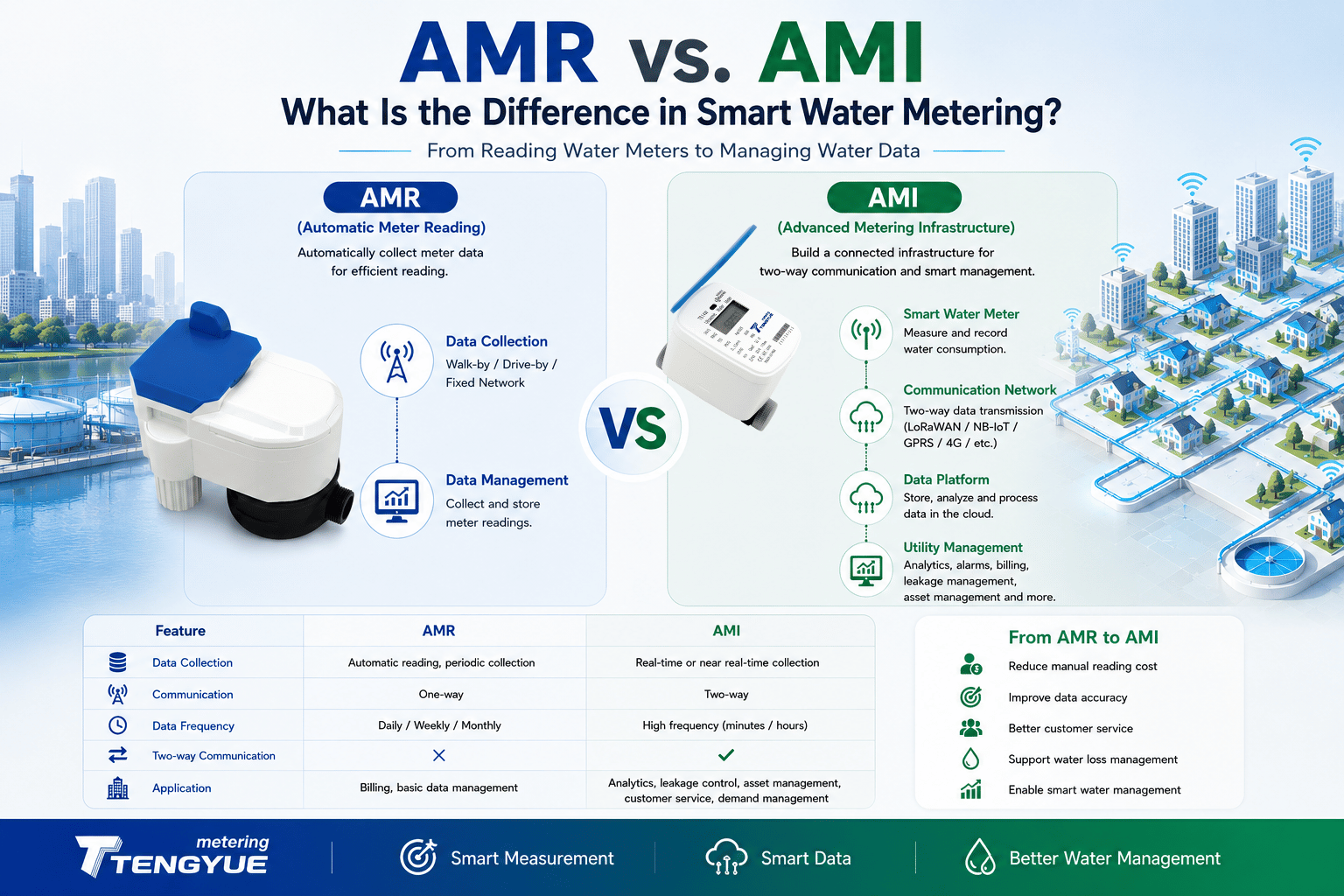
As water utilities move toward digital transformation, traditional manual meter reading is gradually being replaced by automated data collection.
Two terms frequently appear in smart water metering projects:
AMR and AMI.
They are closely related, but they represent different levels of metering infrastructure.
Understanding the difference can help water utilities, distributors, and system integrators choose the right technology for their projects.
What Is AMR?
AMR stands for Automatic Meter Reading
An AMR system allows water meter data to be collected automatically instead of requiring personnel to manually read every meter.
The basic concept is: Water Meter → Automatic Data Collection → Central System
The primary purpose of AMR is to make meter reading more efficient.
It can reduce manual reading work, improve data collection frequency, and provide utilities with easier access to consumption information.
What Is AMI?
AMI stands for Advanced Metering Infrastructure
AMI represents a broader smart metering infrastructure.
Instead of focusing only on automated meter reading, AMI connects meters, communication networks, data platforms, and utility management systems.
A simplified AMI structure can be represented as:
Smart Meter → Communication Network → Data Platform → Analysis → Utility Management
Depending on the system architecture, AMI can support more frequent data collection, advanced alarms, two-way communication, and other smart utility functions.
AMR vs. AMI: What Is the Main Difference?
The easiest way to understand the difference is: AMR focuses on automatically collecting meter readings.
AMI focuses on building a connected metering infrastructure for broader utility management.
This means AMR can be considered a more focused approach, while AMI provides a broader framework for digital water management.
Why Is AMR Useful?
For utilities that primarily want to eliminate manual meter reading, AMR can provide significant operational benefits.
Instead of sending personnel to collect readings manually, consumption information can be collected automatically.
This can help improve:
Reading efficiency
Data availability
Billing processes
Operational productivity
AMR can therefore be an effective first step toward digital metering.
Why Is AMI More Comprehensive?
AMI is designed around a larger data ecosystem.
A utility can potentially use the collected data to analyze:
Consumption patterns
Abnormal usage
Water demand
Leakage indicators
Network performance
Customer consumption
District water balance
This means the meter becomes more than a billing device.
It becomes a source of operational intelligence.
Where Do Smart Water Meters Fit?
Smart water meters are the field devices that collect water consumption information.
Depending on the product configuration, they can use communication technologies such as LoRaWAN, NB-IoT,
GPRS, RS485, M-Bus
The communication technology should be selected according to the project’s network environment and data requirements.
From Meter Reading to Water Intelligence
The evolution can be understood as three stages.
Stage 1: Manual Meter Reading
Meter → Human → Data
Data collection is labor-intensive.
Stage 2: AMR
Meter → Communication → Data
Meter readings can be collected automatically.
Stage 3: AMI
Meter → Communication → Platform → Analysis → Management
Data becomes part of a larger water management system.
This is where smart metering can begin contributing to broader utility objectives.
AMI and Water Loss Management
One of the important opportunities created by connected metering is better visibility into water consumption.
When reliable data is available, utilities can begin combining meter information with:
DMA data
Flow monitoring
Pressure monitoring
GIS
Minimum night flow
Leakage analysis
This can support a more systematic approach to water loss management.
How Should a Utility Choose Between AMR and AMI?
The answer depends on the project’s objectives.
AMR may be appropriate when the primary goal is:
Automated Meter Reading
AMI may be more suitable when the utility wants to build:
A Connected Digital Metering Infrastructure
The decision should therefore be based on the long-term digitalization strategy, not simply on which technology appears more advanced.
AMR and AMI are both important technologies in the development of smart water metering.
AMR focuses on automatically collecting meter data.
AMI goes further by connecting meters, communication networks, software platforms, and utility management.
For utilities planning long-term digital transformation, understanding this difference can help create a metering architecture that supports not only automated reading but also future water management applications.