
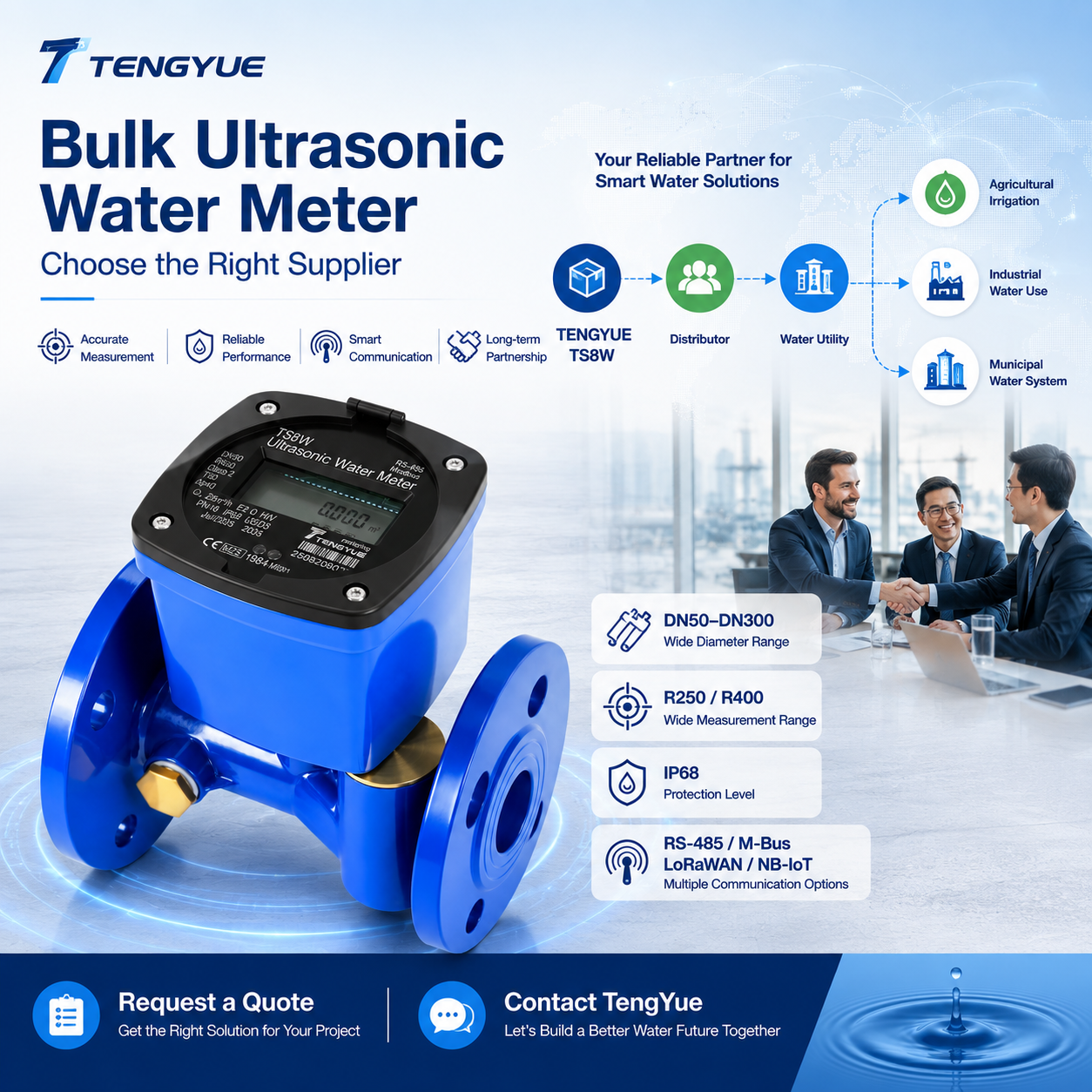
Choosing an ultrasonic water meter supplier is not simply a matter of comparing product prices.
For water utilities, municipalities, distributors, agricultural irrigation projects, and industrial users, the right meter needs to match the actual application.
Pipeline size, measurement range, installation conditions, communication requirements, monitoring functions, and long-term supply capability can all influence the decision.
This becomes even more important for bulk ultrasonic water metering, where the meter may become an important measurement point within a larger water supply or management system.
So, what should you look for when evaluating an ultrasonic water meter manufacturer?
1. Start With the Application
Before comparing suppliers, define where the meter will be used.
A supplier should understand the difference between:
- Water supply main lines
- Agricultural irrigation
- Industrial water use
- Municipal water systems
- Distributor projects
- Smart water management applications
El TS8W is designed for water supply main lines, agricultural irrigation, industrial water use, and other fields.
This application flexibility can be important for distributors who need one product platform that can address multiple customer requirements.
2. Check the Available Meter Sizes
For bulk water metering, pipeline size is one of the first specifications to evaluate.
El TS8W product range covers:
DN50, DN65, DN80, DN100, DN125, DN150, DN200, DN250 and DN300.
This gives distributors and project teams several nominal diameter options within the same product family.
For a distributor, a broader product range can also simplify product portfolio planning when different customers require different pipeline sizes.
3. Evaluate Accuracy and Measurement Range
Accuracy should not be considered separately from measurement range.
El TS8W is specified as Accuracy Class 2 and supports R250/R400 measurement range configurations.
When comparing ultrasonic water meter suppliers, look at the complete measurement specification rather than focusing on a single headline number.
Questions to ask include:
- What accuracy class is available?
- What measurement range ratios are supported?
- What are the applicable flow conditions?
- What pressure loss class is specified?
- What pipeline sizes are available?
These questions help determine whether the product is suitable for the intended bulk water metering application.
4. Look Beyond Basic Flow Measurement
A modern water meter can provide additional information about the condition of the water flow and the meter itself.
El TS8W supports:
- Reverse flow detection
- Non-full pipe detection
- Drip/leakage alarm
- Burst pipe alarm
- Low pressure alarm
- Forward/reverse flow indication
- Fault/alarm indication
These functions are part of the TS8W display and monitoring capabilities.
For utilities and industrial users, these functions can provide useful information when abnormal conditions occur.
For distributors, they can also help differentiate a smart ultrasonic water meter from a conventional meter that provides only cumulative consumption data.
5. Consider Communication Requirements Early
Communication is becoming an increasingly important part of smart water metering.
Different projects may use different communication architectures.
El TS8W supports wired meter reading through:
RS-485 / M-Bus / Pulse
It also supports wireless options including:
LoRa / LoRaWAN / W-MBUS / NB-IoT.
The product manual also provides communication configurations for 4G (Cat.1), LoRaWAN, and W-MBUS, with corresponding communication parameters.
For distributors serving different markets, communication flexibility can be an important consideration.
Instead of asking only:
“Does this water meter support remote reading?”
it is better to ask:
“Which communication technology fits my customer’s existing system?”
6. Evaluate Protection and Installation
A supplier should provide clear information about how the meter can be installed and what environmental conditions it is designed to handle.
El TS8W has an IP68 protection level and supports horizontal, vertical, or inclined installation.
Its technical specifications also identify a maximum working pressure of 1.6 MPa and installation sensitivity class U10/D5.
For a project team, these specifications should be checked against actual site requirements before selecting the final configuration.
7. Think About the Complete Communication-to-Management Chain
For smart water projects, the water meter is only one part of the system.
A typical architecture can look like:
Water Flow → TS8W → Communication Network → Data Platform → Water Management
El TS8W supports multiple communication methods that can be integrated according to project requirements.
This is especially relevant to utilities and smart water solution providers that want to move from manual reading toward remote data collection.
However, communication compatibility should always be confirmed against the actual third-party platform and project architecture. The TS8W manual notes that deployed performance can vary depending on site conditions, network topology, and third-party system integration.
That is an important question to discuss with the supplier before a project begins.
8. Evaluate the Supplier, Not Only the Meter
A technically capable product does not automatically mean that a supplier is the right long-term partner.
Water meter distributors should also consider:
Product consistency
Can the supplier provide the same product specifications consistently across orders?
Product range
Can the supplier support the sizes and configurations required by your market?
Communication options
Can the supplier provide the communication technologies your customers require?
Technical documentation
Are specifications, installation information, communication parameters, and product documentation clearly available?
Project support
Can the supplier discuss application requirements before the order is finalized?
Long-term cooperation
Can the supplier support your business as your customer base grows?
These factors can be particularly important for distributors who are looking for a long-term ultrasonic water meter manufacturer rather than a one-time supplier.
Why Consider TengYue for Bulk Ultrasonic Water Metering?
TengYue’s TS8W is designed as an electronic ultrasonic water meter for bulk water metering applications.
It uses ultrasonic time-difference measurement, has no moving parts in the measuring mechanism, supports DN50–DN300 models, and provides R250/R400 measurement range options.
The meter also supports IP68 protection, reverse flow detection, non-full pipe detection, and multiple wired and wireless communication options.
For water utilities, municipalities, distributors, agricultural irrigation projects, and industrial water users, this provides a product platform that can be considered across different bulk water metering scenarios.
If you are a water meter distributor, water utility, municipal procurement team, irrigation project, industrial water user, or smart water solution provider looking for an ultrasonic water meter supplier, TengYue can discuss your application requirements and help identify the appropriate TS8W configuration.