
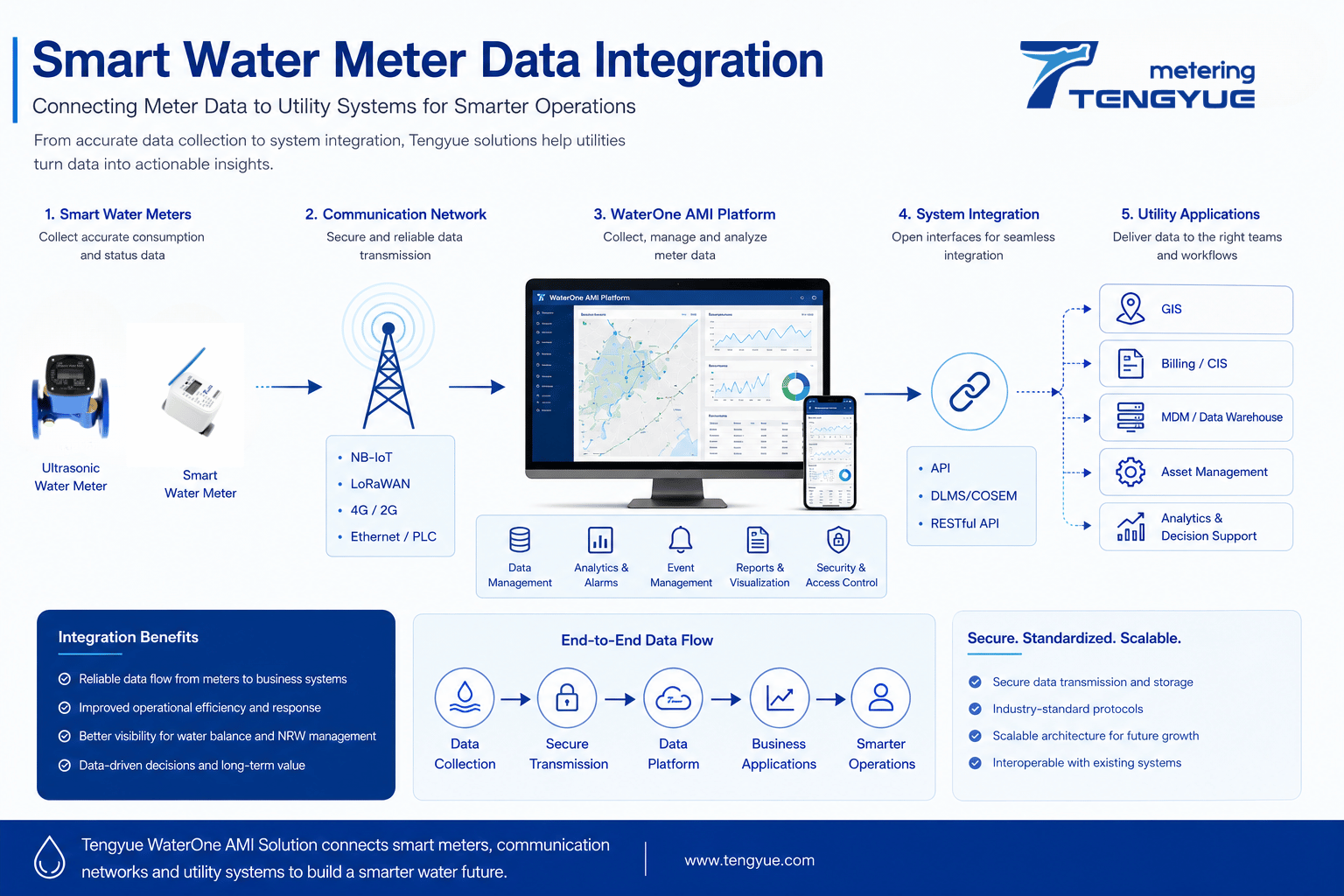
Smart water meter data integration is the process of moving meter readings through a communication network, a data platform, and utility applications so that billing, network operations, maintenance, and planning teams can use the data. Smart water metering projects generate more value when the collected data can be used by those teams. However, installing smart meters does not automatically create a fully integrated digital water system. Utilities need to plan how readings move through the communication network, how data is processed, and how different applications will use it.
A practical integration plan answers four questions: What data is required? How will it move? Who is responsible for each record? How will the utility test the complete workflow before scaling up? This guide sets out a structured approach.
Why Smart Water Meter Data Integration Matters
أ smart meter is not an isolated device. It is part of a chain that includes the meter, communication infrastructure, data platform, and operational applications. If any link is weak, the utility may collect data but fail to use it reliably.
Integration matters because different teams need different views of the same data. Billing needs consumption readings matched to customer accounts. Network operations need flow and pressure trends by DMA. Maintenance needs meter status and alarms. Planning needs asset locations and historical performance. ISO 55000 asset management principles support aligning asset information with risk-based decisions; smart meter data integration is one way to keep that information visible and usable.
The goal is not simply to move more data. It is to make reliable data available to the right team, in the right form, at the right time.
How Does Smart Water Meter Data Flow?
A typical smart metering architecture includes several layers:
Meter → Communication Network → Data Platform → Utility Applications
The meter records water consumption and relevant status information. A wired or wireless network transfers available readings. A data platform receives and organizes the information, while connected applications use it for specific operational purposes. The actual architecture varies by project. Some deployments use a centralized fixed network, while others use mobile reading or a hybrid approach.
| Layer | Main function | Integration question to resolve |
|---|---|---|
| Meter | Records consumption and status | Which fields and intervals are available for this model? |
| Communication network | Transfers readings | Which protocol, band, and coverage apply? |
| Data platform | Receives, validates, and stores data | Who owns the master record and how are errors handled? |
| Utility applications | Billing, GIS, operations, asset management | What interface and data format does each system require? |
A common mistake is to treat the communication layer as the whole project. Communication is necessary, but integration also depends on identifiers, data formats, validation rules, and application requirements. A meter that transmits every 15 minutes may still be unsuitable for billing if the customer-account mapping is unclear.
Define Data Requirements and Confirm Interfaces
Before selecting interfaces or planning integration, define the information each department needs. Examples include consumption readings for billing and reporting, meter status and available alarms for operational follow-up, flow trends for consumption analysis, relevant zone-level measurements for water balance work, and asset identifiers and locations for GIS-based management.
Not every meter provides the same fields or reporting frequency. Confirm the available data against the selected model, communication configuration, and platform. For metering accuracy, ISO 4064 provides a widely used framework; for communication, IEC 62056 / DLMS-COSEM is common in smart metering. These standards do not replace project-specific testing, but they give the utility a common vocabulary for requirements.
Integration planning should also identify how data will be exchanged between systems. Questions to resolve include: Which communication protocols and interfaces are supported? How are meter identifiers mapped to customer accounts and network assets? What formats are used for data exchange? How are missing, duplicated, or delayed readings handled? Which system is responsible for storing and maintaining each record?
TY WaterOne AMI solution documentation describes support for DLMS/COSEM and RESTful API-based integration, including connections with systems such as GIS, customer information systems, and meter data management. The actual interface and compatibility should be confirmed for the proposed deployment.
Connect Data with Operational Context
A consumption reading becomes more useful when the utility knows which meter produced it, where that meter is located, and which customer or network zone it belongs to. Linking monitoring data with GIS can help teams relate a network anomaly to the affected zone and its assets. Connecting readings with customer and billing records can support reconciliation and investigation of unusual consumption.
For DMA monitoring, meter data integration should support DMA water balance and minimum night flow review. If the same DMA shows a persistent balance difference, the utility can use integrated meter and GIS data to narrow the investigation area before field work. These workflows depend on data quality, correct identifiers, suitable access permissions, and a clear integration design.
A useful rule is: do not integrate a data field unless a named team has a defined use for it. Integration without an operational owner tends to create dashboards that nobody maintains.
Illustrative Scenario: A 1,000-Meter Pilot
Consider a desensitized example. A utility plans to integrate about 1,000 smart meters and several DMA boundary bulk meters. The pilot runs for 28 days with 15-minute reading intervals. Success criteria include data availability of at least 98%, correct meter-to-account matching, successful GIS asset linkage, and a documented exception process for missing or delayed readings.
The pilot tests the full path from meter reading to billing, GIS, and DMA water balance review. If the criteria are met, the utility scales up; if not, the team fixes identifiers, interfaces, or validation rules first. This example is illustrative and should not be read as a universal specification.
Plan Data Quality, Security, Testing, and Operational Integration
Integration is not only about connecting systems. Utilities should define how they will monitor data completeness, manage access, protect information, and resolve synchronization errors. Important considerations include consistent meter and asset identifiers, time synchronization and reading intervals, validation of incoming readings, user roles and access controls, secure communication and data transfer, and monitoring of failed transfers or missing data. These requirements should be established early rather than left until after deployment.
A pilot should verify the full path from a meter reading to its intended use. Check whether the reading is collected, transmitted, received, matched to the correct asset or customer, and displayed or processed by the target application. Include exception scenarios such as delayed readings, communication interruptions, and incorrect identifiers. Record the results and resolve issues before expanding the rollout.
TY WaterOne AMI combines smart metering devices, communication infrastructure, and a data platform to support connected water management. Its documented integration approach can help projects plan how meter data connects with wider utility applications. The appropriate architecture depends on existing systems, the required data, and the selected product and platform configuration. Successful integration is not simply about moving data. It is about making reliable data available to the right teams in a form they can use.
Frequently Asked Questions About Smart Water Meter Data Integration
What is smart water meter data integration?
It is the process of connecting meter readings, communication networks, data platforms, and utility applications so that billing, operations, maintenance, and planning teams can use the data reliably.
Which data fields should a utility integrate first?
Start with fields that have a named operational owner: consumption for billing, meter status and alarms for operations, zone-level flow for DMA water balance, and asset identifiers for GIS. Confirm availability against the exact meter and platform configuration.
How are meter identifiers matched to customer accounts and assets?
The utility should define a master identifier scheme and document the mapping between meter IDs, customer accounts, and GIS asset IDs. The pilot should test incorrect and missing identifier scenarios before scale-up.
What standards are relevant to smart metering integration?
ISO 4064 is relevant to meter accuracy; IEC 62056 / DLMS-COSEM is common for smart metering communication; ISO 55000 supports asset information and risk-based decisions. Project-specific interface testing is still required.
How long should an integration pilot run?
A pilot should cover normal demand variation and exception cases. A 28-day period with 15-minute intervals is often useful for trend comparison, but the duration should match project risk, data availability, and integration complexity.
If you are planning smart water meter data integration, contact our engineers to review data requirements, interfaces, identifier mapping, and pilot criteria for your utility.