
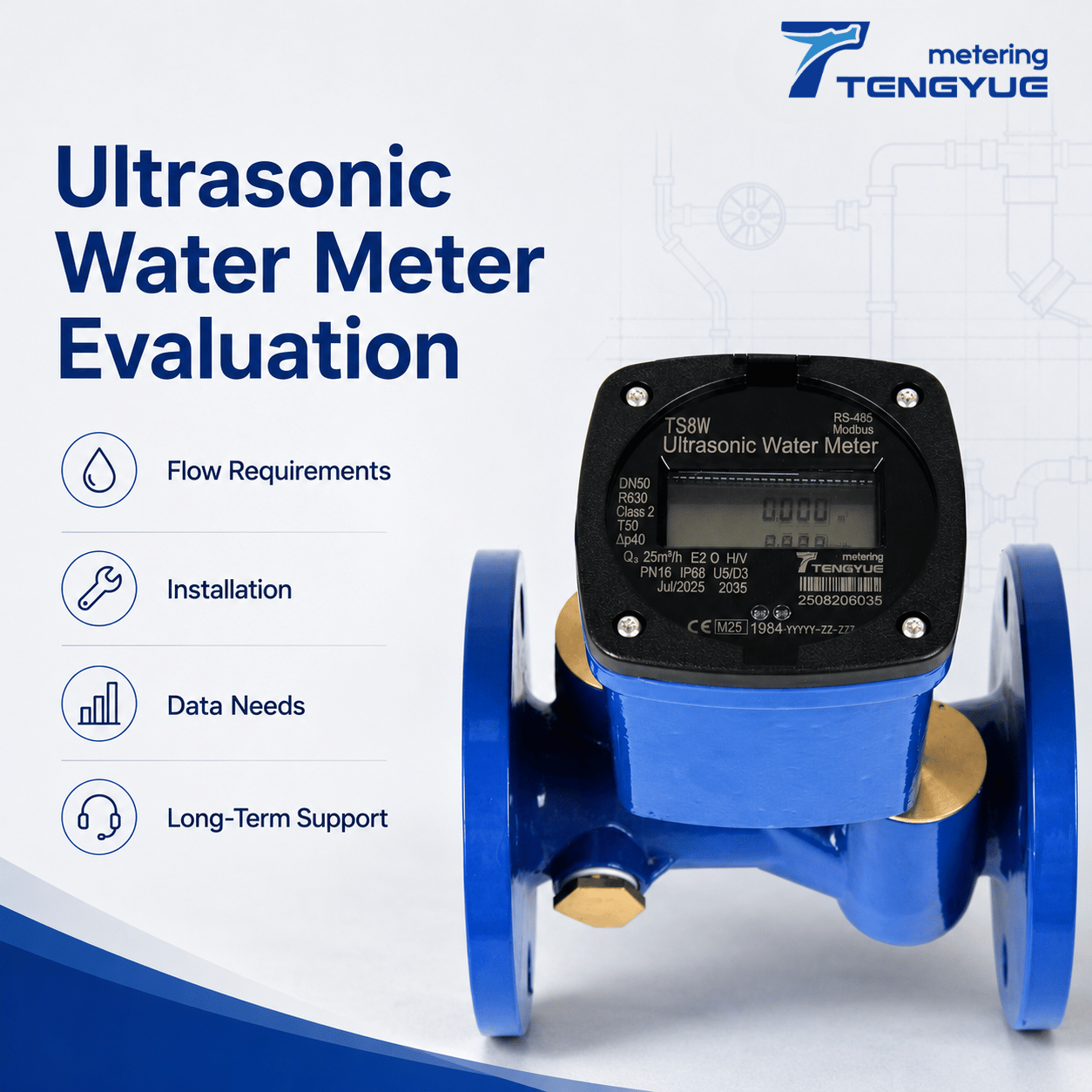
Selecting an ultrasonic water meter for utility projects involves more than comparing product prices or nominal diameters. The right choice depends on operating conditions, measurement requirements, installation environment, and how the collected data will be used. Ultrasonic water meters can be suitable for a range of water measurement applications, but project teams should evaluate each model against the actual requirements of the site.
A good evaluation process starts with the application, checks the specifications, confirms installation conditions, plans data collection, and reviews long-term support. It should also distinguish between a meter that works in a showroom and a configuration that works reliably in a chamber, on a supply main, or at a DMA boundary for years.
How to Evaluate an Ultrasonic Water Meter for Utility Projects
A practical evaluation can be organized into five questions: What must the meter measure? Does it meet the required specifications? Can it be installed correctly? Will its data reach the utility’s systems? Can the supplier support the full service life? These questions should be answered before procurement, not after installation.
The evaluation should also define the project’s data use. A bulk meter used on a water supply main has different requirements from a meter installed in an apartment or commercial building. Consider the expected flow range, pipe size, pressure, water temperature, and operating conditions. For network monitoring projects, also consider whether the meter will be used for boundary inflow measurement, DMA water balance analysis, or routine consumption monitoring.
Define the Measurement Application and Operating Conditions
Start by identifying where the meter will be installed and what it needs to measure. A useful project brief should record the pipe size, expected minimum and maximum flow, normal operating pressure, water temperature range, and any surge or low-flow conditions. It should also note whether the meter is for bulk water measurement, DMA boundary metering, commercial consumption, or another application.
For example, a DN200 bulk meter at a DMA boundary might be expected to cover a flow range of roughly 5–300 m³/h, with normal pressure around 0.3–0.6 MPa and data recorded at 15-minute intervals. These are illustrative project requirements, not universal specifications. The point is to define the operating envelope before comparing models.
If the project includes leak investigation, the meter’s low-flow performance and data interval matter. A meter that is accurate at high flow but cannot resolve low nighttime flow may be less useful for minimum night flow analysis.
Review Measurement Specifications and Standards
Compare the manufacturer’s technical data with the project’s expected operating range. Important items include nominal diameter and flow-rate range, permanent flow rate and range ratio, accuracy class and pressure-loss characteristics, pressure and temperature ratings, installation requirements and flow sensitivity, and environmental protection rating.
Do not assume that specifications available for one model or size apply to every model in a product family. Review the relevant technical table and confirm the exact configuration before procurement. ISO 4064 and OIML R49 provide widely used frameworks for water meter requirements and testing; project teams should ask for the applicable accuracy class, Q3/Q1 range ratio, and test evidence for the exact model being quoted.
| Evaluation item | Why it matters | What to confirm in writing |
|---|---|---|
| Flow range and Q3/Q1 ratio | Low-flow and high-flow performance | Exact model, size, and range ratio |
| Accuracy class | Billing or monitoring suitability | Test certificate and applicable standard |
| Pressure and temperature ratings | Site operating conditions | PN rating and temperature range |
| Pressure loss | Pumping energy and hydraulic impact | Maximum pressure loss at design flow |
| Protection rating | Chamber or flooding conditions | IP rating and installation instructions |
| Communication option | Data collection and platform fit | Exact communication module and protocol |
Check Installation Conditions and Environmental Protection
Installation conditions affect both the suitability of the meter and the quality of the measurement. Check available pipework, mounting orientation, access for maintenance, potential flooding, and the environmental conditions at the site. Confirm whether the meter’s installation requirements match the existing infrastructure.
For example, the TS8W ultrasonic water meter manual documents support for vertical, horizontal, or inclined installation and an IP68 protection rating. The actual installation should still follow the instructions for the selected model and configuration. A utility should also confirm straight-pipe requirements, upstream and downstream conditions, grounding, and chamber access before installation.
Poor installation can create measurement problems that look like meter faults. If the site cannot meet the required installation conditions, the project team should consider an alternative location or configuration rather than assuming the meter will perform as specified.
Plan Data Collection and Smart Metering Integration
If the project requires remote reading, identify how meter readings will be collected and delivered to the utility’s systems. Check the communication interface, network availability, reading frequency, data format, and compatibility with the intended platform. Confirm the exact communication option offered for the meter being quoted.
A communication feature listed for one configuration should not be assumed to be available on every version. For smart metering or DMA monitoring, the project team should also define how data will be validated, stored, and used by operational teams. A 15-minute interval may be useful for pressure and flow trend analysis, while billing may use monthly readings. The data workflow should be agreed before the meter is ordered.
Illustrative Scenario: Evaluating a Bulk Meter for a DMA Boundary
Consider a desensitized example. A utility plans to install an ultrasonic bulk meter at a DMA boundary with about 1,200 connections. The expected flow range is 5–300 m³/h, normal pressure is 0.3–0.6 MPa, and the chamber can be wet. The utility needs 15-minute flow data for DMA water balance and MNF review.
The evaluation compares candidate models on Q3/Q1 range ratio, accuracy class, pressure loss, IP68 suitability, communication protocol, and local support. A pilot installation checks data completeness and low-flow resolution over 28 days before full procurement. This example is illustrative and should not be read as a product specification for every site.
Evaluate Long-Term Operation and Support
A project specification should consider more than the initial purchase price. Review maintenance requirements, access to technical documentation, replacement arrangements, warranty terms, technical support, and the supplier’s ability to support the planned deployment. ISO 55000 asset management principles support risk-based decisions about critical assets; a bulk meter at a DMA boundary may justify more redundancy and support than a non-critical internal meter.
Where smart metering is involved, it is also important to establish how data will be monitored, stored, and used by the utility’s operational teams. Ask who will troubleshoot communication failures, how firmware or configuration changes are managed, and what spare parts are available. These questions help avoid a situation where the meter is installed but the data cannot be sustained.
Tengyue Metering provides ultrasonic water metering options for different applications, including TS8W for bulk water measurement. The appropriate model and configuration should be confirmed against the project’s technical requirements.
Frequently Asked Questions About Ultrasonic Water Meter for Utility Projects
What should a utility check first when selecting an ultrasonic water meter?
Start with the measurement application and operating envelope: pipe size, expected flow range, pressure, temperature, installation conditions, and data use. Then compare specifications and confirm the exact model configuration.
Is a higher Q3/Q1 ratio always better for utility projects?
A wider range ratio can support better low-flow performance, but it should be evaluated with accuracy class, pressure loss, installation conditions, and cost. The right choice depends on the project’s flow profile and data needs.
Can an ultrasonic water meter be installed vertically or horizontally?
Many ultrasonic meters support multiple orientations, but the actual requirement depends on the model and manual. For example, the TS8W manual documents vertical, horizontal, or inclined installation; the selected configuration and site conditions should still be confirmed.
What communication options should be confirmed before purchase?
Confirm the exact communication module, protocol, reading frequency, data format, network availability, and platform compatibility. Do not assume a feature listed for one configuration applies to every version.
How long should a pilot evaluation run before full procurement?
A pilot should cover enough time to see normal demand variation, nighttime flow, and data completeness. A 28-day period is often useful for trend comparison, but the final duration should match the project’s risk and operational objectives.
If you are evaluating an ultrasonic water meter for a utility project, contact our engineers to review flow requirements, installation conditions, communication options, and long-term support.