
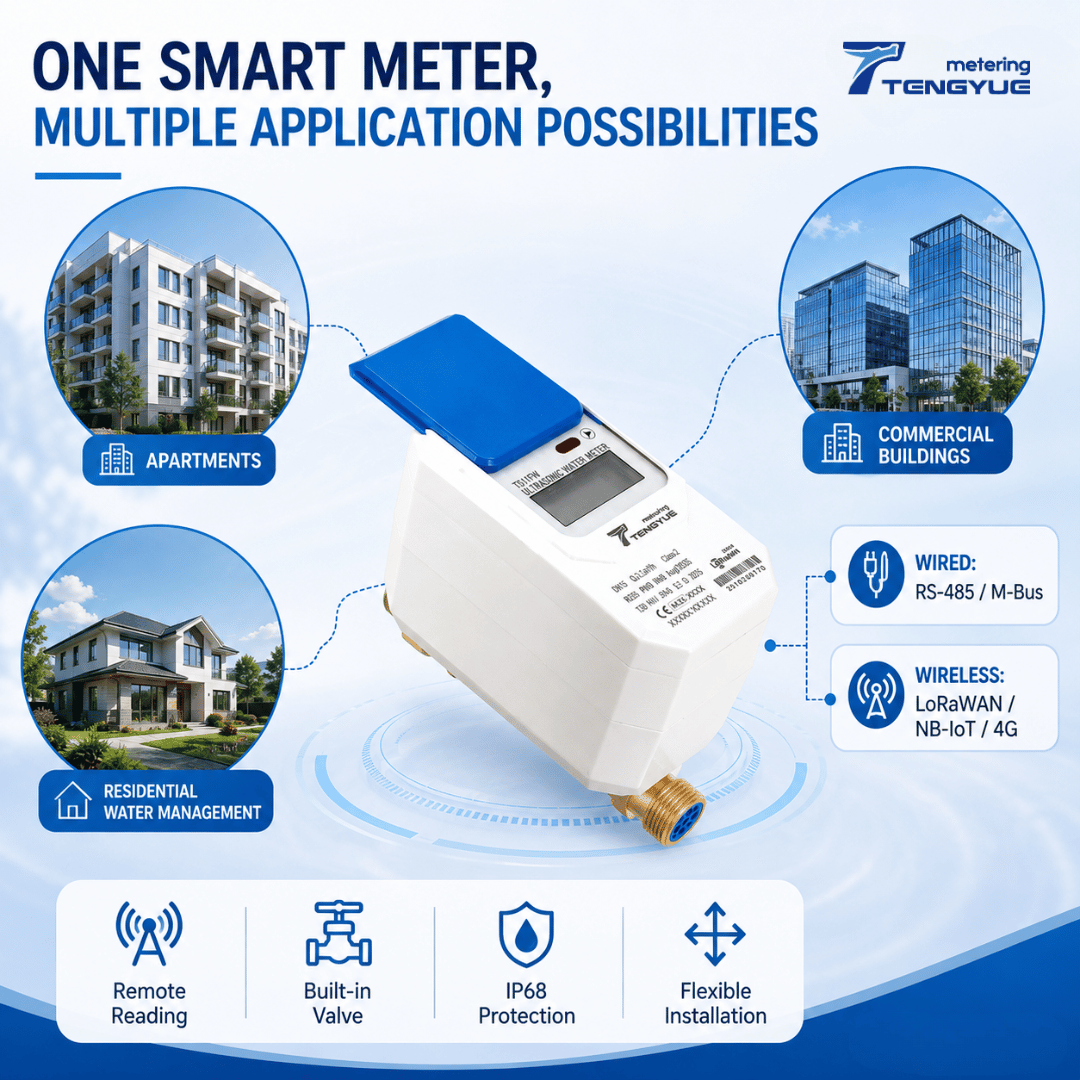
For water meter distributors, importers, wholesalers, and commercial water management companies, selecting an ultrasonic water meter supplier is an important business decision. The right supplier should provide more than a product catalogue. Product configuration, communication options, installation flexibility, technical documentation, and project compatibility can all influence whether a water meter is suitable for a specific market or application.
As smart water metering becomes more common in residential, apartment, and commercial projects, buyers are increasingly looking for ultrasonic water meters that can support both accurate measurement and remote management.
The Tengyue TS11FW is designed for these requirements, combining ultrasonic measurement technology with multiple communication options, monitoring functions, and a built-in valve.
Start with the Application Requirements
Before choosing an ultrasonic water meter supplier, distributors and project buyers should first understand the intended application.
A meter used in an apartment project may need reliable remote reading and compact installation. A commercial building may require more frequent data collection and additional information about abnormal flow. A water utility may prioritize communication compatibility, long-term operation, and centralized management.
Different projects may also require different meter sizes, installation orientations, communication protocols, and control functions.
The TS11FW is designed for water metering scenarios such as households, apartments, and commercial premises. It is available in DN15, DN20, and DN25 configurations, giving project customers several options for small-diameter applications.
Evaluate the Measurement Technology
The measurement method is one of the most important factors when selecting an ultrasonic water meter.
The TS11FW uses the ultrasonic time-difference method to continuously measure, record, and display the volume of water flowing through the sensor. Its measuring mechanism has no moving parts, which helps avoid the wear and tear associated with mechanical measuring components.
The meter has an accuracy class of 2 and supports R250/R400 measurement ranges, depending on the configuration. It also supports a 9-digit LCD display with a minimum measurement unit of mL.
For distributors, these features provide a clear product value proposition. For project customers, they support the need for accurate local measurement and digital water management.
However, buyers should always review the actual technical configuration and applicable operating conditions rather than evaluating a meter only by its product category.
Check Installation Flexibility
Installation conditions can vary significantly between residential buildings, apartments, commercial properties, and replacement projects.
A water meter supplier should therefore be able to provide products that can adapt to different installation requirements.
The TS11FW supports vertical, horizontal, or inclined installation angles. This flexibility may simplify product selection when existing pipe layouts or installation spaces differ between projects.
The product also supports a PN16 pressure class and has low pressure loss. Its IP68 protection rating is designed to support use in various installation environments, although the suitability of a specific installation should still be confirmed according to site conditions.
Distributors should pay attention to meter dimensions, connection requirements, pressure conditions, and installation instructions before recommending a configuration to customers.
Look for Flexible Communication Options
For smart water metering projects, communication capability is often as important as measurement performance.
Different customers may use different data platforms and communication networks. A supplier that offers only one communication method may not be suitable for every market or project.
The TS11FW supports wired remote reading through:
- RS-485 Modbus;
- M-Bus;
- Pulse output.
It also supports wireless reading through options including:
- LoRa;
- LoRaWAN;
- W-MBus;
- NB-IoT.
The manual also lists LoRaWAN, 4G, and NB-IoT wireless configurations. Depending on the selected configuration, the meter can support scheduled data transmission.
For example, LoRaWAN may be suitable for projects that require low-power wireless communication over a broader area. NB-IoT or 4G may be considered when cellular communication is preferred. Wired interfaces may be more suitable for building management systems or projects with existing cable infrastructure.
The exact communication method, frequency band, protocol, and platform compatibility should be confirmed before an order or deployment.
Consider Remote Valve Control
An ultrasonic water meter with a built-in valve can provide additional value for certain water management applications.
The TS11FW includes a built-in ball valve that allows remote water restriction. This function may support operational requirements in apartment management, commercial water management, or other projects where remote control is part of the system design.
For distributors, this feature can help differentiate the TS11FW from basic metering products that only measure and display water consumption.
However, remote valve control should be evaluated together with the project’s management policies, communication reliability, installation conditions, and system integration requirements.
Review Monitoring and Alarm Functions
A smart water meter should provide useful information about its operating status.
The TS11FW supports reverse flow detection and non-full pipe detection. Its display indicators include leakage or drip alarm, low-voltage alarm, valve status, reverse flow indication, fault alarm, and signal strength.
These functions can help users identify conditions that may require further inspection. For example, a leakage or drip indication can provide an early signal of unexpected water flow, while a reverse flow indicator can help identify unusual flow direction.
For commercial buildings and apartment projects, these functions may improve the visibility of meter conditions and reduce dependence on occasional manual checks.
It is important to distinguish between meter-level monitoring and a complete water management platform. The TS11FW can provide useful data and status information, while broader analysis and operational decisions depend on the connected system and project workflow.
Assess the Supplier’s Technical Support
Product specifications are only one part of supplier selection. Distributors and importers should also evaluate whether the supplier can provide clear technical documentation and support for project implementation.
Important questions may include:
- Is the product manual available?
- Are communication protocols clearly documented?
- Are installation requirements provided?
- Can the supplier clarify the available meter configurations?
- Is platform compatibility confirmed before integration?
- Can the supplier support technical communication during project evaluation?
Tengyue provides technical information for the TS11FW, including measurement specifications, communication options, installation information, and product functions.
At the same time, the product manual states that actual performance may vary depending on site conditions, network topology, and third-party system integration. Compatibility with external platforms should therefore be confirmed through the officially published compatibility information and appropriate testing.
Why Product Flexibility Matters for Distributors
For distributors, a product should be suitable for more than one isolated project. It should offer enough flexibility to serve different customer requirements while remaining clear and manageable in the product portfolio.
The TS11FW combines several features that may be valuable across different applications:
- DN15, DN20, and DN25 configurations;
- Multiple installation orientations;
- Wired and wireless communication options;
- Ultrasonic measurement without moving parts;
- Reverse flow and non-full pipe detection;
- Leakage or drip alarm;
- Built-in ball valve;
- IP68 protection rating.
This combination allows distributors to present the product to residential, apartment, commercial, and smart metering customers while selecting the configuration according to the actual project requirements.
Conclusion
Choosing an ultrasonic water meter supplier requires more than comparing prices or selecting a product with a smart label. Buyers should evaluate measurement technology, installation flexibility, communication options, remote control functions, monitoring capabilities, documentation, and technical support.
The Tengyue TS11FW provides a practical combination of ultrasonic measurement, remote reading, multiple communication options, built-in valve control, and meter status monitoring. These capabilities make it a potential solution for distributors, importers, wholesalers, and commercial water management projects.
Looking for a smarter water metering solution? Talk to Tengyue to explore how TS11FW can support your product portfolio or water management project.